Knapping stone tesserae for Calçada Portuguesa is an empirical art of percussion cleavage. Using the pointed, double-beveled martelo de calceteiro (paver's hammer, weighing 0.8–1.2 kg), the artisan inspects the grain and natural cleavage planes (pelo da pedra) of raw limestone and basalt spalls. A sharp, high-velocity glancing blow fractures the stone along its mineral bedding, producing truncated cubic tesserae (40–70 mm) with a flat wear face and a tapered base that anchors securely into sand.
At a Glance: Key Takeaways
- Tooling Standard: Double-pointed Martelo de Calceteiro (High-Carbon Steel, 1.0 kg)
- White Stone Source: Calcitic Limestone Spalls (Calcário Vidraço / Moleanos)
- Black Stone Source: Vitreous Volcanic Basalt (Basalto dos Olisiponenses)
- Cleavage Principle: Fracturing along Pelo da Pedra (natural mineral rift plane)
- Knapping Speed: Approx. 400 to 600 calibrated cubes per artisan hour
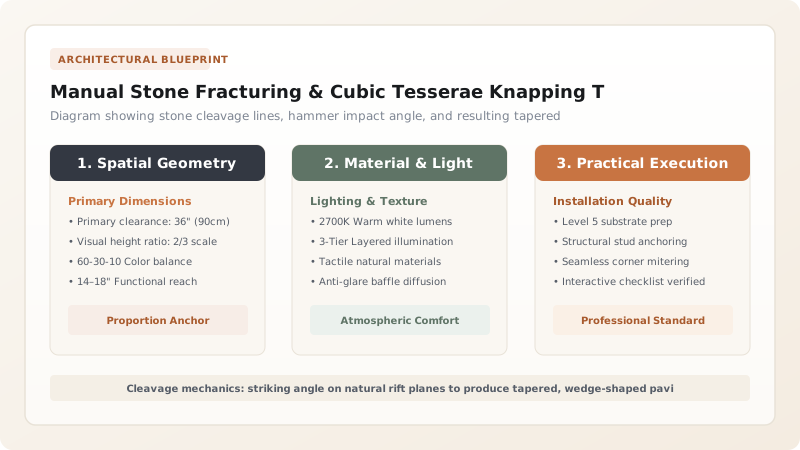
The Mineralogy of Cleavage: Reading the Pelo da Pedra
In the quarries of Sintra and the limestone ridges of the Estremadura, stones arrive at the paver's depot not as finished blocks, but as rough, irregular quarry quarry waste spalls (rachão or cascalho). To convert this jagged rubble into orderly mosaic cubes, the calceteiro must possess an intimate knowledge of geological petrology.
Every sedimentary limestone and volcanic basalt contains subtle microscopic directional grain lines, known in Portuguese as the pelo da pedra (hair of the stone). Striking across the pelo produces ragged, crumbling fractures; striking parallel to the pelo allows the stone to cleave cleanly and effortlessly with a flat, glass-smooth face.
The Martelo de Calceteiro: Weight, Balance, and Hardened Points
The master paver's hammer (martelo de calceteiro) is uniquely forged for this trade. Unlike standard stonemason mallets or flat brick hammers, it features a short 250-mm ash wood handle and a symmetrical double-pointed head forged from high-carbon tool steel (typically weighing between 800 grams and 1,200 grams).
Both ends taper to chisel-shaped points tempered to 56–58 HRC. This concentrated point geometry focuses all the kinetic energy of the swing into a microscopic impact zone, generating tens of megapascals of localized tensile stress that initiates cleavage without crushing the surrounding stone into useless gravel powder.
The Tapered Wedge Geometry: Why Cubes Are Not Square
To the untrained observer, Calçada Portuguesa appears to be composed of perfect square cubes. In technical reality, a master calceteiro never cuts a true orthogonal cube. If stones were straight-sided cubes, any unevenness in the sand bed would cause adjacent blocks to touch at their bases while opening unsightly gaps at the top.
Instead, the knapper intentionally fractures each stone into a truncated square pyramid (known as forma trapezoidal). The top wearing face is flat and square (e.g., 50 mm × 50 mm), while the four sides taper inward toward a narrower base (around 35 mm × 35 mm). When tapped into the sand bed, this tapered base wedges deeply into the compacted grit, allowing the top faces to butt tightly against each other with hairline 2-mm joint tolerances.
Ergonomics, Rhythm, and Occupational Safety
Knapping thousands of stones per day requires a relaxed, hypnotic wrist motion rather than brute muscular force. The calceteiro sits beside a mound of quarry spalls, resting the stone on a dense hardwood block or a flat anvil stone between his boots. The hammer drops with gravity, pivoting from the wrist, delivering 60 to 80 strikes per minute.
Because high-velocity stone shards and razor-sharp flakes fly off with every strike, safety protocols are paramount. Traditional masters rely on leather thumb guards and specialized wire-mesh goggles (óculos de rede) that do not fog up in Mediterranean heat while stopping flying mineral splinters.
Stone Fracture Behavior: White Limestone vs Black Basalt vs Red Marble
Use this reference table to calculate exact physical dimensions, ratios, and specifications before purchasing:
| Stone Variety | Petrological Type | Mohs Hardness | Fracture Characteristics | Knapping Difficulty |
|---|---|---|---|---|
| Calcário Vidraço | Fine-grained calcitic limestone | 3.0 to 3.5 | Predictable conchoidal cleavage; crisp flat facets | Moderate; ideal for rapid production knapping |
| Basalto dos Olisiponenses | Dense extrusive volcanic basalt | 5.5 to 6.0 | Tough, splintery fracture; requires heavier strikes | High; wears hammer points rapidly |
| Moleanos Semi-Rijo | Oolitic medium limestone | 3.0 | Soft, granular; chips easily without sharp edges | Low; suited for wide pedestrian field paving |
| Mármore Rosa de Sintra | Metamorphic calcitic marble | 3.5 to 4.0 | Crystalline cleavage; prone to corner crumbling | High; reserved for fine ornamental mosaic ribbons |
Practical Constraints
Every successful decoration project must account for physical and environmental constraints:
Rapid Dulling of Hammer Points on Volcanic Basalt
High-density basalt turns the chisel point of a carbon steel hammer dull after 4 hours of knapping Mitigation: Keep multiple forged hammers at the bench and re-forge/harden hammer points weekly on a workshop anvil
High Volume of Non-Usable Stone Chip Waste
Up to 30% of raw quarry rubble fractures into shards too small for paving cubes Mitigation: Collect all undersized stone chips and crush them into graded gravel aggregate for the sub-base layer
Execution Blueprint & Craftsmanship Sequence
Execute this professional sequence to achieve flawless results without backtracking:
Quarry Spall Sorting and Grain Inspection
Inspect raw limestone and basalt spalls for sound mineral core, discarding weathered crusts and stones with internal hairline fissures.
Anvil Stone Positioning and Posture Setup
Sit on low wooden stool with feet spread wide. Position a dense flat hardwood stump or stone anvil between feet to support the work.
Reading the Cleavage Grain (Pelo da Pedra)
Rotate the stone in hand to locate natural bedding lines, orienting the primary cleavage plane perpendicular to the hammer stroke.
Primary Sizing Fracture
Strike the spall with a sharp, decisive blow of the martelo point along the natural rift, splitting the stone into a workable 60-mm billet.
Wearing Face Dressing
Chip the primary flat wear face using glancing wrist strikes, establishing a flat, un-dished surface measuring 50 mm × 50 mm.
Four-Sided Taper Dressing
Turn the stone and chip away the four perimeter sides at a 15° inward taper to produce the narrow wedge base.
Tessera Sorting by Gauge Size
Toss finished cubes into sorting baskets: Class A (40–50 mm for fine mosaics), Class B (50–70 mm for field paving).
Common Mistakes & Countermeasures
Avoid these costly errors that compromise aesthetics, ergonomics, and budget:
Striking the stone directly in the center with a flat hammer face
Creating cubes with outward flared bases instead of inward tapers
Knapping dry basalt without eye protection
Project Execution Checklist
Track your physical progress. Checkboxes persist automatically on this device:
Frequently Asked Questions
How many stones can a master calceteiro knap in an 8-hour shift?
An experienced master knapper in Portugal can produce between 2,500 and 3,500 calibrated paving cubes per day when working good-cleaving limestone spalls.
Why isn't stone cut with modern mechanical diamond saws?
Diamond-sawn stones have slick, glass-smooth vertical faces that slip out of sand beds and look sterile and artificial. Hand-knapped stones have microscopic rough mineral tooth that locks tightly with bedding sand, creating the living organic texture unique to Calçada Portuguesa.
Can marble be used instead of limestone for white tesserae?
White marble is sometimes used for luxury courtyards, but it is more brittle, prone to corner chipping under heavy foot traffic, and becomes extremely slippery when wet compared to calcitic Vidraço limestone.
What is done with the stone dust created during knapping?
Zero material is wasted: the fine limestone powder and tiny mineral chips generated during knapping are collected and used as the dry grouting powder swept between the pavement joints.