
Portuguese Azulejo architectural compositions span two primary typologies: modular repetitive geometric patterns (Padrões) and monumental narrative murals (Painéis Historiados). Padrão compositions utilize 2x2 (quatrocentão) or 4x4 modular tile units that rotate and interlock to create infinite kaleidoscopic optical illusions, framed by specialized border friezes (barras) and corner tiles (cantos). In contrast, monumental Baroque murals treat entire palace and church walls as vast single-point perspective canvases, enclosing blue-and-white figurative narratives within exuberant trompe-l'œil architectural cartouches, volutes, and floral swags.
At a Glance: Key Takeaways
- Architectural Framing: Running border friezes (Barras) + specialized corner tiles (Cantos)
- Layout Technique: Full-room dry assembly numbering on workshop floor before masonry installation
- Modular Grid Units: 2x2 (Quatrocentão, 28x28cm) or 4x4 (Padrão de 16 azulejos, 56x56cm)
- Narrative Style: Baroque Painéis Historiados with single-point perspective trompe-l'œil
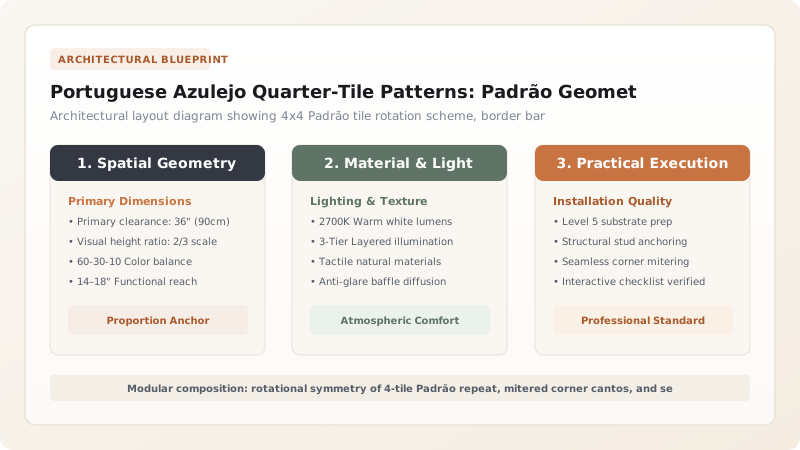
The Geometry of the Padrão: Rotational Modules and Infinite repeats
In 17th-century Portuguese architecture, repetitive patterned tiles known as Padrões transformed dark ecclesiastical interiors into radiant, carpet-like tapestries. Rather than designing a single tile that repeats indefinitely, Portuguese tilemakers developed complex multi-tile modules based on 90-degree rotational symmetry.
The most iconic is the Padrão de quatrocentão (a 2x2 grid of four tiles) and the Padrão de 16 azulejos (a 4x4 grid of sixteen tiles). Each individual tile contains only an asymmetrical fragment of the complete motif—a curving leaf, a quarter-star, or a diagonal ribbon. When four or sixteen tiles are rotated and assembled on the wall, the individual joints dissolve, giving birth to sweeping concentric circles, interlocking octagons, and dynamic diagonal strapwork that visually expands the spatial dimensions of the room.
Architectural Framing: Barras, Cantos, and Base Moldings
A Padrão field was never terminated abruptly against an architectural corner or baseboard. Portuguese master builders treated tiled revetments as complete architectural orders, requiring specialized framing elements:
- Barras (Border Friezes): Horizontal and vertical single-tile borders decorated with running acanthus scrolls, Renaissance laurel wreaths, or undulating wave motifs that contain the central pattern.
- Cantos (Corner Tiles): Meticulously designed corner tiles that resolve the 90-degree intersection of two running barras without breaking motif continuity.
- Rodapés (Baseboards): Darker, highly durable bottom rows that anchor the wall to the floor and absorb floor-washing moisture.
Monumental Murals: The Art of Painéis Historiados
During the 'Golden Age of the Azulejo' (reign of King João V, 1706–1750), Portuguese masters pushed ceramic art into monumental figurative painting. Known as Painéis Historiados (historiated panels), these massive murals were created by workshop masters like Gabriel del Barco, António de Oliveira Bernardes, and Manuel dos Santos.
Rather than working tile by tile, the master painter assembled hundreds of raw, chalk-coated tiles on the workshop floor, treating the massive tiled rectangle as a single giant canvas. Drawing inspiration from Dutch and French engravings, they painted expansive biblical scenes, royal battles, and hunting pageants. The scenes were framed by breathtaking trompe-l'œil cartouches—imitation sculpted marble columns, dynamic fluttering cherubs, broken pediments, and draped velvet curtains that created an illusion of infinite architectural space extending far beyond the solid stone wall.
Workshop Logistics: Numbering Grids and Masonry Installation
Executing a mural containing 2,000 individual tiles required flawless organizational logistics. Once painted on the workshop floor, each tile was marked on its back or lower edge with an alphanumeric grid coordinate (e.g., Row 14, Column 22) using red ochre or cobalt oxide.
The tiles were then fired in kiln saggars and packed into straw-lined wooden crates according to wall quadrant. At the construction site, masons snapped horizontal chalk reference lines on the damp lime-rendered wall. Working from the bottom center outward, the masons set each tile in a thick bed of lime putty and washed sand, tapping with wooden mallets to maintain absolute surface flatness across the monumental composition.
Portuguese Azulejo Compositional Layout Systems
Use this reference table to calculate exact physical dimensions, ratios, and specifications before purchasing:
| Compositional Typology | Grid Module Structure | Visual / Optical Effect | Primary Architectural Zone | Joint Precision |
|---|---|---|---|---|
| Padrão 2x2 (Quatrocentão) | 4 tiles rotated at 90° | Interlocking stars, octagons, floral rosettes | Church cloisters, residential staircases | 1.5 – 2.0 mm uniform joints |
| Padrão 4x4 (16 Tiles) | 16 tiles forming complete repeat | Grand circular medallions & diamond lace | Palace dining halls & monumental salons | 2.0 mm aligned grout lines |
| Painel Historiado | Custom grid (100 to 5,000+ tiles) | Single-point perspective figurative painting | Cathedral naves, chancel apses, civic facades | Tight 1.0mm joints to preserve drawing lines |
| Albarrada (Flower Vase) | Vertical 2x3 or 2x4 panel | Symmetrical urn filled with blooming roses | Piers between windows, garden courtyards | Framed with yellow-blue border barras |
Practical Constraints
Every successful decoration project must account for physical and environmental constraints:
Irregular Historic Masonry Walls Out of Plumb and Square
Medieval and Renaissance stone walls deviate by up to 50mm from plumb, causing rigid ceramic tiles to step and cast shadows. Solution: Apply a thick, multi-layer hydraulic lime leveling float coat (Reboco) to create a dead-flat plumb substrate before setting tiles.
Tile Breakage During Kiln Firing of Custom Hand-Painted Murals
If three central tiles crack in the kiln, re-painting and re-firing them risks severe color and shrinkage mismatches. Solution: Paint critical central tiles with identical duplicate backups, firing both sets simultaneously in the same kiln saggar.
Execution Blueprint & Craftsmanship Sequence
Execute this professional sequence to achieve flawless results without backtracking:
Architectural Wall Survey and Modular Grid Drafting
Measure wall dimensions; calculate exact multiples of 140mm tile modules; draft cartoon layout ensuring full tiles meet visual focal points.
Workshop Floor Dry Assembly and Charcoal Pouncing
Lay unglazed raw tiles across the workshop floor; verify seamless joints; transfer full-scale cartoon using perforated pounce bags.
Trompe-l'œil Cartouche and Narrative Cobalt Painting
Paint architectural border cartouches, cherubs, and central narrative scenes with cobalt oxide, maintaining continuous line work across seams.
Tile Numbering and Refractory Saggar Firing
Inscribe grid coordinates on the back of each tile; fire in kiln saggars to 1,000°C; unpack and reassemble on floor to verify mural integrity.
Wall Substrate Prep and Chalk Reference Snapping
Scrabble stone masonry; apply hydraulic lime leveling scratch coat; snap horizontal datum lines and plumb centerlines with chalk.
Sequential Lime Bedding and Wooden Mallet Truing
Butter tile backs with slaked lime putty mortar (1:3 sand); set tiles sequentially according to grid numbers; true faces with straightedge.
Common Mistakes & Countermeasures
Avoid these costly errors that compromise aesthetics, ergonomics, and budget:
Failing to Number Tile Backs Before Firing the Mural
Starting Tile Installation from Wall Edges Rather Than Architectural Center
Project Execution Checklist
Track your physical progress. Checkboxes persist automatically on this device:
Frequently Asked Questions
What is the difference between a Padrão and a Painel Historiado?
A Padrão is a modular geometric or stylized floral pattern that repeats indefinitely across a wall using rotating 2x2 or 4x4 tile units. A Painel Historiado is a non-repeating, monumental narrative painting where hundreds or thousands of tiles come together to depict a single unified scene (such as a historical battle, biblical story, or landscape).
How do masons prevent tiles from slipping down the wall while the lime mortar cures?
Traditional masons install a temporary wooden ledger batten horizontally along the bottom of the wall, leveled with a spirit level. Tiles are set from the ledger upward, course by course. The suction of the pre-soaked porous clay biscuit pulling water from the lime mortar creates instant capillary suction that holds the tile firmly in place.
Why are Baroque Azulejo borders (cartouches) painted with such dramatic shading?
The dramatic chiaroscuro shading on the surrounding cartouches was designed to mimic carved three-dimensional gilded woodwork (Talha Dourada) and sculpted Italian marble. By painting deep indigo shadows under the scrolling acanthus volutes and cherubs, the artists created breathtaking trompe-l'œil illusions that made the flat wall appear to ripple with monumental sculptural relief.
What is an 'Albarrada' panel?
An Albarrada is an independent vertical tile panel (typically 2 to 4 tiles wide and 3 to 6 tiles high) depicting a stylized vase or urn filled with blooming flowers, flanked by birds or dolphins. Derived from Persian and Italian Renaissance motifs, Albarradas were placed on piers between windows, along garden terraces, and on staircase landings.


