
The luminous pictorial depth of Portuguese Azulejos relies on the chemical interaction between an opaque stanniferous glaze (tin oxide in a lead-silicate matrix) and hand-painted cobalt oxide (CoO). Applied to the unfired, chalky glaze layer (esmalte cru), the painter uses graduated water dilutions of cobalt pigment to execute camaïeu blue tonal shading. During the single 1,000°C glost firing, the glaze melts into an opaque white vitreous layer while the cobalt oxide dissolves into the molten glass, developing an incandescent sapphire-blue coloration that never fades under ultraviolet light.
At a Glance: Key Takeaways
- Brushwork Ground: Raw, unfired, porous stanniferous enamel powder
- Coloring Pigment: Pulverized Cobalt Oxide (CoO) + trace Manganese flux
- Glost Firing Temperature: 980°C to 1,020°C in an oxidizing kiln atmosphere
- Opacifying Oxide: Tin Oxide (SnO₂, 7% to 9% by weight)
Crystallography of White: Tin Oxide (SnO₂) Light Scattering
Unlike transparent lead glazes used in coarse pottery, the white ground of an authentic Azulejo is a triumph of metallurgical chemistry: stanniferous majolica glaze. Compounded by calcining lead and tin together in specialized oxidization furnaces, the resulting 'calcina' is melted with silica sand and potassium flux into a frit.
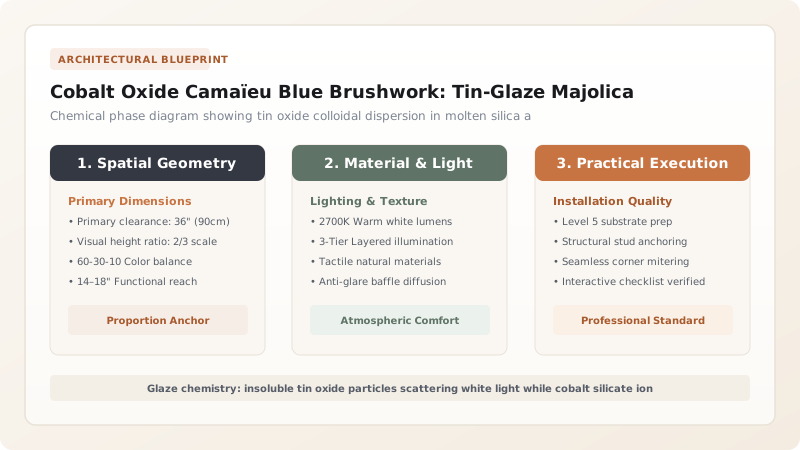
When milled and suspended in water, the glaze contains between 7% and 10% tin oxide (SnO₂ / cassiterite). During kiln firing, tin oxide remains completely insoluble in the molten silicate glass. It disperses as trillions of sub-microscopic crystalline particles (~0.5 microns in size). Because the refractive index of tin oxide (2.0) is drastically higher than the surrounding lead glass (1.55), light rays entering the glaze are refracted and scattered in every direction, producing an intense, opaque, milky-white luster that obliterates the dark red clay biscuit beneath.
The Challenge of Raw Enamel: Painting on Esmalte Cru
The signature artistic challenge of traditional Azulejo production is Pintura sobre o esmalte cru (painting on raw, unfired glaze). After the biscuit tile is dipped in the liquid tin-glaze bath, the water is sucked into the porous clay within seconds, leaving a delicate, powdery, chalk-like coating on the surface.
The artisan must paint directly onto this brittle powder without brushing away the loose particles. The surface is so thirsty that once a wet brush makes contact, the pigment liquid is absorbed instantly into the glaze body. The painter cannot blend strokes on the surface, cannot erase errors, and cannot rest their hand on the tile. Masters suspend their wrists above the work or steady their hand on a wooden bridge (tenta-mão), painting with rapid, decisive strokes of remarkable calligraphic fluidity.
Cobalt Oxide Chemistry: From Grey Powder to Luminous Sapphire
When applied to the raw tile, the cobalt oxide paint does not look blue; it is a dull, drab, dark purplish-gray powder. The painter must visualize the final fired result purely through experience. To create pictorial depth, painters master camaïeu bleu—graduated monochromatic shading using water dilutions:
- Dilution 1 (Água forte): Highly concentrated cobalt oxide with trace iron/manganese for jet-black linework, foreground contours, and deep shadow folds.
- Dilution 2 (Meio-tom): Medium dilution used for sculptural modeling, drapery curves, and facial features.
- Dilution 3 (Lavado): Highly dilute wash (98% water, 2% cobalt) used for floating atmospheric clouds, distant seascapes, and delicate flesh tones.
Firing Kinetics: Grand Feu Vitrification at 1,000°C
The alchemy completes inside the kiln during the Grand Feu (high-fire) glost cycle. Loaded into refractory ceramic boxes (saggars) separated by three-legged tripod stilts (pés de galo), the tiles are fired to between 980°C and 1,020°C in a strictly controlled oxidizing kiln atmosphere.
As the temperature passes 900°C, the lead-silica matrix melts into a viscous liquid pool. The dull grey cobalt oxide dissolves instantly into the liquid glass, where cobalt ions (Co²⁺) coordinate with four oxygen atoms in tetrahedral configuration, creating an intense, incandescent optical absorption band in the yellow-red spectrum that leaves radiant sapphire blue to shine forth. As the kiln cools slowly over 24 hours, the glaze solidifies into a crystal-hard, glossy enamel bonded molecularly to the clay biscuit.
Azulejo Cobalt Pigment Dilutions & Tonal Performance
Use this reference table to calculate exact physical dimensions, ratios, and specifications before purchasing:
| Tonal Grade | Mix Formulation (Cobalt : Water : Gum) | Unfired Appearance | Fired Optical Result | Pictorial Function |
|---|---|---|---|---|
| Contorno (Outline) | 1 : 2 (Cobalt + 5% Manganese flux) | Dark charcoal gray | Deep velvet indigo black | Structural outlines, eyes, architectural borders |
| Sombra (Deep Shadow) | 1 : 5 (Pure Cobalt Oxide in water) | Medium matte gray | Rich royal sapphire blue | Drapery folds, deep water, receding shadow |
| Meio-Tom (Mid-Tone) | 1 : 15 (Dilute cobalt suspension) | Pale lilac wash | Vibrant cerulean blue | Foliage modeling, skies, drapery highlights |
| Lavado (Light Wash) | 1 : 50 (Trace cobalt in gum water) | Faint water stain | Soft ethereal sky blue | Distant horizons, skin tones, cloud billows |
Practical Constraints
Every successful decoration project must account for physical and environmental constraints:
Toxicity of Traditional Raw Lead Oxide in Historic Glazes
Historic lead-tin glazes present severe respiratory hazards to artisans during milling and dry powder handling. Solution: Utilize pre-fritted lead bisilicate glass powders where lead is chemically locked into insoluble vitreous granules.
Differential Cobalt Volatilization at Kiln Hot-Spots
Uneven kiln temperatures cause cobalt to crawl or bubble on tiles placed near burners, ruining large mural color matching. Solution: Enclose all tiles inside sealed fireclay saggars and utilize modern digital pyrometric cones to verify 100% heat uniformity.
Execution Blueprint & Craftsmanship Sequence
Execute this professional sequence to achieve flawless results without backtracking:
Chacota Biscuit Dipping in Stanniferous Slurry
Grip 950°C-fired biscuit with wire tongs; submerge for 3 seconds in stanniferous glaze bath; allow to dry into a powdery 0.8mm white coat.
Cobalt Oxide Grinding on Porphyry Slab
Grind pure cobalt oxide with clean distilled water and 2% gum arabic using a glass muller on a porphyry slab until particle size is <10 microns.
Charcoal Pounce Dot Transfer
Position perforated cartoon over the dry raw glaze; gently pat with a cloth bag filled with powdered charcoal to transfer design dots.
Contour Drawing with Long-Haired Ox Brushes
Dip fine pointed brush into concentrated cobalt; trace structural design lines, holding the wrist elevated above the fragile powder.
Camaïeu Wash Modeling and Tonal Shading
Apply dilute cobalt washes with flat wash brushes; shade shadows and drapery with swift, unhesitating strokes without puddling.
Saggar Loading and 1,000°C Glost Firing
Stack painted tiles in fireclay saggars on ceramic stilts; fire to 1,000°C over 18 hours in an oxidizing atmosphere; cool for 24 hours.
Common Mistakes & Countermeasures
Avoid these costly errors that compromise aesthetics, ergonomics, and budget:
Re-brushing Over Damp Raw Enamel While Applying Cobalt Washes
Firing Tiles in a Reducing (Oxygen-Starved) Kiln Atmosphere
Project Execution Checklist
Track your physical progress. Checkboxes persist automatically on this device:
Frequently Asked Questions
What are the tiny tripod marks visible on the surface of antique Azulejos?
These marks, known as 'pés de galo' (rooster feet), are the scars left by small three-legged refractory ceramic stilts placed between tiles stacked inside the kiln saggar. They allowed potters to fire dozens of tiles simultaneously without the melting glazes fusing the tiles together. In fine 18th-century work, painters carefully touched up these marks.
Why didn't Azulejo artists paint on fired white glaze instead of raw powder?
Painting on already-fired white glaze (overglaze enamel) requires a second, low-temperature firing, which produces a flat, superficial painted layer that can scratch off over centuries. Painting directly on the raw, unfired glaze allows the cobalt to sink deep into the molten glass during the grand feu firing, creating rich optical luminescence and permanent, scratch-proof weather resistance.
Why is gum arabic added to the cobalt paint?
A tiny drop of natural gum arabic (from the acacia tree) acts as a temporary binder. It increases the brush's smooth flow across the dry, chalky raw glaze powder and glues the dry cobalt pigment to the surface, preventing the delicate brushwork from being smudged when tiles are handled and loaded into kiln saggars.
Can cobalt blue fade from exposure to outdoor sunlight?
Never. Unlike organic paints or textile dyes that fade under ultraviolet radiation, cobalt oxide in a fired tin glaze is an inorganic silicate glass that has undergone high-temperature fusion at 1,000°C. Its atomic structure is impervious to solar UV radiation, remaining just as intensely blue after 300 years as the day it came out of the kiln.


