
Portuguese Azulejos (from the Arabic az-zulayj, meaning 'polished stone') represent a monumental decorative tradition combining tin-glazed majolica ceramic chemistry with monumental architectural storytelling. Evolving from Hispano-Moresque geometric tilework into the monochromatic cobalt blue (camaïeu bleu) narrative murals of the Baroque 'Golden Age' (1690–1750) and 19th-century urban street facades, Azulejos provide total wall revetment. Constructed from porous calcareous clay biscuits dipped in opaque white tin-lead glaze and hand-painted with pulverized cobalt oxide, Azulejo facades insulate stone masonry against Atlantic driving rains while diffusing radiant summer sunlight.
At a Glance: Key Takeaways
- Architectural Bedding: Non-hydraulic slaked lime + coarse river sand mortar (1:3)
- Ceramic Substrate: Calcareous porous earthenware biscuit (Chacota, 140x140x10mm)
- Glaze Chemistry: Opaque white stanniferous glaze (Silica + Lead oxide + Tin oxide)
- Pigment Technology: High-temperature pulverized Cobalt Oxide (CoO) brushwork
In-Depth Guides in this Directory
Explore specialized subtopic blueprints, technical dimensions, and execution checklists:
Cobalt Oxide Camaïeu Blue Brushwork: Tin-Glaze Majolica Chemistry, Raw Enamel Painting & Firing Dynamics
Master ceramic artisan guide to Azulejo tin-glaze chemistry: stanniferous opacification, raw enamel brushwork, cobalt oxide pigment dilution, and 1,000°C firing kinetics.
Portuguese Azulejo Quarter-Tile Patterns: Padrão Geometries, Cartouche Framing & Baroque Historiated Murals
Architectural composition guide to Portuguese Azulejos: modular 2x2 and 4x4 Padrão patterns, rococo cartouche border moldings, and monumental historiated narrative panels.
Azulejo Facade Bedding Mortars & Salt Conservation: Hydraulic Lime Adhesion, Desalination Poultices & Glaze Spalling Prevention
Master conservator manual on Portuguese Azulejo preservation: traditional lime-sand bedding mortars, salt crystallization mechanics (sub-florescence), and poultice desalination.
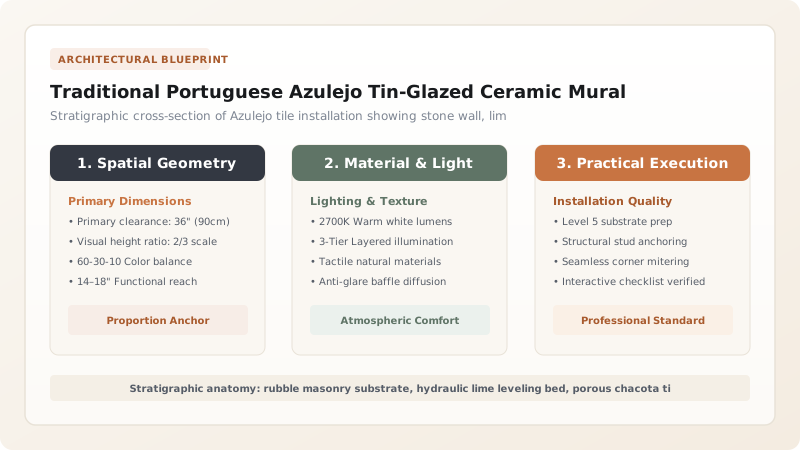
Historical Evolution: From Moorish Geometry to Baroque Blue Murals
In Portugal, the ceramic tile—Azulejo—transcended mere surface ornament to become the primary medium of national architectural identity. Introduced via Seville in the late 15th century under King Manuel I, early Azulejos utilized Islamic relief techniques such as Corda Seca (greasy manganese resist lines) and Aresta (molded clay ridges) to contain colorful lead glazes within intricate Mudéjar geometric patterns.
By the late 17th century, under the influence of imported Chinese Ming dynasty porcelain and Dutch Delftware, Portuguese tilemakers abandoned polychromy in favor of monumental cobalt blue on white (camaïeu bleu). Entire church interiors, palace staircases, and civic squares were enveloped in thousands of tiles forming seamless historiated panels (painéis historiados) depicting biblical narratives, maritime voyages, and allegorical gardens, framed by exuberant Baroque trompe-l'œil architectural cartouches.
Material Science: Calcareous Chacota and Stanniferous Majolica Glaze
An architectural Azulejo begins as a porous earthenware tile biscuit called the Chacota. Portuguese potters formulated the clay body from red alluvial marl blended with high-calcium carbonate quarry silt. When fired to approximately 950°C, the calcium reacts with silica to form stable anorthite and gehlenite crystals. This calcareous clay produces a tile with high porosity (12% to 16%) that matches the thermal expansion of the overlying glaze, preventing crazing.
The biscuit is immersed in a liquid glaze slurry formulated from silica sand, potash, lead oxide (the flux), and tin oxide (SnO₂, the opacifier). The tin oxide does not dissolve in the melt; its suspended sub-micron crystals scatter light, transforming what would be a transparent glass into a snow-white, milky, opaque enamel capable of completely concealing the reddish clay beneath.
Artisanal Execution: Pouncing, Cobalt Shading, and Grand Feu Firing
Painting on unfired tin glaze is an unforgiving high-wire act known as Pintura sobre o esmalte cru. The powdery, raw glaze layer is as absorbent as dry chalk; once a brushstroke touches the surface, the moisture is sucked out instantly, making corrections or erasures completely impossible.
Master painters transfer massive cartoon drawings to the tiles using the pouncing technique (estampar a carvão)—tapping charcoal dust through pin-pricked paper templates. Using long, flexible ox-hair brushes, the artist paints using pulverized cobalt oxide suspended in water with a drop of gum arabic. By varying the pigment concentration, the painter achieves seven distinct tonal values, from faint atmospheric skies to deep, velvet-black indigo shadows. The tiles are then fired in the kiln at 1,000°C (grand feu), where the powder fuses into a glossy, impervious vitreous enamel.
Architectural Revetment, Salt Degradation, and Heritage Conservation
In 19th-century Lisbon and Porto, Azulejos migrated from interior cloisters to exterior street facades. Beyond their radiant beauty, the glazed tiles provided a waterproof skin against the humid, driving Atlantic rains, preventing stone masonry from absorbing moisture while reflecting hot summer sun away from urban apartments.
Preserving historic Azulejo facades requires strict adherence to lime chemistry. Tiles must be bedded in pure non-hydraulic or low-hydraulic lime mortar (1:3 slaked lime to washed river sand). If modern Portland cement is used, the cement introduces soluble sodium and potassium sulfates. As moisture evaporates through the edges, these salts crystallize beneath the glaze (sub-florescence), exerting immense pressure that pops the precious painted tin-enamel off the clay biscuit. Conservators employ warm-water desalination poultices and reversible acrylic consolidants (Paraloid B-72) to stabilize degrading murals.
Portuguese Azulejo Historical Periods & Technical Specifications
Use this reference table to calculate exact physical dimensions, ratios, and specifications before purchasing:
| Era / Period | Dominant Palette | Manufacturing Technique | Typical Tile Sizing | Architectural Role |
|---|---|---|---|---|
| Moresque / Manueline (1500–1580) | Polychrome (Green, Amber, Manganese) | Aresta (relief ridge) & Corda Seca | 135 x 135 x 15 mm | Geometric carpet borders & palace courtyards |
| High Baroque (1690–1750) | Monochromatic Cobalt Blue on White | Freehand majolica brushwork on raw glaze | 140 x 140 x 10 mm | Monumental narrative church & cloister murals |
| Pombaline Post-Earthquake (1755–1800) | Polychrome (Blue, Yellow, Green) | Pattern stenciling & transfer woodblocks | 140 x 140 x 8 mm | Standardized urban facade & stair revetments |
| 19th-Century Industrial Facades | Semi-industrial relief & transfer print | Hydraulic press stamping & automated kilns | 145 x 145 x 7 mm | Full exterior street facades & thermal insulation |
Practical Constraints
Every successful decoration project must account for physical and environmental constraints:
Marine Salt Aerosol Crystallization Along Coastal Port Towns
Airborne sea salts penetrate unglazed tile edges in Porto and Lisbon, crystallizing behind the glaze and pushing it off in flakes. Solution: Wash historic facades with deionized water poultices (sepiolite clay) to extract sub-surface chlorides, then repoint with hydraulic lime.
High Vibrational Shear from Modern Tram Traffic Shaking Facades
Street vibrations loosen brittle historic lime mortar beds, causing whole sections of antique tile murals to detach and fall. Solution: Re-adhere loose tiles using flexible, micro-injected natural hydraulic lime grouts (NHL 2) fortified with micronized silica.
Execution Blueprint & Craftsmanship Sequence
Execute this professional sequence to achieve flawless results without backtracking:
Calcareous Clay Sourcing and Biscuit Pressing
Blend red alluvial clay with calcium carbonate marl; hand-press into 140x140mm wooden frame molds; dry slowly; biscuit fire to 950°C.
Stanniferous Tin-Glaze Slurry Compounding
Melt silica, lead oxide, and 8% tin oxide into glass frit; grind in water ball mills to 200-mesh suspension; immerse Chacota biscuit.
Cartoon Pouncing (Estampar a Carvão)
Prick lines of full-scale mural cartoon with needles; lay across tiles; pounce charcoal dust pouch to transfer guide dots onto raw glaze.
Cobalt Oxide Monochromatic Brushwork
Grind cobalt oxide with gum arabic water; paint contours and wash shading using fine ox-hair brushes directly onto dry raw enamel powder.
Grand Feu Glost Kiln Firing (1,000°C)
Stack tiles vertically in fireclay refractory saggars; fire to 1,000°C over 18 hours; cool slowly for 24 hours to fuse glaze into glass.
Hydraulic Lime Facade Bedding and Joint Pointing
Dampen masonry wall; butter back of soaked tiles with non-hydraulic lime putty and river sand (1:3); set with 2mm open lime joints.
Common Mistakes & Countermeasures
Avoid these costly errors that compromise aesthetics, ergonomics, and budget:
Bedding Historic Azulejos with Modern Portland Cement Adhesives
Setting Exterior Facade Tiles with Zero Grout Gap (Tight Butt-Joints)
Project Execution Checklist
Track your physical progress. Checkboxes persist automatically on this device:
Frequently Asked Questions
Why did Portuguese Azulejos become predominantly blue and white in the 18th century?
The shift to blue and white was driven by the global craze for Chinese blue-and-white porcelain from the Kangxi reign and Dutch Delftware tiles. Blue on white was considered the height of aristocratic refinement. Furthermore, cobalt oxide was one of the few mineral colorants capable of surviving the intense 1,000°C grand feu kiln firing without vaporizing or changing hue.
Why are Portuguese tiles called 'Azulejos'?
The word Azulejo derives from the Arabic 'al-zulayj' (الزليج), meaning 'polished stone' or 'little polished tile'. The Moors originally introduced glazed tile mosaics to the Iberian Peninsula to simulate the luxury of Roman and Byzantine polished marble pavements.
Can broken or missing antique Azulejos be authentically reproduced today?
Yes. Traditional ceramic ateliers in Lisbon and Caldas da Rainha still formulate authentic calcareous clay chacotas, apply hand-dipped tin-lead glazes, and paint cobalt oxide using charcoal pounces. Reproductions match the subtle imperfections, undulating surface depth, and cobalt tonal richness of 18th-century originals.
How do tiles protect the exterior walls of Portuguese residential buildings?
Glazed Azulejos act as an impervious architectural raincoat. Lisbon and Porto experience heavy, wind-driven Atlantic rains. The vitrified glaze sheds water instantly, keeping the porous limestone and rubble masonry walls bone dry, while the white background reflects intense Mediterranean summer heat to keep interiors cool.


