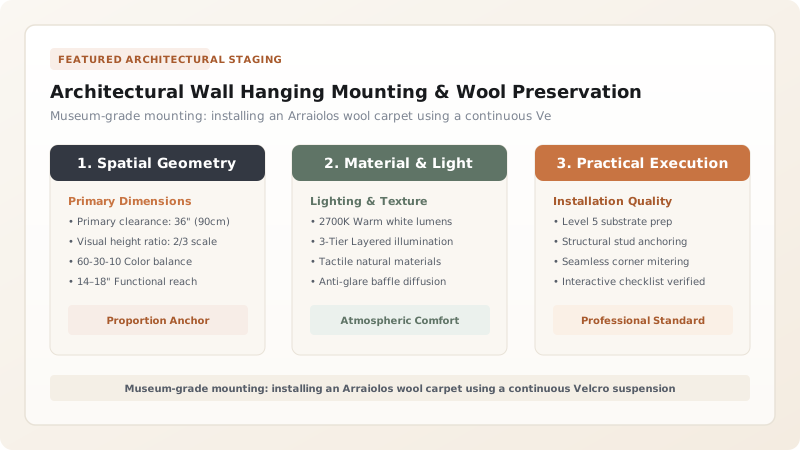
Architectural wall hanging mounting and wool preservation for Arraiolos carpets require non-invasive structural support and rigorous environmental control. To suspend heavy embroidered wool rugs on palatial walls without sagging or tearing, conservators stitch continuous hook-and-loop (Velcro) sleeves onto unbleached cotton backing bands. Preservation involves stabilizing relative humidity (45–55%), installing UV-filtering glazing, and preventing moth infestation through natural botanical deterrents.
At a Glance: Key Takeaways
- Mounting System: Continuous Hook-and-Loop (Velcro) Strip on Hardwood Slat
- Support Fabric: Pre-Washed Heavy Unbleached Cotton Duck / Muslin
- Hanging Hardware: Anodized Aluminum or Sealed White Oak Suspension Batten
- Optimal Humidity: 45% to 55% Relative Humidity (RH) at 18–22°C
- Pest Deterrents: Dried Lavender, Cedar Heartwood Oils & Micro-Mesh Screens
Gravitational Mechanics and Textile Conservation Standards
In historic Portuguese architecture—from the grand episcopal palaces of Évora to the aristocratic manor houses (solares) of the Minho—monumental Arraiolos embroidered carpets were frequently elevated from the floor and displayed as wall tapestries. However, suspending a heavy, dense textile weighing up to 25 or 35 kilograms presents severe structural challenges.
Because an Arraiolos carpet consists of thousands of wool stitches worked onto an open-weave jute or linen canvas (estopa), gravitational force exerts continuous downward tension. If a rug is suspended using localized rings, clips, or nails, the entire deadweight is concentrated onto tiny contact points. Within months, this concentrated shear stress stretches the canvas into unsightly scalloped waves, tears the foundational warp threads, and causes the embroidered wool stitches along the top border to pop and unravel. Modern textile conservation dictates that gravitational load must be distributed 100% uniformly across the entire width of the textile.
The Continuous Hook-and-Loop (Velcro) Mounting System
The international museum standard for hanging heavy embroidered carpets is the continuous hook-and-loop (Velcro) mounting system. This technique combines maximum structural support with total reversibility, ensuring that the historic textile is never subjected to adhesives, staples, or irreversible alterations.
A band of pre-washed, unbleached heavy cotton duck or linen webbing (50 to 75 millimeters in width) is prepared. The soft loop side of a high-tenacity Velcro tape is machine-stitched securely along the center of this webbing. Next, the webbing assembly is hand-stitched to the reverse top margin of the carpet using a flexible, staggered herringbone stitch (ponto de espinha). The conservator's needle catches only the thick structural threads of the backing canvas, never piercing the front-facing embroidered wool. On the wall, a straight hardwood or anodized aluminum suspension slat faced with the matching hook-side Velcro is anchored level. When the carpet is pressed against the slat, the micro-hooks interlock across the entire width, providing seamless, sag-free suspension.
Environmental Control: Relative Humidity, Lighting, and Ventilation
Once hung, the long-term preservation of an Arraiolos carpet depends on rigorous environmental stewardship. As a natural protein fiber, sheep's wool is highly hygroscopic, absorbing and releasing moisture in response to ambient atmospheric conditions. The optimal indoor environment maintains a relative humidity (RH) between 45% and 55% at a temperature of 18°C to 22°C. Humidity levels above 65% encourage the growth of mold and mildew, while levels below 40% cause wool fibers to become brittle and prone to breakage.
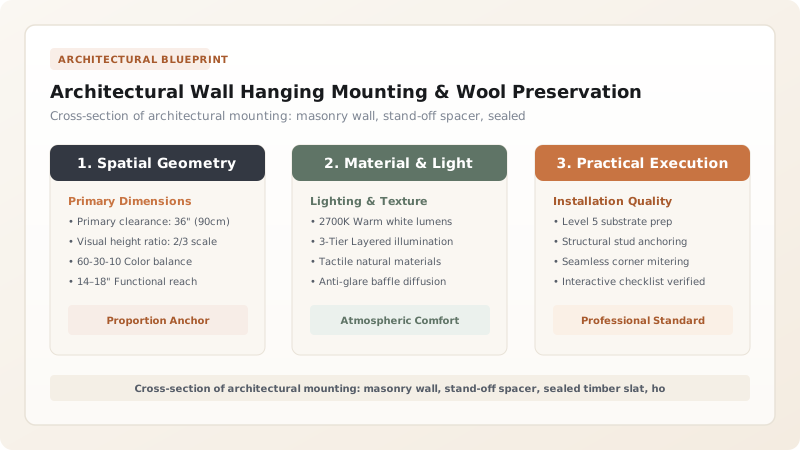
Furthermore, carpets must never be suspended directly against exterior stone or masonry walls. Historic stone walls act as thermal bridges, causing cold spots and interstitial condensation that rots the canvas backing. To prevent this, conservators mount 20 mm stand-off spacers behind the wooden hanging slat, creating a continuous, ventilated air chimney that allows ambient room air to circulate behind the textile. Lighting must also be carefully regulated: direct solar radiation must be blocked, and artificial illumination should be limited to UV-filtered LED fixtures providing no more than 50 to 150 lux.
Integrated Pest Management (IPM) for Proteinaceous Textiles
The greatest biological threat to historic Arraiolos wool carpets is the webbing clothes moth (Tineola bisselliella) and the carpet beetle (Anthrenus verbasci). It is not the adult flying insects that cause damage, but their microscopic larvae, which feed voraciously on the keratin proteins of natural wool, digesting the embroidery yarns down to the bare canvas.
Traditional preventative conservation rejects harsh chemical mothballs (such as naphthalene or paradichlorobenzene), which release toxic fumes, leave irreversible odors, and can chemically react with historic dyes. Instead, conservators employ an Integrated Pest Management (IPM) protocol. Both sides of the suspended carpet are vacuumed gently twice a year using a variable-suction museum vacuum fitted with a soft horsehair brush through a protective nylon conservation screen. Sticky pheromone traps are installed around the perimeter of the room to detect flying insects early, while natural botanical repellents—such as sachets of dried lavender flowers, cloves, and natural cedar heartwood blocks—are placed nearby to deter colonization.
Mounting Methods, Structural Load Capacity & Conservation Suitability
Use this reference table to calculate exact physical dimensions, ratios, and specifications before purchasing:
| Mounting Method | Weight Capacity (kg/m) | Stress Distribution | Reversibility | Conservation Grade |
|---|---|---|---|---|
| Continuous Velcro on Cotton Slat | Up to 15 kg/m | 100% Uniform linear distribution | Completely reversible (Hand-stitched) | Museum & Historic Palace Standard |
| Sleeve with Wooden Dowel Rod | Up to 10 kg/m | Uniform across top seam | Completely reversible | High (Suitable for smaller tapestries) |
| Brass Ring Suspension (Clips) | Up to 5 kg/m | Concentrated point-loading (Scalloping) | Moderate risk of fabric distortion | Not Recommended for large rugs |
| Direct Stapling to Strainer Bar | High (Immediate hold) | Extreme localized shear stress | Irreversible fiber damage | Unacceptable (Destructive) |
Practical Constraints
Every successful decoration project must account for physical and environmental constraints:
High Deadweight of Monumental Hand-Embroidered Carpets
A large 3x4 meter Arraiolos carpet can weigh 25 to 35 kg, causing significant gravitational stretch over time. Mitigation: Incorporate secondary intermediate Velcro support strips horizontally across the midpoint of the carpet reverse.
Thermal and Moisture Bridges on Exterior Masonry Walls
Hanging tapestries directly against cold stone palace walls causes condensation to form on the carpet back. Mitigation: Install 20 mm stand-off spacers behind the mounting slat to maintain a continuous, ventilated air cavity behind the textile.
Execution Blueprint & Craftsmanship Sequence
Execute this professional sequence to achieve flawless results without backtracking:
Condition Assessment and Vacuuming
Lay the carpet flat on a clean padded table. Vacuum both front and back through a fine monofilament conservation screen.
Preparing Cotton Webbing Support
Pre-shrink 75 mm wide unbleached cotton twill webbing by washing in hot water. Cut to length 20 mm shorter than the carpet width.
Attaching Loop-Side Velcro
Machine-stitch the loop side of 50 mm wide Velcro along the center of the cotton webbing using archival polyester thread.
Hand-Stitching Webbing to Carpet
Hand-stitch the cotton webbing along the top reverse edge of the carpet using curved needles, catching only the backing canvas threads.
Fabricating the Wall Slat
Cut a straight white oak or aluminum bar (20x60 mm). Seal wooden slats with polyurethane to prevent acid vapor off-gassing.
Adhering Hook-Side Velcro to Slat
Staple and adhere the hook side of the Velcro tape continuously along the front face of the wooden suspension slat.
Wall Mounting and Leveling
Anchor the suspension slat to the wall using heavy toggle bolts or masonry anchors, checking alignment with a spirit level.
Hanging and Alignment
Press the carpet's top Velcro band onto the wall slat, starting from the center and working outward to eliminate ripples and ensure plumb hang.
Common Mistakes & Countermeasures
Avoid these costly errors that compromise aesthetics, ergonomics, and budget:
Nailing, stapling, or screwing an Arraiolos carpet directly into a wall or wooden frame
Enclosing an embroidered wool carpet in an airtight, non-ventilated glass display case
Using chemical mothballs (paradichlorobenzene) in domestic living spaces
Project Execution Checklist
Track your physical progress. Checkboxes persist automatically on this device:
Frequently Asked Questions
Why is Velcro (hook-and-loop) considered the safest mounting method for tapestries?
A continuous Velcro strip distributes the heavy gravitational weight of the carpet perfectly evenly across its entire top edge, eliminating the point-load stress concentrations caused by hooks, rings, or nails that inevitably cause sagging and tearing.
Why must an air gap be maintained behind a wall-hung Arraiolos carpet?
Historic stone or brick walls often experience temperature differentials that can cause interstitial moisture condensation. A 15 to 20 mm air gap allows room air to circulate freely behind the carpet, preventing moisture accumulation and mold growth.
How can wool moths be safely prevented without harming antique fibers?
Preventive maintenance is key: vacuum the carpet regularly, inspect creases and fringe seams biannually, install sticky pheromone monitoring traps in the room, and use natural botanical repellents such as dried lavender flowers and cedarwood blocks.