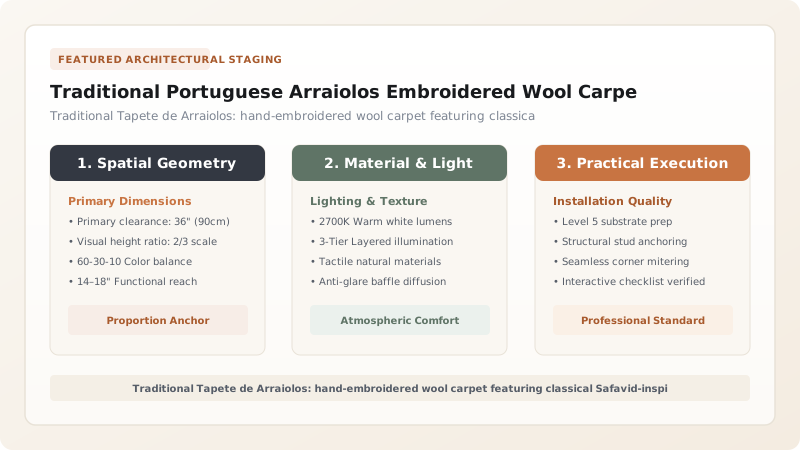
Traditional Portuguese Arraiolos carpets (Tapetes de Arraiolos) are hand-embroidered wool rugs originating in the Alentejo town of Arraiolos during the late 15th and 16th centuries. Stitched entirely with pure sheep's wool onto an open-weave linen or jute canvas (estopa), they utilize the distinctive oblique cross-stitch (ponto de Arraiolos). Fusing Moorish geometric patterns, Persian arabesques, and Portuguese folk flora, these durable textiles served as aristocratic floor rugs and palatial wall hangings.
At a Glance: Key Takeaways
- Artisan Origin: Arraiolos, Alentejo, Portugal
- Signature Stitch: Ponto de Arraiolos (Oblique Long-Arm Cross-Stitch)
- Foundation Canvas: Open-Weave Natural Linen or Jute Burlap (Estopa)
- Embroidery Yarn: 100% Native Alentejano Sheep's Wool (Merino Blend)
- Design Influences: Moorish Mudéjar Lattices, Persian Safavid & Renaissance Florals
In-Depth Guides in this Directory
Explore specialized subtopic blueprints, technical dimensions, and execution checklists:
Slanted Cross-Stitch Ponto de Arraiolos on Jute Canvas: Stitch Geometry & Tension
Technical guide to the slanted cross-stitch ponto de Arraiolos on jute canvas (estopa): thread count, needle geometry, tension control, and border finishing.
Natural Plant-Dyed Wool Palette & Persian Arabesque Motifs in Arraiolos Tapestries
Guide to traditional plant-dyed wool palettes (madder, weld, indigo) and Persian Safavid arabesque motifs in historic Portuguese Arraiolos carpets.
Architectural Wall Hanging Mounting & Wool Preservation for Arraiolos Rugs
Conservation guide to architectural wall hanging mounting, Velcro sleeve systems, and preventive wool preservation for historic Arraiolos carpets.
Moorish Heritage and Convento Origins in the Alentejo
High on a sun-bleached hill crowned by a circular 14th-century castle in Portugal's southern Alentejo province lies the town of Arraiolos. Here, in the late 15th and early 16th centuries, arose one of Europe's most celebrated textile traditions: Tapetes de Arraiolos (Arraiolos embroidered carpets).
The roots of Arraiolos carpets lie in the complex cultural crucible of medieval Iberia. Following the Christian Reconquista and King Manuel I's 1496 edict requiring Jews and Muslims to convert or leave Portugal, many skilled Moorish textile artisans (mouriscos) sought refuge in the Alentejo interior. Settling in Arraiolos, these artisans found abundant wool from vast local sheep flocks and established home workshops. Collaborating with local craftswomen and Clarissan convent nuns, they adapted the visual language of knotted Persian, Turkish, and Andalusian carpets to the accessible technique of needlepoint embroidery on linen canvas, creating a vernacular luxury that quickly adorned royal palaces and noble manors across the Portuguese Empire.
Ponto de Arraiolos: Anatomy and Mechanics of the Oblique Cross-Stitch
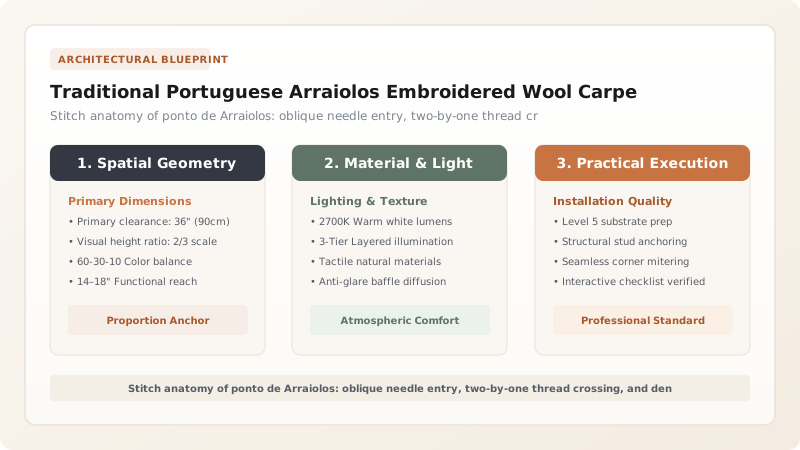
Unlike Persian or Turkish rugs, which are woven on looms with hand-tied knots (Ghiordes or Senneh knots), an Arraiolos carpet is executed entirely with an embroidery needle. The defining technical achievement of this craft is the ponto de Arraiolos (Arraiolos stitch)—a specialized variation of the long-legged oblique cross-stitch.
Worked over counted threads of an open-weave canvas (estopa), each stitch crosses two vertical warp threads and one horizontal weft thread. The needle traverses diagonally, overlapping the previous stitch by half its length. This asymmetrical crossing creates a dense, braided, herringbone-like surface on the face of the carpet. On the reverse, the thread travels strictly in compact vertical parallel bars. This dual-sided structural geometry gives the carpet substantial thickness, prevents the underlying canvas from showing through, and creates an extraordinarily dense wool pile that resists crushing under heavy furniture and foot traffic.
Design Evolution: From Mudéjar Lattices to Safavid Arabesques
The stylistic evolution of Arraiolos carpets is traditionally classified into three distinct historical epochs. The First Epoch (17th century) is heavily dominated by Moorish Mudéjar geometry and Safavid Persian carpet imports that arrived via Portuguese maritime trade routes from Ormuz and Goa. These carpets feature complex interlocking diamond lattices, stylized geometric animal figures (birds, hounds, and stags), and a dominant palette of natural sheep's wool, indigo blue, and saffron yellow.
During the Second Epoch (18th century), the design language absorbed Indian chintz and Chinese porcelain motifs (Chinoiserie). Compositions featured a grand central medallion (medalhão) filled with dynamic scrolling arabesques, palmettes, and corner quadrants (cantos), framed by wide borders of blooming lotuses and carnations. The Third Epoch (late 18th to 19th century) reflected European Rococo and Neoclassical tastes, introducing lighter cream grounds, delicate floral garlands, ribbon swags, and pastel tones suited to the sunlit drawing rooms of Portuguese country estates (solares).
Architectural Integration: Palace Floor Carpets and Tapestry Wall Hangings
In traditional Portuguese domestic and palatial architecture, Arraiolos carpets performed vital functional and decorative roles. The stone-built manor houses, convents, and palaces of the Alentejo featured cool, polished terracotta tile or white Estremoz marble floors that became cold and damp during winter rains. Large-format Arraiolos rugs, often measuring three to five meters in length, were laid across salon floors to provide essential thermal insulation and acoustic dampening.
Beyond floor coverings, monumental Arraiolos tapestries were suspended on salon walls from wrought iron or turned brass poles. Hung against whitewashed lime walls or paired with hand-painted blue-and-white azulejo ceramic tile dadoes, the rich, tactile wool tapestries introduced warmth, acoustic comfort, and opulent color to grand public chambers. Their enduring physical resilience has allowed hundreds of antique 17th- and 18th-century specimens to survive in museum and private collections today in pristine condition.
Arraiolos Carpet Epochs, Stylistic Motifs & Color Palettes
Use this reference table to calculate exact physical dimensions, ratios, and specifications before purchasing:
| Period / Century | Primary Stylistic Influence | Core Motifs | Color Harmony | Architectural Role |
|---|---|---|---|---|
| 17th Century (First Epoch) | Persian Safavid & Mudéjar Islamic | Geometric lattices, central star medallions, stylized animals | Indigo blue, saffron yellow & natural ecru | Monastic prayer rugs & noble banquet halls |
| 18th Century (Second Epoch) | Oriental Indian & Chinese Chinoiserie | Tree of life, exotic birds, porcelain-inspired vases | Rich madder red, turquoise, olive green & gold | Palace reception salons & bedchamber rugs |
| Late 18th Century (Third Epoch) | European Rococo & Neoclassical | Bouquets of roses, ribbon swags, scrolling acanthus | Pastel roses, cream, soft grey & sage green | Manor house drawing rooms (Solares) |
| 19th–20th Century (Folk Revival) | Alentejo Vernacular Folk Art | Wild carnations, wheat sheaves, local village flora | Contrasting black backgrounds with jewel-toned floras | Domestic thermal insulation & wall tapestries |
Practical Constraints
Every successful decoration project must account for physical and environmental constraints:
Moth Larvae (Tineola bisselliella) Infestation in Natural Wool
Keratin-feeding moth larvae eat through wool yarns, leaving bare patches in the jute canvas. Mitigation: Infuse storage chests with dried lavender, cedar shavings, and wormwood, and clean carpets biannually with sunlight and aeration.
Canvas Distortion Under Heavy Foot Traffic on Hard Stone Floors
Smooth Alentejo marble or terracotta floors cause unbacked embroidered rugs to slip and stretch diagonally. Mitigation: Line the reverse face of the carpet with natural linen backing or lay over high-friction natural felt underlayment.
Execution Blueprint & Craftsmanship Sequence
Execute this professional sequence to achieve flawless results without backtracking:
Canvas Selection and Edging
Cut natural jute or linen canvas (estopa) to dimensions, basting perimeter edges with cotton tape to prevent fraying during work.
Frame Tensioning
Lash the canvas onto a sturdy pine or chestnut embroidery frame using cotton cords, tightening until the canvas sounds like a drum.
Yarn Selection and Palette Planning
Sort plant-dyed wool skeins into color families, calibrating contrasting values between outline threads and background fill.
Counting and Design Registration
Identify the exact geometric center of the canvas. Chart the central medallion (medalhão) using counted-thread graph charts.
Stitching Motif Contours
Execute the ponto de Arraiolos stitch to outline all major arabesques, floral cartouches, and border guard bands.
Filling Decorative Details
Embroider the interior areas of leaves, blossoms, and geometric stars with dense, two-ply wool in rich chromatic gradations.
Filling the Background Field
Stitch the vast background field (armação) using uniform horizontal rows of ponto de Arraiolos in natural unbleached or black wool.
Finishing Borders and Steaming
Turn under canvas margins, secure with whipstitched wool binding, sew hand-braided wool fringes, and block-steam the finished rug.
Common Mistakes & Countermeasures
Avoid these costly errors that compromise aesthetics, ergonomics, and budget:
Varying embroidery stitch tension across adjacent sections of the canvas
Using synthetic nylon or acrylic yarns instead of pure virgin sheep's wool
Cutting canvas margins too close to the embroidered border before finishing
Project Execution Checklist
Track your physical progress. Checkboxes persist automatically on this device:
Frequently Asked Questions
What makes the ponto de Arraiolos stitch structurally unique compared to standard cross-stitch?
Ponto de Arraiolos is an oblique, long-legged cross-stitch worked over two vertical threads and one horizontal thread of the canvas. Because the diagonal arms overlap in alternating directions, the stitch forms a continuous braided, herringbone-like wool surface on the front while creating dense parallel vertical bars on the reverse, yielding exceptional thickness and wear resistance.
Why did Arraiolos in the Alentejo region become the center of Portuguese carpet making?
Arraiolos was located at the heart of Portugal's vast sheep-raising plains of the Alentejo, providing an inexhaustible supply of high-grade wool. Additionally, following the 1496 edict expelling Jews and Moors from Portugal, many skilled Moorish weavers and embroiderers settled in Arraiolos, transferring Islamic carpet-making knowledge to local convent nuns and craftswomen.
How should an authentic antique Arraiolos carpet be cleaned and cared for?
Traditional carpets should be gently vacuumed with suction-only (no beater brush), aired outside in dry shade once a year, and never dry-cleaned with harsh synthetic solvents. Surface stains should be dabbed with lukewarm water and mild wool-safe Castile soap.