Exterior log chinking floral striping is the defining architectural signature of Zalipie cottages. Horizontal joints between dark pine wall logs are packed with moss and wood shavings, capped with a breathable lime-and-sand mortar fillet (mszenie), and coated with high-calcium slaked whitewash tinted with ultramarine bluing. These brilliant white horizontal ribbons serve as the structural canvas upon which continuous folk floral garlands, rosettes, and undulating vine tendrils are painted, visually dematerializing the heavy timber structure into a flowering garden.
At a Glance: Key Takeaways
- Chinking Substrate: Dried wetland moss, wood shavings, and fat lime-sand mortar
- Whitewash Formula: Aged slaked lime (Ca(OH)2) + rainwater + 0.5% synthetic ultramarine
- Log Joinery Type: Squared pine logs stacked with dovetail or half-lap corner notches
- Visual Contrast: Deep oxidized grey/brown pine logs vs brilliant white floral chink bands
- Maintenance Cycle: Annual spring washdown and refresh prior to Corpus Christi festivities
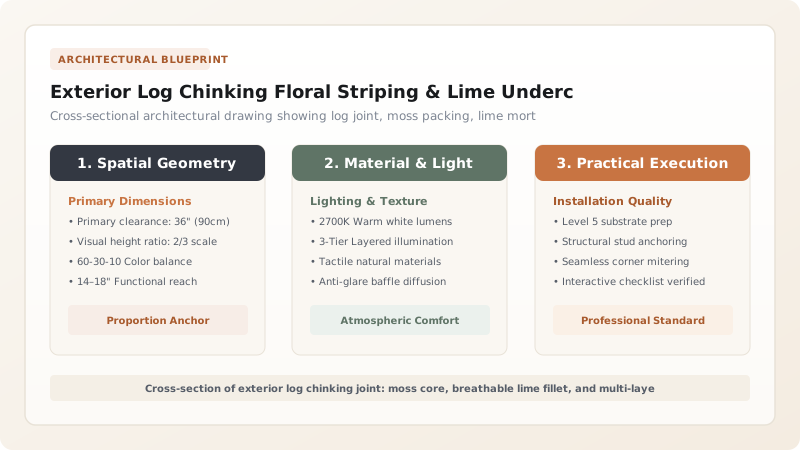
The Architectural Rationale of Log Wall Chinking
In the traditional wooden architecture of Lesser Poland, log construction (zrąb) was built from massive pine logs hand-hewn into flat-faced timbers with broadaxes. Even with masterly carpentry, seasonal shrinkage and natural twists in the timber grain leave gaps between courses measuring 20 to 60 mm in height. In the continental climate of the region, where winter temperatures plunge below -20°C and summer thunderstorms unleash torrential driving rains, hermetically sealing these horizontal voids was paramount to domestic survival.
The craft of mszenie was the vernacular solution. Specially trained craftsmen used wedge-shaped wooden caulking irons (szpachtle) to ram dry forest moss and wood shavings deep into the joint, packing it to wood-like density. Over this insulation, a protective render of fat lime putty, sharp pit sand, and chopped animal hair was troweled into a smooth, slightly concave band. This breathable, vapor-permeable seal protected the core timber from wind-driven moisture while allowing interior humidity to escape safely without rotting the log interfaces.
Formulating & Applying the Ultramarine-Blued Lime Undercoat
The lime undercoat serves as the luminous architectural foundation for all Zalipie floral murals. Unlike synthetic latex primers that form an impermeable plastic skin, the traditional undercoat is pure slaked quicklime (wapno gaszone). Quicklime rocks (calcium oxide) were slaked in wooden pits and aged under water for months, converting the calcium hydroxide into an exceptionally fine, colloidal crystal putty with unparalleled covering power.
To achieve the signature optical brilliance of Zalipie facades, painters dilute this lime putty with soft rainwater to the consistency of heavy cream, adding a precise 0.5% measurement of laundry ultramarine powder (błękitka). The subtle blue wavelength counteracts the slight yellow cast of sand grains, creating an incandescent snow-white field. Applied with broad horsehair brushes in two to three rapid coats, the lime absorbs carbon dioxide from the surrounding air, curing into crystalline calcite that bonds chemically into the mortar substrate.
Geometry, Rhythm & the Freehand Floral Striping Process
Painting the horizontal chinking ribbons is an exercise in rhythmic choreography. Rather than viewing the facade as a static flat canvas, the Zalipie folk artist treats the building as a sculptural relief. The dark, weathered pine logs—aged by decades of ultraviolet exposure to deep shades of umber and charcoal grey—act as natural architectural frames that bracket the brilliant white chink stripes.
Execution begins by establishing anchor points: large multi-tiered rosettes or stylized poppies placed at regular intervals of approximately 40 to 50 cm along the band. These floral hubs are then linked with sweeping, undulating stems painted in deep viridian green or lampblack. Secondary blossoms, delicate cornflower clusters, and serrated fern leaves are layered along the vine, filling negative spaces. The painter never uses rulers or preliminary chalk guides; the hand moves with practiced kinetic instinct, calibrating the scale of each leaf cluster to the variable width of the mortar joint.
Corner Articulations, Architraves & Environmental Resilience
The aesthetic power of Zalipie architecture reaches its zenith at the building's intersections. Where the horizontal log courses meet at the corners in overlapping dovetail notches (węgły na obłap), the painted floral ribbons do not terminate abruptly. Instead, the white undercoat and floral swags turn 90 degrees, cascading down the projecting timber ends in a continuous vertical tapestry of blossoms that accents the structural joinery.
Window and door architraves are similarly enveloped in decorative framing borders (szpalery), visually tying the fenestration into the wall rhythm. Because these exterior surfaces endure driving rain and relentless sun, the mineral-casein paint naturally weathers over a twelve-month cycle. Rather than viewing this as deterioration, the village embraces it as part of an agricultural rhythm. Each spring, the weathered bands are gently washed down, re-whitewashed, and repainted—ensuring the cottage remains a dynamic, living cultural organism.
Log Chinking & Undercoat Technical Specifications
Use this reference table to calculate exact physical dimensions, ratios, and specifications before purchasing:
| Application Stage | Binder Composition | Aggregate / Filler | Layer Thickness | Function |
|---|---|---|---|---|
| Deep Void Tamping | None (mechanical compression) | Dried peat moss & flax tow | 30–60 mm depth | Thermal insulation & elastic expansion barrier |
| Base Mortar Fillet | 1 part Slaked Fat Lime putty | 3 parts washed pit sand (0–2 mm) | 15–20 mm thickness | Structural moisture shedding & weather barrier |
| Blued Lime Primer | High-calcium lime milk (1:3 with water) | 0.5% ultramarine blue powder | 0.5 mm (2 coats) | Luminous optical white reflective canvas |
| Floral Mural Layer | Lime-casein curd emulsion | Pure dry mineral oxides | 0.2–0.4 mm | Folk iconography & UV surface protection |
| Protective Glaze (Optional) | Potassium water glass (dilute) | None | Penetrating spray | Consolidates mineral pigment without forming plastic skin |
Practical Constraints
Every successful decoration project must account for physical and environmental constraints:
Dynamic seasonal expansion and contraction of solid timber logs
Log swelling in autumn humidity and shrinking in winter cold induces shear cracks in chinking seams Mitigation: Incorporate cut hair or animal fiber reinforcement into the lime fillet to absorb mechanical stresses
Splashing rain and capillary ground moisture along bottom log courses
Lower 600 mm of floral striping suffers dirt spatter, salt migration, and premature whitewash erosion Mitigation: Install wide fieldstone plinths and apply a darker soot-tinted protective border base along bottom logs
Execution Blueprint & Craftsmanship Sequence
Execute this professional sequence to achieve flawless results without backtracking:
Joint Inspection & Excavation
Inspect all exterior log courses, chiseling away crumbly legacy mortar and raking out rotten fiber packing down to solid timber.
Elastic Fiber Packing (Mszenie)
Drive dried sphagnum moss and wood shavings into the void using hardwood caulking irons and mallets until densely packed.
Lime-Sand Fillet Tooling
Trowel a pliable 1:3 fat lime and sand mortar over the moss backing, tooling the joint surface with a concave slicker.
Carbonation & Curing Cycle
Mist the fresh mortar daily with clean water for seven days, protecting it from direct hot sun to ensure deep carbonation.
Ultramarine-Blued Lime Wash Application
Brush two uniform coats of slaked lime wash tinted with 0.5% ultramarine along the mortar strip, creating crisp, brilliant white bands.
Vine Geometry & Focal Spacing
Establish rhythmic layout points along each horizontal band, sketching curved stem lines with diluted green casein paint.
Floral Motif Execution
Paint bold rosettes, poppies, and cornflowers directly over the white lime ground using dense cow-tail hair brushes.
Corner Notch & Architrave Continuation
Wrap painted floral ribbons seamlessly around the projecting dovetail log corners (węgły) and window surround trims.
Common Mistakes & Countermeasures
Avoid these costly errors that compromise aesthetics, ergonomics, and budget:
Using modern Portland cement mortar to seal horizontal timber log seams
Whitewashing directly over dirty, soot-laden or algae-stained mortar fillets
Over-extending the white lime undercoat broadly onto the exposed faces of the dark pine logs
Project Execution Checklist
Track your physical progress. Checkboxes persist automatically on this device:
Frequently Asked Questions
What is 'mszenie' in Polish vernacular timber construction?
Mszenie refers to the traditional craft of caulking the longitudinal gaps between stacked logs in wooden architecture. Historically performed using meadow moss (mech), flax fibers, or twisted wood excelsior, it provides both weather sealing and thermal insulation, creating a flexible backing for the lime mortar fillet.
Why is the exterior whitewash tinted with blue pigment?
Natural slaked lime can appear slightly dull or warm greyish-yellow when dry, especially over unrefined sand mortar. Adding a trace of synthetic ultramarine bluing powder counteracts warm tones through optical color balance, making the lime appear blindingly crisp and snow-white under direct midday sun.
How do painters paint straight floral borders without using masking tape?
Traditional Zalipie artists never use tape or rulers. They anchor their forearm against the lower timber log, using the natural curved edge of the hewn wood as a steady mechanical guide. By maintaining consistent wrist angle and brush pressure, they execute perfectly parallel ribbons freehand.