In traditional Zalipie cottage painting, brushes are hand-fashioned from the coarse, resilient hairs of a cow's tail switch bound to flexible birch twigs with waxed linen thread. Unlike commercial synthetic brushes, cow-tail hair possesses natural taper, micro-ridges, and high stiffness capable of carrying dense mineral-and-milk emulsions across uneven lime-plastered timber. Dry pigments—ranging from burnt soot to natural ochres and ultramarine—are mulled with skimmed cow's milk or egg white to create durable, water-resistant folk distempers.
At a Glance: Key Takeaways
- Brush Fiber Material: Natural bovine tail switch hair (włosie z ogona krowiego)
- Brush Handle Wood: Split weeping birch (Betula pendula) or hazel shoots
- Binding Medium: Skimmed milk curd (casein), egg white, or fermented rye paste
- Pigment Source: Ground mineral earth oxides, soot, and laundry ultramarine bluing
- Stroke Precision: High elasticity with fine natural flagging for tapered petal tips
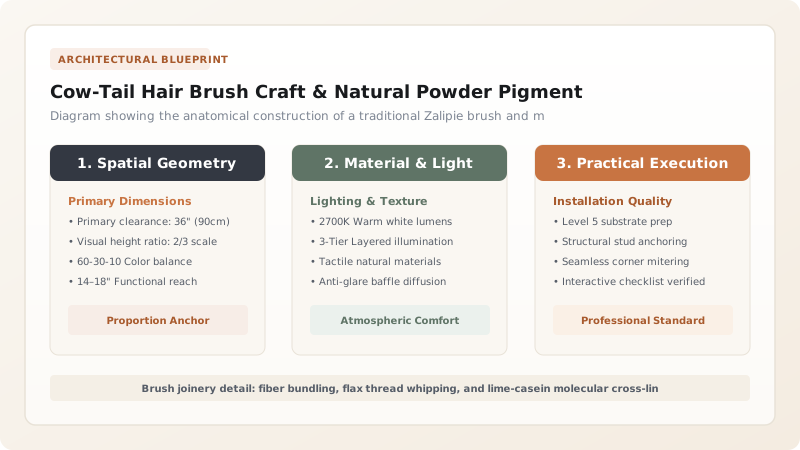
The Anatomy & Metallurgy of Cow-Tail Brushes
In the material culture of Zalipie, the artist’s brush (pędzel) is never bought from an art supply merchant; it is an organic extension of the peasant barnyard. The primary bristle material is harvested from the switch of the bovine tail (włosie z krowiego ogona). Unlike the soft fur of squirrel or sable used by classical watercolorists, cow-tail hair is thick, stiff, and exceptionally resilient. Under microscopic examination, each hair shaft possesses a distinct conical taper ending in a split 'flagged' tip, surrounded by imbricated keratin cuticles.
These micro-serrations grant cow-tail hair an astonishing capacity to load and suspend heavy, non-Newtonian slurries of slaked lime and coarse mineral earths. When swept across rough timber logs or pitted mortar joints, the bristles do not splay unpredictably. Instead, they spring back with elastic vigor, allowing the painter to deposit a broad, saturated teardrop shape that tapers effortlessly into a razor-sharp petal apex with a single flick of the wrist.
Handle Crafting & Waxed Linen Binding Techniques
The construction of a traditional Zalipie brush requires meticulous handcraft. For handles, painters select straight, well-seasoned shoots of weeping birch (Betula pendula), goat willow, or hazel gathered during winter dormancy. The wood is stripped of outer bark, whittled to a smooth taper of roughly 150 to 200 mm, and dried by the masonry stove. The working end is carved into a blunt cone designed to wedge into the center of the hair bundle.
A precisely measured tuft of degreased hair is seated into an inverted horn or turned plum-wood leveling tube to ensure all tips align in an arc. The root ends are then bound with three-ply natural flax thread heavily rubbed with pure beeswax. The whittled birch core is driven into the base of the bundle, and the thread is whipped in tight, helical coils around the wood, finished with three interlocking half-hitches. The finished joint is traditionally sealed with a drop of warm pine pitch or liquid hide glue, creating a lightweight, water-impermeable tool that lasts for years of rigorous painting.
The Organic Chemistry of Milk-Casein Binders
Color without a durable binder is merely dust on the wind. In the historical vernacular economy of Powiśle Dąbrowskie, egg whites, animal glues, and milk were the foundational adhesives. The most durable and weather-hardy binder was farba kazeinowa (casein distemper). Casein is a phosphoprotein found in mammalian milk. When whole milk is allowed to turn naturally sour, or coagulated with rennet, the casein precipitates into curds, separating from the aqueous whey.
To convert cottage cheese curds into an industrial-strength architectural binder, the painter washes the curds thoroughly in cold rainwater to strip away lingering lactose and residual butterfat. The washed curds are then ground on a stone slab while adding a small quantity of slaked lime putty (calcium hydroxide). An exothermic chemical reaction ensues: the alkaline lime dissolves the curd, forming water-soluble calcium caseinate. As the paint dries on the cottage wall, calcium caseinate absorbs atmospheric carbon dioxide, carbonating into completely insoluble calcium carbonate cross-linked with protein chains that withstand driving summer rains.
Mineral Pigment Sourcing & Grinding Mechanics
The historical palette of Zalipie was governed by regional geography and petty trade. Yellow ochre and red bole were dug directly from local riverbank clay cuts along the Dunajec and Vistula rivers. These raw earths were purified through levigation: suspended in wooden tubs of water, allowing heavy sand to settle, while fine clay pigments were skimmed off and dried in sun-baked patties. Black was obtained by capturing soot from kerosene lamps or scrapings from the bread oven flue, ground finely with a splash of vodka to break surface tension.
In the late 19th century, industrial synthetic pigments reached village markets. Powdered synthetic ultramarine ('błękitka paryska'), used as a laundry brightener, gave Zalipie murals their electric sky-blue accents. Lead chromate brought vibrant marigold yellow, and synthetic alizarin crimson enriched floral centers. Master painters ground these dry powders on granite slabs with stone mullers, working them into the lime-casein vehicle until every particle was thoroughly wetted, producing an opaque, matte finish that resists ultraviolet fading under intense summer sunlight.
Zalipie Brush & Pigment Formulation Matrix
Use this reference table to calculate exact physical dimensions, ratios, and specifications before purchasing:
| Brush Typology | Hair Bundle Diameter | Handle Spec | Recommended Pigment Mix | Application Use |
|---|---|---|---|---|
| Packar (Spotting Stippler) | 12–16 mm round stub | 10 cm stout birch twig | Slaked fat lime paste | Stippling foundational roundels (packi) and background clouds |
| Kwiatownik (Petal Sweep) | 6–8 mm tapered flat | 18 cm flexible hazel twig | Casein + red iron oxide / chrome yellow | Sweeping multi-petal floral rosettes and poppy cups |
| Wąsik (Vine & Tendril Liner) | 2–3 mm needle-point | 20 cm slender willow shoot | Egg tempera + lampblack / vine green | Intricate hair-thin vines, serrated leaf margins, stamens |
| Szablonik (Border Spreader) | 10–12 mm chisel flat | 15 cm squared alder stick | Linseed-milk emulsion + ultramarine | Crisp window casing borders, exterior log corner trims |
Practical Constraints
Every successful decoration project must account for physical and environmental constraints:
Short working open time of milk-casein paint formulations
Milk-curd emulsions begin coagulating and thickening within 3 to 4 hours in warm ambient air Mitigation: Mix small batches of 100–150 ml per color session and keep covered with damp linen cloths
Abrasive nature of rough-hewn pine logs and textured lime plaster
Plaster texture rapidly wears down bristle tips, altering line thickness during mural execution Mitigation: Keep multiple duplicate brushes of each grade on hand and rotate them across smooth and rough zones
Execution Blueprint & Craftsmanship Sequence
Execute this professional sequence to achieve flawless results without backtracking:
Hair Harvesting & Sorting
Cut 60–80 mm lengths of coarse, straight hair from the bottom tuft of a dairy cow's tail, discarding crimped or broken strands.
Scouring & Degreasing
Simmer the hair bundle in rainwater mixed with mild vegetable potash soap for 20 minutes to strip all organic oils, rinsing in clear water.
Tip Alignment in Wooden Funnel
Drop the dried hair fibers tip-first into an inverted cow-horn or turned wooden funnel, tapping rhythmically to seat all tips uniformly.
Binding Bristle Quill to Birch Shaft
Tightly wrap the root ends of the bundle with pre-waxed flax thread, insert a shaved birch handle end into the bundle core, and lash securely with half-hitches.
Pigment Grinding & Dry Levigation
Crush dry raw iron oxides, burnt soot, and mineral ultramarine into fine powder inside a granite mortar, sifting through fine silk bolting cloth.
Casein Binder Emulsion Preparation
Allow fresh unpasteurized milk to curdle, press out all liquid whey, and blend the solid cottage curd (casein) with slaked lime putty until clear and honey-like.
Color Mixing & Viscosity Calibration
Work the ground pigment powders into the lime-casein binder using a flat horn spatula, adjusting viscosity with drops of rainwater until creamy.
Common Mistakes & Countermeasures
Avoid these costly errors that compromise aesthetics, ergonomics, and budget:
Using soft horse mane or goat hair instead of bovine tail switch hair
Leaving natural animal fats and grease on the hair fibers before binding
Mixing dry pigments into whole unskimmed milk containing butterfat
Project Execution Checklist
Track your physical progress. Checkboxes persist automatically on this device:
Frequently Asked Questions
Why is cow-tail hair superior to synthetic nylon bristles for Zalipie painting?
Cow-tail hair features a microscopic cuticle structure that acts like thousands of tiny reservoirs, holding dense, mineral-heavy milk paint without dripping. Furthermore, the natural resilience of bovine hair withstands the abrasive dragging motion across coarse, rough-hewn pine logs and sand-textured lime mortar without fraying.
How did traditional Zalipie painters create bright white paint?
Pure white was achieved by slaking high-calcium rock lime with clean rainwater. A tiny measure of laundry bluing (ultramarine powder) was traditionally added; the imperceptible blue tint cancels out any natural yellowish cast in the lime, producing an extraordinarily brilliant, optical snow-white base.
Can acrylic paints replace milk-casein in authentic restorations?
While modern acrylics are occasionally used on tourist souvenirs, they are avoided in authentic architectural restorations. Acrylics form a non-breathable plastic film that traps vapor in historic log chinking, whereas milk-casein and lime paints breathe with the timber, preventing subterranean log rot.