Zalipie painted cottage architecture is a vibrant Polish folk vernacular tradition originating in Powiśle Dąbrowskie, Lesser Poland, during the late 19th century. Born from the necessity of brightening soot-blackened walls in chimneyless cottages (kurne chaty), local women developed freehand floral painting using handmade cow-tail brushes and milk-casein pigments. Today, this tradition adorns exterior log chinking, bread ovens, timber gables, wells, and interior ceilings with exuberant, multi-layered floral bouquets and geometric garlands.
At a Glance: Key Takeaways
- Geographic Origin: Zalipie village, Powiśle Dąbrowskie, Lesser Poland (Małopolska)
- Primary Medium: Slaked lime whitewash, milk-casein binders, and powdered earth pigments
- Key Structural Canvas: Hewn pine log cabins (zrąb), lime-clay chinking (mszenie), and bread stoves
- Core Iconography: Multi-petaled rosettes, poppy heads, cornflowers, and meandering vine garlands
- Historical Luminary: Felicja Curyłowa (1904–1974), pioneer of the modern Zalipie painting school
In-Depth Guides in this Directory
Explore specialized subtopic blueprints, technical dimensions, and execution checklists:
Cow-Tail Hair Brush Craft & Natural Powder Pigment Mixing in Zalipie Tradition
Learn authentic cow-tail hair brush crafting and traditional powder pigment formulation used by folk painters in Zalipie, Poland.
Exterior Log Chinking Floral Striping & Lime Undercoats in Polish Cottage Craft
Master the art of log chinking, slaked lime undercoats, and exterior floral striping in traditional Zalipie Polish cottage architecture.
Chimneyless Smoke-Stained Whitewashing & Earthen Bread Stove Blooms
Discover how chimneyless black cottages (kurne chaty) and soot-stained bread ovens birthed Zalipie's intricate floral stove blooms.
The Soot-Stained Origins of Zalipie Folk Architecture
In the flat, fertile lowlands of Powiśle Dąbrowskie in southeastern Poland, vernacular architecture was historically defined by the kurna chata—the chimneyless peasant cottage. Built from massive hewn Scots pine (Pinus sylvestris) and fir logs joined at the corners with dove-tail notches, these dwellings lacked brick chimneys until the late 19th century. Smoke from open masonry hearths and massive bread ovens drifted freely beneath low ceilings, depositing heavy layers of pungent creosote and soot across timber joists and clay-plastered walls before escaping through small ceiling apertures into the thatched attic.
Faced with oppressive darkness and grime, village women developed a practical domestic remedy. Taking split birch brooms dipped in slaked quicklime paste, they dabbed round white spots—known locally as packi—directly over the darkest soot accumulations. As chimneys were introduced and lime supplies became more affordable, these practical whitewash patches coalesced into decorative rosettes, wavy borders, and ultimately dense, symphonic compositions of native flora that spread from the stove across interior partitions and onto exterior facades.
Anatomy of the Zalipie Wooden Cottage Substrate
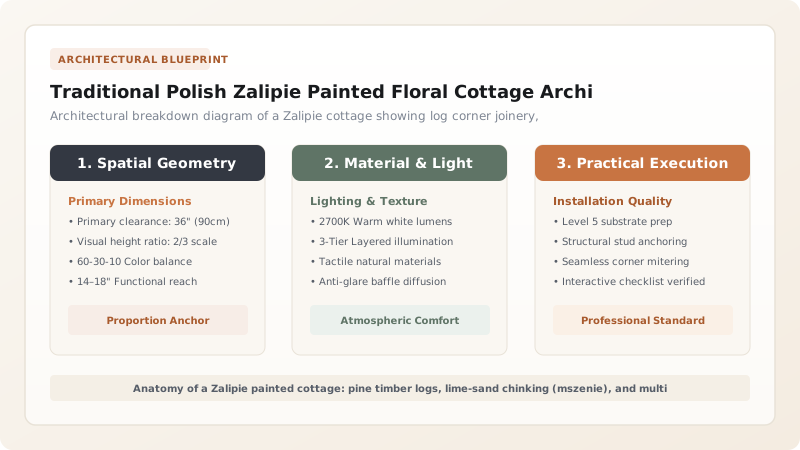
The canvas for Zalipie folk painting is not a flat industrial board, but an organic, movement-prone timber envelope. Traditional cottages were constructed using horizontal log stacking (konstrukcja zrębowa). Because logs vary in diameter and bow slightly along their length, substantial horizontal voids occur between courses. Carpenters sealed these gaps through mszenie—tightly hammering dried wetland moss, flax tow, and wood shavings into the seams, followed by a bevel-faced paring of lime, river sand, and animal dung.
It is precisely these concave, light-catching chinking bands that form the primary exterior painting ground. Left in natural timber tones, the dark weathered pine logs create a rich, somber frame that makes the brilliant white lime stripes and intensely saturated floral pigments vibrate with optical energy. Master painters like Felicja Curyłowa recognized that the rhythmic horizontal banding of the log walls gave the architecture an intrinsic musicality, allowing floral vines to climb across corners, frame double-hung window casings, and crown the timber eaves.
Color Chemistry & Botanical Iconography
Authentic Zalipie decoration relies on a disciplined, highly symbolic vernacular palette rooted in rural botany. The core motif is the zalipiański bukiet (Zalipie bouquet), dominated by the field poppy (mak), cornflower (chaber), wild rose, and bellflower, woven together with spiraling tendrils, scalloped leaves, and radial fern sprays. The designs are entirely freehand; no stencils, compasses, or graphite under-drawings are permitted by village tradition, demanding exceptional spatial awareness and neuromuscular dexterity from the artist.
Historically, pigments were prepared by hand. Natural clays provided yellow ochre, raw sienna, and umber, while burnt horn and hearth soot yielded velvety blacks. Vibrant blues were achieved using laundry bluing powder (ultramarine silicate), and reds were extracted from madder root or imported minium. The binding agent was crucial: raw cow's milk skimmed of fat, beaten egg whites, or fermented rye flour sourdough provided water-resistant protein adhesives that allowed the mineral colors to bond permanently into the carbonating lime whitewash.
Preservation, Seasonal Renewal & Modern Architectural Legacy
Unlike museum paintings sealed behind climate-controlled glass, Zalipie cottage murals are living, seasonal architectural interventions. Exposed to the harsh continental winters of the Vistula River basin, exterior lime washes naturally undergo superficial chalking and hairline stress fractures. Tradition mandates an annual cycle of renewal: every spring, in the days preceding Corpus Christi (Boże Ciało), households wash down their facades and repaint faded blooms in preparation for village festivities.
Today, the annual Malowana Chata competition, inaugurated in 1948 by ethnographers to heal post-war community trauma, ensures that over thirty historic homesteads, barns, wells, and contemporary civic structures remain painted canvases. Contemporary architects and conservators study Zalipie not merely as quaint folklore, but as a masterclass in vernacular surface articulation—demonstrating how humble, non-toxic, site-sourced materials can humanize rural timber architecture and forge indestructible cultural identity.
Architectural Surface Treatments in Zalipie Painted Cottages
Use this reference table to calculate exact physical dimensions, ratios, and specifications before purchasing:
| Surface Substrate | Traditional Primer | Pigment Vehicle | Pattern Typology | Durability Profile |
|---|---|---|---|---|
| Exterior Log Chinking (Mszenie) | Slaked fat lime + ultramarine tint | Milk curd + boiled linseed oil | Linear vine garlands & dot clusters | 1–2 years; refreshed annually for Corpus Christi |
| Interior Bread Oven (Piec) | Dense hydraulic lime wash | Egg yolk tempera + skim milk | Large central bouquets & symmetrical wreaths | 3–5 years depending on thermal cycling |
| Exposed Pine Wall Logs | Bleached potash lye wash | Casein distemper | Scattered floral sprigs & border friezes | 5–8 years under covered eaves |
| Ceiling Joists (Sosręby) | Clear beeswax rub | Powder pigment in animal glue | Geometric star rosettes & undulating acanthus | 10–15 years in dry indoor air |
| Exterior Timber Wells & Fences | Slaked lime + common salt | Rye flour paste + pigment oxides | High-contrast folk botanicals | 1 year; exposed directly to seasonal driving rain |
Practical Constraints
Every successful decoration project must account for physical and environmental constraints:
Extreme continental freeze-thaw cycles in southeastern Poland
Exposed exterior murals suffer hairline fracture cracking and pigment erosion during winter frost Mitigation: Incorporate micro-fibers into lime chinking and re-apply breathable mineral silicate consolidants each spring
Soot and thermal expansion from active wood-burning masonry stoves
Heat differentials cause fine plaster cracks and soot discoloration across painted oven blooms Mitigation: Incorporate crushed chamotte fireclay into stove plaster and paint only with heat-stable mineral oxide pigments
Execution Blueprint & Craftsmanship Sequence
Execute this professional sequence to achieve flawless results without backtracking:
Log Wall Chinking & Substrate Stabilisation
Pack gaps between squared pine logs tightly with dried meadow moss, wood excelsior shavings, and an elastic lime-sand mortar.
Slaked Lime Whitewash Preparation
Slake high-calcium quicklime in wooden vats for 30 days, diluting with water and adding a pinch of ultramarine blue powder to counteract yellow undertones.
Undercoat Whitewash Application
Brush three thin coats of lime whitewash across the recessed chinking seams and timber window architraves, allowing 24 hours carbonation between coats.
Handmade Brush Crafting
Harvest coarse hair from the switch of a cow's tail, bundle fibers into tapered quills, and bind securely to straight birch twigs using waxed linen thread.
Mineral Pigment & Casein Binding
Grind natural earth ochres, lampblack, cinnabar red, and chrome green powders on a stone slab, blending with skimmed milk curd binder.
Stem & Vine Structural Blocking
Stroke dark green and charcoal undulating curves freehand across the white lime base to establish structural rhythm and floral placement.
Petal Layering & Chromatic Modeling
Stamp and sweep broad vibrant petals using dense cow-tail brushes, layering crimson, cadmium yellow, and cobalt blue over dried base forms.
Dotting, Stippling & Vernacular Detailing
Apply delicate white and yellow stippled pollen dots (packi), scalloped leaf margins, and feathering to give dimensional depth to the painted blossoms.
Common Mistakes & Countermeasures
Avoid these costly errors that compromise aesthetics, ergonomics, and budget:
Applying synthetic acrylic or oil enamel paints directly over unprimed raw log chinking
Using rigid commercial nylon brushes for delicate organic petal shading
Painting over damp or green clay chinking without adequate carbonation curing
Project Execution Checklist
Track your physical progress. Checkboxes persist automatically on this device:
Frequently Asked Questions
Why did the villagers of Zalipie start painting their cottages?
The custom began in the late 19th century when homes had chimneyless wood-burning stoves (kurne chaty). Smoke poured into the main living room before slowly filtering out through attic vents, blackening interior walls and stoves with dense soot. Women began dabbing lime spots (packi) with birch twigs to cover the black stains, which gradually evolved into intricate floral bouquets and exterior murals.
How often are the painted cottages in Zalipie repainted?
Historically, cottages were freshened or completely repainted every spring ahead of the religious feast of Corpus Christi. Today, this tradition lives on through the annual 'Malowana Chata' (Painted Cottage) competition held in Zalipie the weekend after Corpus Christi, where artists restore and create new murals.
Can Zalipie floral painting techniques be applied to modern drywall or masonry?
Yes. While historically executed on log chinking and lime-plastered masonry, the technique translates seamlessly to modern drywall or lime-rendered brick provided the surface is primed with a breathable, mineral-based flat undercoat and executed with casein or silicate-compatible pigments.
What is the historical significance of Felicja Curyłowa in Zalipie?
Felicja Curyłowa (1904–1974) was a master folk painter who elevated Zalipie's domestic practice into an internationally recognized architectural art form. Her home, now a branch of the District Museum in Tarnów, is an immaculate preservation site where every interior surface, from ceiling beams to bed frames, is enveloped in folk floral murals.