Inca imperial dry-stone masonry (developed in Cusco, Sacsayhuamán, and Machu Picchu between 1438 and 1533 CE) is one of human civilization's supreme architectural feats. Built completely without lime mortar, iron tools, or draft animals, massive multi-ton blocks of igneous andesite and granite were shaped using dense hematite hammerstones, negative profile scribing, and abrasive stone scraping. Characterized by rounded 'cushioned' (pillow-faced) surface bevels, sunken hairline joints so tight that a razor blade cannot penetrate, inward seismic wall batters (3°–5°), and trapezoidal openings, Inca walls withstand catastrophic Andean earthquakes through dynamic friction dissipation.
At a Glance: Key Takeaways
- Origins & Era: Cusco & Sacred Valley, Peru (Inca Empire / Tawantinsuyu, 1438–1533 CE)
- Dominant Stone: Volcanic Andesite, Diorite & Sacred Valley White Granite
- Mortar Specification: 100% Dry-Stone (Zero mortar; mortarless friction fit)
- Surface Profile: Cushioned pillow-faced bosses with drafted border margins
- Seismic Engineering: 3°–5° Inward batter, trapezoidal apertures, dry shear dissipation
In-Depth Guides in this Directory
Explore specialized subtopic blueprints, technical dimensions, and execution checklists:
Andesite Boulder Fracturing & Hematite Hammerstone Pecking
Technical guide to quarrying volcanic andesite boulders, thermal splitting, and shaping dry-stone ashlar using dense hematite hammerstones (jiwayna).
Negative Profile Scribing & Cushioned Pillow Bevel Drafting
Technical analysis of Inca negative profile transfer, multi-angle contour scribing, and drafting cushioned pillow bevels on dry-stone blocks.
Seismic Inward Batter, Trapezoidal Apertures & Dry Shear Locking
Engineering study of Inca seismic architecture: 3–5° inward wall batter, trapezoidal doors and windows, and dry-stone shear dissipation dynamics.
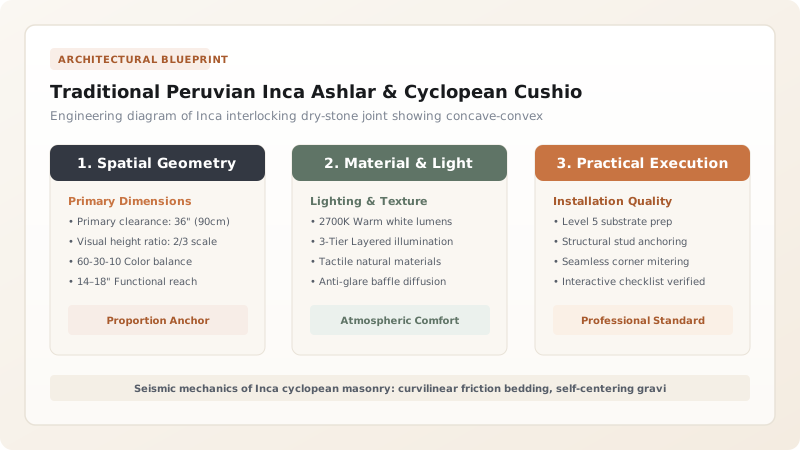
The Architectural Zenith of Tawantinsuyu
High in the seismic spine of the Peruvian Andes, the stonemasons of the Inca Empire (Tawantinsuyu) created an architectural tradition that defied the limitations of bronze-age metallurgy. Without steel chisels, wheeled carts, draft horses, or cementitious mortar, the builders of Cusco, Ollantaytambo, Sacsayhuamán, and Machu Picchu erected monumental palaces and temples from igneous rock so unyielding that modern masonry equipment struggles to cut it.
Known as Ashlar (orthogonal rectangular blocks) and Cyclopean Polygonal Masonry (irregular multi-angled interlocking monoliths weighing up to 120 tons), these walls fit together with microscopic precision. Centuries of catastrophic Andean earthquakes—which repeatedly brought Spanish colonial cathedrals and concrete structures crashing to the ground—have left the underlying Inca foundations completely undamaged.
The Lithic Technology: Hematite Hammers and LLamp'u Abrasives
For centuries, romantic myths suggested that the Incas possessed mysterious stone-softening plant extracts or extraterrestrial laser cutting. Rigorous experimental archaeology by modern lithic scholars (notably Jean-Pierre Protzen) has debunked these fables, revealing an astonishing mastery of percussion mechanics and petrology.
Inca quarry workers exploited natural rift planes in volcanic andesite and granite using fire-setting, wooden expansion wedges soaked in water, and heavy diorite drop-balls. The blocks were shaped entirely through progressive percussion with dense river cobbles made of hematite, olivine basalt, and diorite (termed jiwayna), weighing from 1 kg to 10 kg. A worker wielding a 5-kg hematite hammerstone strikes the stone with controlled glancing blows, crushing the feldspar and pyroxene crystals into fine powder. Finishing was achieved by rubbing joint faces with quartzite sand slurries (llamp'u), creating complementary mating surfaces accurate to fractions of a millimeter.
The Anatomy of Cushioned Pillow Bevels and Drafted Margins
The visual hallmark of imperial Inca masonry is the cushioned or pillow-faced block (almohadillado). Each block does not possess a flat planar face; instead, its center swells outward in a gentle organic dome, while its peripheral perimeter drops into a meticulously sunken, chamfered bevel margin.
This detailing served both functional and aesthetic imperatives. Visually, the recessed margins emphasize the interlocking geometry of the wall, casting crisp horizontal and vertical shadow lines under the intense Andean sun. Structurally, chamfering the block edges prevents the brittle stone lips from point-loading and spalling off during severe earthquake ground shaking, protecting the internal bearing surfaces from crushing.
Seismic Resilience: The Dynamic Dry-Friction Organism
Modern reinforced concrete relies on rigid strength to resist ground acceleration; when lateral shear stresses exceed tensile yield strength, concrete fractures catastrophically. The Incas engineered an entirely different paradigm: dynamic seismic isolation through dry friction dissipation.
Because the multi-ton blocks are un-mortared, they are free to move independently during an earthquake. When ground shockwaves strike, the interlocking blocks 'dance'—sliding infinitesimally along curved concave-convex bedding planes, absorbing and dissipating seismic kinetic energy through frictional resistance. Because the walls are built with a pronounced inward batter (tilting inward 3° to 5°) and trapezoidal openings, gravity acts as a perpetual self-centering restoring force, pulling every stone back into its original seat once tremors subside.
Inca Stone Masonry Typologies: Imperial Sedimentary vs Polygonal vs Cellular
Use this reference table to calculate exact physical dimensions, ratios, and specifications before purchasing:
| Masonry Classification | Block Geometry | Joint Precision | Tooling / Surface Finish | Typical Building Context |
|---|---|---|---|---|
| Imperial Ashlar (Sedimentary Style) | Uniform orthogonal rectangular courses | Absolute hairline fit (< 0.1 mm) | Smooth flat or subtle pillow boss with drafted margins | Sun Temple (Qorikancha), Acllahuasi, Royal Palaces |
| Cyclopean Polygonal (Sacsayhuamán) | Monumental multi-angled blocks (up to 12-sided) | Seamless interlocking curvilinear joints | Heavy cushioned pillow faces with lifting protrusions | Fortress bastions, terrace retaining walls, military gates |
| Cellular Polygonal (Pirca) | Medium irregular polygons, roughly squared | Tight dry joints; minor small stone packing | Hammer-pecked faces without drafted margins | Elite residences, secondary storehouses (qullqas) |
| Fieldstone Rubble (Rústico) | Unworked irregular stones bedded in clay mortar | Loose mortar joints (chinked with mud) | Natural rough boulders without dressing | Common farming dwellings, agricultural perimeter walls |
Practical Constraints
Every successful decoration project must account for physical and environmental constraints:
Extreme Weight of Cyclopean Andesite Monoliths
Single stones at Sacsayhuamán weigh between 20 and 120 metric tons Mitigation: Shape lifting lugs (bosses) directly into stone faces for lever attachment, utilizing earthen inclined ramps for staged raising
Extensive Labor Intensity for Trial-and-Error Joint Fitting
A single complex polygonal joint requires 5 to 10 trial liftings and lowerings for profile refinement Mitigation: Employ anathyrosis technique: hollow the central joint floor so only outer 50-mm margins require precision contact
Execution Blueprint & Craftsmanship Sequence
Execute this professional sequence to achieve flawless results without backtracking:
Quarry Sourcing and Natural Rift Splitting
Select sound volcanic andesite or granite from high quarries (e.g., Rumiqolqa or Cachiccata). Split blocks along natural mineral cleavage using wooden wetting wedges.
Transportation on Timber Rollers and Earthen Ramps
Drag multi-ton rough blocks over earthen transport ramps to the construction site using braided llama-wool cables and hardwood rollers pulled by teams of workers.
Foundation Bedding and Inward Batter Layout
Excavate to bedrock. Chisel level foundation sockets directly into living rock, establishing a 3° to 5° inward wall batter angle.
Primary Hammerstone Pecking (Jiwayna Dressing)
Rough-dress the block faces and sides using heavy 8-kg diorite hammerstones, striking at 45° angles to pulverize stone crystals down to general dimensions.
Negative Profile Scribing and Trial Lowering
Hoist the block over its seat. Scribe the contour of the underlying stone onto the upper block face using clay mud paste or bronze scribe calipers.
Concave-Convex Bedding and Pocket Hollowing
Peck the bedding joint with light 1-kg hematite hammers, creating a subtle concave-convex depression (anathyrosis) where only perimeter margins carry contact load.
Cushioned Pillow Margin Drafting
Peck a continuous 20-mm wide sunken border around each block face at a 30° bevel, leaving the central body protruding in an organic pillow curve.
Quartz Abrasive Lapping and Final Seating
Pour wet quartz sand slurry into the joint. Lower the block home and drag back and forth slightly to lap mating surfaces into airtight dry contact.
Common Mistakes & Countermeasures
Avoid these costly errors that compromise aesthetics, ergonomics, and budget:
Attempting to cut andesite with standard modern carbon steel chisels
Using lime or cement mortar between Inca-style interlocking blocks
Constructing vertical 90° walls instead of introducing an inward seismic batter
Project Execution Checklist
Track your physical progress. Checkboxes persist automatically on this device:
Frequently Asked Questions
Why did the Incas build without mortar?
In a severe earthquake zone like the Andes, rigid mortar cracks and crumbles, leading to sudden wall collapse. Dry-stone construction allows the blocks to move, dissipate energy, and settle back together unharmed. Furthermore, the Incas possessed the craftsmanship to achieve joint tolerances so tight that mortar was unnecessary.
What are the small rectangular protrusions seen on some Inca blocks?
These are lifting lugs or transport bosses. They were left on the stone during quarrying to provide purchase points for levers, ropes, and timber cribbing. After final placement, most bosses were pecked off flush, but some were intentionally left as decorative or symbolic elements.
How did the Incas transport massive stones weighing up to 100 tons?
Through massive organized communal labor (the Mita system). Stones were dragged down mountain slopes and across rivers over packed earthen ramps using thousands of men pulling thick braided ropes, utilizing gravel slip-ways, hardwood rollers, and wooden lever fulcrums.
Can modern stonemasons replicate Inca dry joints today?
Yes. Modern stonemasons using traditional hammerstones and diamond grinding tools can replicate the exact joints. Experimental archaeologists have demonstrated that a single skilled worker using diorite hammerstones can dress and seat a 1-ton block in approximately two to three weeks of steady work.