
Constructing Karbandi arch ribs without wooden falsework represents one of the greatest feats of traditional Persian masonry engineering. Masons utilize square, thin kiln-fired bricks (khesht-e pokhteh) laid on edge, bonded with 'Gach-e Zendeh'—an unretarded fast-setting alabaster gypsum mortar that hardens within two minutes. By cantilevering bricks into open space and using rapid chemical crystallization to resist gravitational shear, master masons spring diagonal arch ribs across spans exceeding 12 meters entirely freehand.
At a Glance: Key Takeaways
- Brick Format: Traditional square yellow clay brick (200 × 200 × 35–40mm)
- Centering Support: Zero timber formwork; pure cantilever adhesion
- Mortar Chemistry: Pure calcined calcium sulfate hemihydrate (CaSO4 · 0.5 H2O)
- Set Time Window: 120 to 180 seconds from water contact
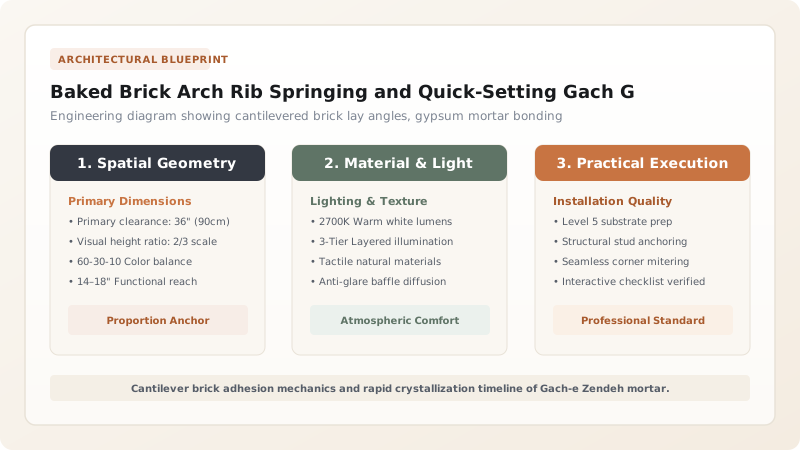
Persian Kiln-Fired Brick (Khesht-e Pokhteh) Specifications
Unlike thick modern modular bricks, traditional Persian architectural bricks (khesht-e pokhteh or aajor-e nezami) are thin, broad, and square (typically 200mm × 200mm × 35mm). Sourced from alluvial clay beds in Varamin or Yazd, the clay is thoroughly washed to remove destructive sulfate salts.
Fired in traditional wood or oil kilns (koureh-ye aajor-pazi) at 1000°C, the bricks vitrify into a warm pale-yellow or buff-ochre stone. Their high surface porosity (12% to 16% water absorption) is intentional: it allows dry bricks to absorb water instantaneously from wet gypsum paste, creating a powerful capillary suction lock within seconds of contact.
Gach-e Zendeh: Chemical Crystallization and Rapid Set Kinetics
In standard building trades, gypsum plaster is considered a finishing material. In Persian architecture, it is a primary structural mortar. Pure alabaster rock (CaSO4 · 2 H2O) is calcined in kiln pits at 150°C to drive off three-quarters of its chemically combined water, yielding dry bassanite (hemihydrate).
When mixed with water in small rubber bowls, Gach-e Zendeh (living gypsum) undergoes rapid, violent re-crystallization back into interlocking needle-like gypsum dihydrate crystals. The reaction is strongly exothermic, heating the mortar in the mason’s hand. Within 90 to 150 seconds, the paste transforms from a liquid cream into a rigid structural stone capable of bearing tensile shear stresses.
Freehand Cantilever Springing Mechanics (Bedoon-e Ghaleb)
To spring an arch rib into open air, the mason begins at the wall-mounted Pa-kar footing. The mason scoops a dollop of Gach-e Zendeh onto the brick edge and presses it against the previous brick, angling the unit slightly back toward the springing point.
The mason holds the brick immobile with hand pressure for roughly 60 seconds. As the exothermic gypsum reaction peaks, the mortar achieves immediate adhesive strength. The mason releases the brick, which hangs unsupported in space. Repeating this sequence from opposing springing points, two parabolic brick cantilevers climb toward the vault center until meeting at the crown key brick (kelid-e tooyzeh).
Shear Transfer at Sar-Kar Intersections and Seismic Consolidation
Where two arch ribs cross at a Sar-kar node, bricks must be carefully notched or cross-lapped using specialized brick chisels. Masons pack the junction with high-density gypsum mortar reinforced with chopped flax fibers or goat hair to absorb dynamic shear stresses.
Because gypsum is water-soluble, historic Karbandi vaults must be strictly protected from roof leaks. If water penetrates the outer dome shell, gypsum mortar dissolves, causing instant catastrophic de-bonding. Conservation protocols mandate hydrophobic clay-straw (kahgel) waterproofing or lead-sheet flashing across exterior vault surfaces.
Gach Mortar Mix & Setting Parameter Specifications
Use this reference table to calculate exact physical dimensions, ratios, and specifications before purchasing:
| Mortar Grade | Water-to-Plaster Ratio | Initial Set Time | Compressive Strength (24h) | Structural Application |
|---|---|---|---|---|
| Gach-e Zendeh (Fast Set) | 0.65 : 1.0 by weight | 90 – 150 seconds | 8.5 MPa | Freehand cantilever arch rib erection |
| Gach-e Koshteh (Deadened) | 1.0 : 1.0 (mechanically worked) | 30 – 45 minutes | 3.0 MPa | Ultra-smooth finish plastering & tooling |
| Gach-o-Khak (Plaster & Earth) | 1 Part Gach : 1 Part Sifted Loam | 5 – 8 minutes | 5.2 MPa | Internal Shaprak vault infill masonry |
| Gach-o-Kaf (Fiber-Reinforced) | Gach + 1% flax fiber / goat hair | 3 – 5 minutes | 10.0 MPa | Sar-kar node intersections & key joints |
Practical Constraints
Every successful decoration project must account for physical and environmental constraints:
Vulnerability of Gypsum Mortar to Roof Infiltration
A single persistent rainwater leak can dissolve load-bearing Gach mortar joints, triggering sudden localized vault collapse.
Intense Physical Demands on the Master Mason
Freehand cantilever laying requires continuous overhead work with non-stop mixing and rapid holding, limiting daily output to 1–2 arches.
Execution Blueprint & Craftsmanship Sequence
Execute this professional sequence to achieve flawless results without backtracking:
Brick Quality and Water Absorption Inspection
Inspect yellow baked bricks for sound ringing tone and dimensional squareness; clean surface dust without soaking in water.
Pa-Kar Base Bedding and Springing Angle
Establish the masonry springing plinth on the wall plate, laying the first course of starter bricks at the calculated Panj-o-Haft springing inclination.
Small-Batch Gach-e Zendeh Mixing
Sprinkle fine gypsum plaster over clean well water in a flexible rubber bowl; stir rapidly for 15 seconds to achieve lump-free creamy consistency.
Cantilever Brick Setting and Hand Hold
Apply a 5mm mortar bed to the brick face; press firmly against the cantilevered arch end, holding rigidly with hand pressure for 60 seconds.
Opposing Arch Progression and Sar-Kar Lap
Advance arch ribs symmetrically from both sides, notching bricks at Sar-kar intersection nodes and packing with fiber-reinforced gypsum.
Crown Keying and Joint Dressing
Drive a tapered key brick into the vault crown ring; dress exposed joint margins flush and scrape away excess set gypsum before hardening.
Common Mistakes & Countermeasures
Avoid these costly errors that compromise aesthetics, ergonomics, and budget:
Re-Tempering or Adding Water to Stiffening Gach Mortar
Pre-Soaking Bricks in Water Before Gypsum Laying
Project Execution Checklist
Track your physical progress. Checkboxes persist automatically on this device:
Frequently Asked Questions
Why don't Persian masons soak bricks in water before laying with gypsum?
Unlike cement or lime mortars which require saturated bricks to avoid losing hydration water, fast-setting gypsum relies on immediate capillary suction to draw water out of the paste, initiating hyper-rapid crystallization that locks the brick in place instantly.
How large of a span can be vaulted using freehand brick and gypsum ribs?
Historic Iranian masters constructed Karbandi ribs spanning 12 to 16 meters across bazaar intersections and mosque sanctuaries without any timber centering, relying purely on the rapid setting of Gach and parabolic arch geometry.


