Mosaic faience (kashi-ye mo’arraq) is the pinnacle of Persian architectural ceramics, reaching its zenith during the Timurid and Safavid periods. Monochrome glazed earthenware tiles are hand-chipped into thousands of curved petal-shaped tesserae using a sharp tisheh hammer, with edges beveled to 45° so backing mortar locks them firmly. Assembled face-down over full-scale paper cartoons, these prefabricated panels project 2D girih geometries onto 3D doubly-curved muqarnas squinches and dome shells.
At a Glance: Key Takeaways
- Ceramic Technique: Kashi-ye Mo’arraq: Hand-cut monochrome mosaic faience tesserae
- Cutting Tool: Tisheh: Sharp double-beveled iron chipping hammer on a wooden anvil
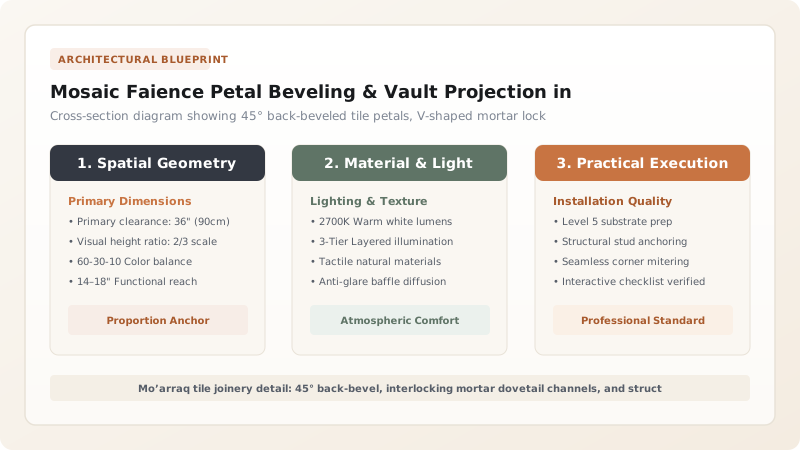
- Edge Bevel Angle: 45° reverse chamfer toward the tile back to provide mortar anchoring
- Assembly System: Reverse face-down paper cartoon assembly backed with gypsum mortar
- Projection Canvas: Doubly-curved muqarnas corbels, pendentive squinches, & domes
The Jewel of Safavid Architecture: Kashi-ye Mo’arraq
If carved stucco represents the architectural spirit of medieval Seljuk Iran, kashi-ye mo’arraq (mosaic faience) is the crowning glory of the Timurid and Safavid golden ages. Developed to its absolute zenith under Shah Abbas I in seventeenth-century Isfahan, mo’arraq transformed the massive, earth-toned brick masses of imperial mosques into shimmering, jewel-encrusted celestial visions.
Unlike ordinary tilework, where designs are painted onto square commercial tiles with glazes that run during firing, mo’arraq is true ceramic marquetry. Thousands of individually fired monochrome tiles—possessing the purest, saturated hues of Persian turquoise, cobalt blue, saffron yellow, milk white, and aubergine black—were hand-cut into microscopic curved polygons and assembled into vast architectural jigsaw puzzles covering entire dome shells and vaulted iwans.
Tooling and Kinetics: The Tisheh Hammer and 45° Back-Beveling
The shaping of mo’arraq tesserae is an extraordinary exhibition of motor skill and material physics. The primary tool is the tisheh—a double-headed forged iron hammer with razor-sharp, tempered chisel ends, mounted on a short wooden haft. The artisan rests the fired tile atop a cylindrical anvil block of dense hornbeam or walnut wood (kandeh).
Holding the tile with his left hand, the craftsman strikes with rapid, percussive glancing blows. Crucially, he cuts with a 45-degree reverse bevel (pakh-kardan). The front glazed edge of the tile is kept razor-sharp and vertical, while the unglazed terracotta body on the reverse is chiseled away at a steep inward slope. This back-bevel serves two critical functions: it allows the fragile surface glazes to butt tightly against one another on the front with hairline 1 mm seams, and it creates deep, V-shaped channels on the reverse into which backing mortar can flow, forming an unbreakable mechanical dovetail lock.
The Reverse Face-Down Paper Assembly Technique
Monumental mosaic domes were not assembled tile-by-tile on scaffolding high in the air. Instead, master builders developed an ingenious prefabricated reverse assembly technique. Master draftsmen drew the complete girih composition at 1:1 scale on heavy sheets of paper laid out on the workshop floor.
The thousands of hand-beveled tile petals were then placed glazed-face down over the paper drawing, fitting them together with puzzle-like precision. Once an entire section was assembled face-down, artisans poured a 30-millimeter layer of slow-setting gypsum-lime mortar over the exposed, beveled backs of the tiles. Bundles of flexible willow twigs, split reeds, and galvanized iron anchor hooks were embedded into the wet mortar bed. When the mortar hardened, the paper was peeled off the front using warm water, revealing an immaculate, monolithic mosaic slab ready to be hoisted into place.
Projecting 2D Girih onto 3D Spherical Domes and Muqarnas Vaults
The ultimate test of the master tilemaker was spherical projection. A decagonal girih pattern constructed on a flat sheet of paper cannot simply be wrapped around a hemispherical dome or a doubly-curved stalactite (muqarnas) vault without severe geometric tearing and distortion.
Persian architects resolved this through sophisticated three-dimensional trigonometric adjustments. For spherical domes, the composition was mapped into curved vertical segments (gores), wherein the edge lengths of the decagonal girih tiles were progressively tapered as they approached the apex of the dome, compensating for spherical convergence. For muqarnas corbels, the complex 3D facets were decomposed into flat planar modules (such as the shamsah, tas, and biped corbel units), allowing flat girih mosaics to flow seamlessly across undulating three-dimensional vaults, uniting mathematics, ceramics, and architecture in divine harmony.
Persian Architectural Ceramic Typologies: Mo’arraq vs Haft-Rangi
Use this reference table to calculate exact physical dimensions, ratios, and specifications before purchasing:
| Ceramic Typology | Manufacturing Process | Color Brilliance & Purity | Curved Vault Suitability | Labor & Cost Index |
|---|---|---|---|---|
| Kashi-ye Mo’arraq (Mosaic Faience) | Monochrome tiles hand-cut & beveled into tesserae | Maximum (Purest individual mineral glazes) | Exceptional (Follows complex 3D muqarnas) | Extremely High (Months of manual chipping) |
| Haft-Rangi (Seven-Color Painted) | Polychrome designs painted on square tiles | Moderate (Glazes blend/run at borders) | Moderate (Requires stepped square facets) | Moderate (Rapid mass production) |
| Cuerda Seca (Dry-Cord Glaze) | Manganese wax lines prevent glaze mixing | High (Vivid, crisp glaze boundaries) | Moderate (Limited to planar/faceted walls) | High (Requires precise hand painting) |
| Banna’i (Glazed Brickwork) | Standard glazed bricks laid in masonry bonds | High saturation; bold graphic impact | Low (Strictly rectilinear facades) | Low to Moderate (Standard bricklaying) |
Practical Constraints
Every successful decoration project must account for physical and environmental constraints:
High Shear Stress from Gravitational Inversion on Vault Soffits
Multi-ton ceramic mosaic panels hung on ceiling vaults risk catastrophic detachment and crushing failure. Mitigation: Incorporate bent iron anchor ties (galvanized hooks) embedded directly into the backing mortar and brick ribs.
Lead and Copper Toxicity in Traditional Low-Temperature Glaze Slurries
Ceramic artisans face severe heavy-metal poisoning risks during glaze preparation and kiln firing. Mitigation: Enforce modern enclosed wet-grinding mills and operate kilns with external downdraft exhaust scrubbers.
Execution Blueprint & Craftsmanship Sequence
Execute this professional sequence to achieve flawless results without backtracking:
Monochrome Tile Production
Cast high-quartz terracotta tiles; apply single-color mineral glazes (cobalt blue, turquoise, saffron yellow, manganese black) and fire at 980°C.
Full-Scale Cartoon Drafting
Draft the girih composition at 1:1 scale on heavy paper; duplicate the drawing onto multiple sheets to serve as cutting templates (tarh).
Template Pasting and Glaze Scoring
Paste paper pattern shapes onto glazed tiles with water-soluble starch glue; score the glaze along paper contours with a diamond-tipped stylus.
Tisheh Hammer Chipping
Rest the tile on a hornbeam wooden anvil (kandeh); strike along scored lines with the chisel-headed tisheh hammer to fracture out the precise petal.
Back-Beveling (Pakh-Kardan)
Using the chisel face of the tisheh or a carborundum rasp, bevel the unglazed ceramic backing at 45° inward, leaving a razor-sharp glaze rim.
Reverse Face-Down Mosaic Layup
Lay the beveled ceramic petals glazed-face down over the master paper cartoon laid inside a curved plaster mold matching the vault contour.
Reinforced Mortar Backing Pour
Pour a 30 mm layer of slaked gypsum-lime mortar over the beveled tile backs, embedding willow laths and bent copper anchor wires into the slurry.
Vault Hoisting and Grouting
Once cured, peel away the front paper template with warm water; hoist prefabricated panels into the vault, tying anchor wires to structural brick ribs.
Common Mistakes & Countermeasures
Avoid these costly errors that compromise aesthetics, ergonomics, and budget:
Chipping tiles from the front glazed face downward with the hammer
Failing to back-bevel tile edges, leaving square 90° edges on tesserae
Projecting flat 2D girih cartoons directly onto 3D spherical vaults without curvature compensation
Project Execution Checklist
Track your physical progress. Checkboxes persist automatically on this device:
Frequently Asked Questions
Why is Kashi-ye Mo’arraq superior in color to painted tiles?
In painted polychrome tiles (Haft-Rangi), all seven colors must be fired together at a single compromises firing temperature, which causes certain colors to run or fade. In Mo’arraq, each color is fired on its own monochrome tile at its optimal temperature, resulting in pure, jewel-like chromatic brilliance.
What is a "Tisheh" and how does the tilemaker use it?
A tisheh is a specialized double-headed iron chipping hammer with sharp chisel edges. Resting the glazed tile on a hardwood block, the craftsman strikes with rapid, glancing blows from the unglazed underside, using the natural cleaving fracture of the clay body to cut curved petals without cracking the tile.
How are flat 2D Girih patterns projected onto 3D curved Muqarnas vaults?
Craftsmen utilize an architectural projection system where the 3D muqarnas vault is broken down into planar facets (biped, jug, and almond-shaped corbels). The 2D girih decagonal grid is mapped onto these faceted modules so that when the 3D corbels are assembled, the strapwork lines align across the curved surface.