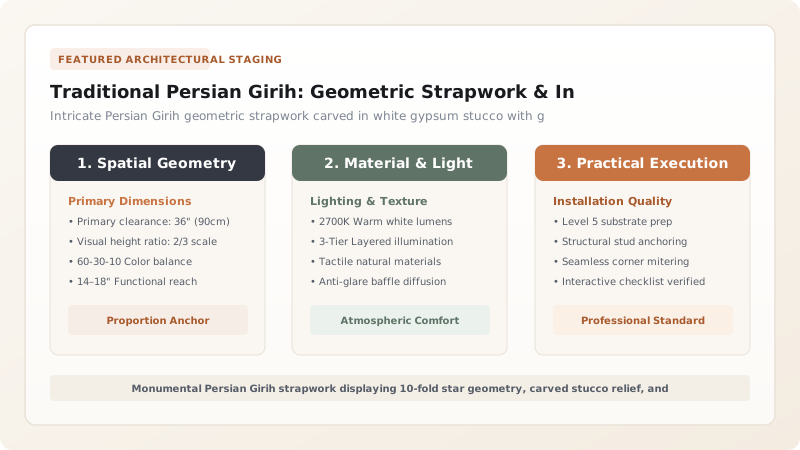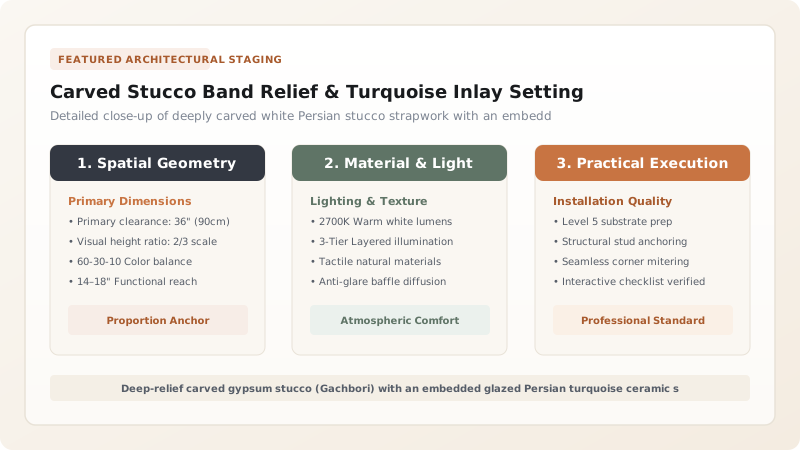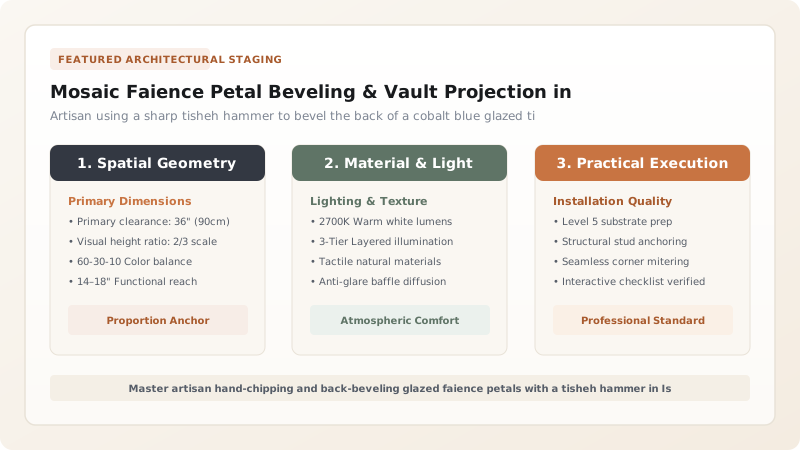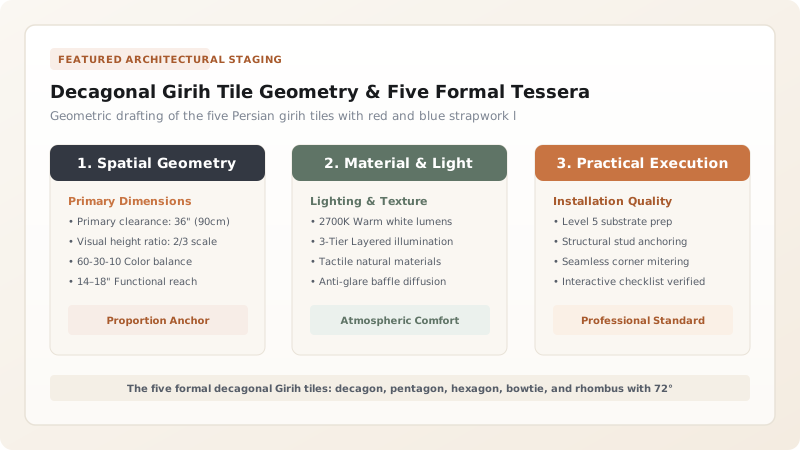
Decagonal Girih tile geometry is a modular design toolkit consisting of five formal polygons: regular decagon, elongated hexagon, bowtie (non-convex hexagon), rhombus, and regular pentagon. Every tile features pre-inscribed internal strapwork lines that cross each edge at precisely 72° at its midpoint. When tiled edge-to-edge without gaps, these tiles automatically generate complex, continuous quasi-crystalline strapwork networks with 10-fold and 20-fold symmetry.
At a Glance: Key Takeaways
- The Five Tiles: Regular Decagon, Pentagon, Elongated Hexagon, Bowtie, & Rhombus
- Intersection Rule: Strapwork lines cross every edge at exactly 72° at the midpoint
- Rotational Symmetry: 10-Fold (36° fundamental sector) & 20-Fold Star Symmetries
- Mathematical Class: Quasi-Crystalline Penrose-Type Tessellation (Self-Similar fractals)
- Historic Documentation: Topkapı Scroll (Istanbul) & Mirza Akbar Architectural Scrolls
The Decagonal Revolution in Medieval Islamic Mathematics
For centuries, the geometric ornamentation of early Islamic architecture—such as Umayyad mosaics in Damascus and Abbasid plasterwork in Samarra—relied primarily on four-fold and six-fold symmetries derived from simple square and hexagonal grids. By the early eleventh century in Iran, however, an intellectual leap occurred: the introduction of decagonal geometry based on ten-fold rotational symmetry (angles of 36°, 72°, 108°, and 144°).
Because regular decagons and pentagons cannot tile the two-dimensional Euclidean plane alone without leaving gaps, early draftsmen struggled to extend ten-fold stars across broad surfaces. The breakthrough came when Persian mathematician-architects realized that by combining the regular decagon with four other specific non-regular polygons, the plane could be covered completely. This marked the birth of the five formal girih tiles.
Anatomy of the Five Formal Tiles
The toolkit discovered by modern physicists Lu and Steinhardt in 2007 consists of exactly five modular polygons. Crucially, all five tiles share identical edge lengths, allowing them to interlock seamlessly like a geometric puzzle:
- The Regular Decagon: A 10-sided polygon with internal angles of 144°, containing a central 10-pointed star with radiating strapwork spokes.
- The Elongated Hexagon: A 6-sided polygon with bilateral symmetry, featuring internal angles of 72°, 144°, 144°, 72°, 144°, and 144°.
- The Bowtie: A non-convex 6-sided polygon with two reflex angles of 216° and four angles of 72°.
- The Rhombus: An equilateral parallelogram with two acute angles of 72° and two obtuse angles of 108°.
- The Regular Pentagon: A 5-sided polygon with internal angles of 108°, containing a central 5-pointed star.
The 72° Strapwork Rule: Mechanics of Seamless Interlace
The true genius of the girih tile system is that the tiles themselves were merely a temporary scaffolding. The final visible design was not the tiles, but the internal strapwork lines pre-drawn across their faces. Master builders inscribed these lines according to a rigid, inviolable geometric law: every tile edge must be crossed by two strapwork lines that intersect the edge at exactly 72° at its midpoint.
Because every tile shares identical edge lengths and identical 72° crossing angles, when any two tiles are mated edge-to-edge, their internal strapwork lines meet with absolute mathematical precision. The artisan did not need to calculate complex curves across a 30-meter wall; simply by packing the five tiles across the surface and tracing their internal lines, a continuous, flawless web of interlacing straps emerged automatically, requiring zero guesswork.
Fractal Deflation and Quasi-Crystalline Self-Similarity
On monumental imperial architecture—such as the Darb-i Imam shrine in Isfahan (1453 AD)—Persian architects achieved a level of geometric sophistication that astonishes modern crystallographers: fractal deflation. Architects did not merely tile the surface with a single scale of tiles; they subdivided large "mother" tiles into smaller "child" tiles of the exact same five shapes.
This deflation process generated a two-level, self-similar hierarchical pattern: a macro-girih pattern visible from a distance of 100 meters, which dissolved upon close inspection into a micro-girih pattern of identical mathematical structure. This arrangement satisfies the mathematical definition of a quasi-crystal: a pattern that is ordered and self-similar, possessing 10-fold rotational symmetry, yet completely non-periodic (never repeating identically across the infinite plane). Persian builders perfected this order five hundred years before Western science formulated the concept.
The Five Formal Girih Tiles and Their Geometric Properties
Use this reference table to calculate exact physical dimensions, ratios, and specifications before purchasing:
| Tile Name | Polygon Geometry | Internal Angles | Number of Edges | Internal Strapwork Motif |
|---|---|---|---|---|
| Decagon (Dah-Zeli) | Regular 10-sided polygon | 144° at all 10 vertices | 10 edges | Central 10-pointed star with radiating spokes |
| Elongated Hexagon (Shish-Zeli) | Hexagon with 4 long & 2 short symmetry | Two 72° and four 144° angles | 6 edges | Central elongated 6-point star motif |
| Bowtie (Papiyon) | Non-convex 6-sided polygon | Two 72°, two 216°, and two 72° | 6 edges | Two opposing nodal crosses |
| Rhombus (Lozi) | Equilateral 4-sided rhombus | Two 72° and two 108° angles | 4 edges | Central 4-point diamond strapwork |
| Pentagon (Panj-Zeli) | Regular 5-sided polygon | 108° at all 5 vertices | 5 edges | Central 5-pointed star motif |
Practical Constraints
Every successful decoration project must account for physical and environmental constraints:
Accumulation of Fractional Scribing Errors Across Large Dome Shells
A microscopic 0.2° error in decagon drafting compounds across 50 meters into a massive multi-foot pattern collision. Mitigation: Establish macro-radial structural reference chords before laying individual ceramic or plaster tiles.
Visual Illegibility of Complex Geometries When Scaled Down Excessively
Packing miniature girih tiles onto small panels creates visual clutter where ribbons blur together. Mitigation: Scale tile edge lengths to a minimum of 80 mm for stucco relief and 40 mm for mosaic faience.
Execution Blueprint & Craftsmanship Sequence
Execute this professional sequence to achieve flawless results without backtracking:
Golden Ratio Base Construction
Construct a golden ratio (Phi = 1.618) proportioned triangle using a beam compass to generate a regular decagon circle division.
The Decagon Prototype Layout
Inscribe a regular 10-sided decagon; verify that all internal angles measure 144° and all edge lengths are congruent.
Strapwork Rule Inscription
Draw internal strapwork lines crossing each edge at its exact midpoint at an angle of 72°, forming a concentric 10-point star inside the decagon.
Deriving the Companion Four Tiles
Construct the pentagon, elongated hexagon, bowtie, and rhombus by extracting geometric intersections from the master decagonal star grid.
Tessellation Assembly Planning
Lay out full-scale paper copies of the five tiles across the architectural surface, fitting them together tightly like jigsaw pieces without gaps.
Fractal Deflation (Multi-Scale Girih)
Subdivide large mother tiles into miniature child tiles according to Islamic fractal deflation rules to create nested levels of detail.
Strapwork Path Tracing
Trace only the continuous internal lines of the assembled tiles, ignoring the outer polygon borders of the tiles themselves.
Over-and-Under Interlace Weaving
Assign alternating over-and-under crossings to every ribbon intersection, converting the 2D geometric grid into an undulating woven strapwork.
Common Mistakes & Countermeasures
Avoid these costly errors that compromise aesthetics, ergonomics, and budget:
Altering the edge lengths between different girih tile types in the same composition
Drawing internal strapwork lines at arbitrary angles rather than precisely 72°
Assuming girih is simply periodic wallpaper repeating on a square or hexagonal lattice
Project Execution Checklist
Track your physical progress. Checkboxes persist automatically on this device:
Frequently Asked Questions
Why is the angle 72° fundamental to all Girih tiles?
In a regular decagon (10-sided polygon), the central angle of each sector is 360° / 10 = 36°. The exterior angle is 36°, and its supplementary interior angle is 144°. The strapwork lines bisect these angles at precisely 72° (half of 144°), ensuring that when any two tiles are placed edge-to-edge, their internal lines meet seamlessly at identical angles.
Did medieval Persian architects understand quasi-crystals?
Medieval master builders did not describe quasi-crystals in modern mathematical physics terminology, but they possessed a profound practical understanding of self-similar, non-periodic tiling systems. By utilizing the five girih tiles and deflation rules, they constructed infinite, non-repeating tilings with 10-fold symmetry that adhere to modern quasi-crystalline physics.
What is the Topkapı Scroll?
The Topkapı Scroll (Topkapı Parşömeni) is a late 15th-century Timurid architectural scroll preserved in the Topkapı Palace Library in Istanbul. Measuring nearly 30 meters in length, it is an invaluable master pattern book containing 114 individual geometric drawings used by Persian and Ottoman architects to construct girih and muqarnas vaults.