The crystalline depth and extraordinary weather durability of Ottoman Iznik architectural tiles are achieved through their specialized lead-alkaline transparent glaze and wood-fired updraft kiln cycle. Formulated from high-refractive lead oxide (minium), powdered quartz, and soda/potash flux, the glaze melts at 900°C to 940°C into an ultra-brilliant, crystal-clear glass that magnifies underglaze mineral pigments without milkiness. Stacked vertically inside protective refractory saggars and fired with resinous mountain pine over 24 hours followed by three days of sealed cooling, the tiles achieve exceptional thermal shock resistance that resists centuries of thermal cycling and humidity shifts.
At a Glance: Key Takeaways
- Glaze Typology: Transparent high-lead alkaline glass glaze (high refractive index n ≈ 1.60)
- Flux Chemistry: Red lead oxide (Pb3O4 / minium) + potassium carbonate from plant ash
- Firing Temperature: 900°C to 940°C (Cone 010–08) in wood-fired updraft kilns (fırın)
- Kiln Fuel: Seasoned dry mountain pine wood (Pinus brutia / Karaçam)
- Thermal Durability: Immune to moisture crazing; 500+ years of indoor/outdoor architectural service
The Glass Alchemy of the Ottoman Lead-Alkaline Glaze
The ultimate visual glory of an Iznik architectural tile—that diamond-bright, liquid depth that makes viewers feel they are peering into a pool of still water over an enchanted garden—is the direct result of its lead-alkaline glaze formulation. In ceramic physics, a glaze is not a surface paint; it is an amorphous silica glass fused to a ceramic substrate.
Iznik potters rejected the opaque white tin glazes used in Persian and European maiolica, recognizing that tin oxide particles scatter light and create a milky, cloudy veil that deadens underglaze brushwork. Instead, Iznik chemists formulated a crystal-clear glaze composed of 60% to 65% red lead oxide (minium, Pb3O4), combined with powdered quartz silica and potassium carbonate flux. Lead oxide imparts a remarkably high refractive index (n ≈ 1.60), mimicking the optical properties of fine cut crystal glass, bending and magnifying the underlying mineral pigments with dazzling optical depth.
The Wood-Fired Updraft Kiln: Fırın Architecture
Firing an Iznik tile was a monumental logistical and pyrotechnical undertaking. Historic Iznik kilns (fırın) were multi-chambered, wood-fired updraft structures constructed from refractory brick, featuring a lower combustion chamber and an upper domed firing chamber measuring up to four meters in diameter.
Fuel selection was strictly governed by imperial decree: potters burned exclusively seasoned, bone-dry Anatolian red pine (Pinus brutia). Hardwoods like oak produce short, intensely hot coals with heavy smoke, whereas resinous pine burns with long, billowing, luminous flames that circulate smoothly through the upper chamber, providing uniform radiant heat. Stoking was an art requiring constant vigilance: over twenty-four hours, stokers maintained an intensely oxidizing atmosphere with excess oxygen, preventing combustion smoke from reducing iron-reds into black or clouding transparent glazes.
Saggar Architecture and Stilt Stacking Mechanics
In a wood-fired kiln, the greatest threat to molten glaze is airborne debris: burning embers, flying fly ash, and volatile mineral gases carried by the updraft. If a single speck of wood ash lands on a molten lead glaze, it leaves an indelible black pit or crater.
To guarantee imperial perfection, every Iznik tile was fired inside a saggar (mücevher kutusu / jewel box)—a heavy, cylindrical container thrown from refractory fireclay. Inside each saggar, tiles were stacked vertically, held apart by delicate three-pointed ceramic stilts (sacayak) that touched only the unglazed edges. The sealed saggars acted as individual mini-muffle furnaces, shielding the delicate tiles from direct flames while allowing radiant kiln heat to melt the glaze into a flawless, mirror-like sheet.
Thermal Shock Mechanics and Five Centuries of Durability
The ultimate testament to Iznik ceramic engineering is its architectural endurance. In monuments like Topkapı Palace and the Blue Mosque, thousands of tiles have remained in active service for more than four hundred and fifty years without fading, yellowing, or spalling off the masonry walls.
This longevity is the product of perfect thermal expansion matching between the quartz stonepaste body and the lead-alkaline glaze. After reaching its peak melt at 920°C, the kiln was sealed airtight and allowed to cool naturally over three full days. This slow, gradual cooling cycle—known as annealing—allows the silica glass molecules to relax and eliminate internal mechanical stresses. The resulting tiles possess an ultra-dense, non-porous vitreous surface that is impervious to acid rain, atmospheric soot, thermal freeze-thaw cycles, and microbial decay, ensuring that the botanical masterpieces of the Ottoman court endure as eternal monuments of world ceramic art.
Architectural Glaze Formulations: Iznik Lead-Alkaline vs Modern Leadless vs Tin-Opacified
Use this reference table to calculate exact physical dimensions, ratios, and specifications before purchasing:
| Glaze Formulation | Optical Refractive Index | Firing Temperature | Color Magnification & Clarity | Historic Authenticity |
|---|---|---|---|---|
| Iznik Lead-Alkaline Glaze | Very High (n ≈ 1.58–1.62; diamond brilliance) | 900°C–940°C | Exceptional; reveals every brushstroke with deep 3D clarity | 100% authentic to 16th-century imperial court revetments |
| Modern Borosilicate Leadless Glaze | Moderate (n ≈ 1.48–1.52; flatter glass look) | 1000°C–1060°C | Good; can appear slightly cloudy over rich copper greens | Contemporary health-code standard; non-toxic production |
| Opaque Tin-Opacified Glaze (Maiolica) | Opaque milky white (SnO2 crystals scatter light) | 950°C–1020°C | Zero transparency; requires on-glaze painting technique | Authentic for Italian Maiolica and Dutch Delft, not Iznik |
| Industrial High-Fire Feldspathic Glaze | High (dense vitrified surface) | 1200°C–1280°C | Poor for Iznik; thermal heat destroys turquoise and coral red | Modern industrial floor tile standard; unsuited for fritware |
Practical Constraints
Every successful decoration project must account for physical and environmental constraints:
Occupational Toxicity of Raw Red Lead Oxide (Minium) During Glaze Compounding
Lead inhalation or ingestion poses severe neurological health risks for ceramic artisans. Mitigation: Use pre-fritted lead bisilicate glass powders and operate glaze dipping under high-velocity HEPA extraction booths.
Soot Deposition on Molten Glazes in Wood-Fired Kilns
Direct flame impingement deposits fly ash and carbon soot into liquid glaze, causing grey speckling. Mitigation: Encapsulate tiles inside sealed refractory fireclay saggars (mücevher kutusu) to isolate them from raw combustion smoke.
Execution Blueprint & Craftsmanship Sequence
Execute this professional sequence to achieve flawless results without backtracking:
Glaze Compounding and Fritting Protocol
Weigh high-grade red lead oxide (minium, 62%), crushed quartz powder (28%), and potassium carbonate flux (10%). Wet-mill in an alumina ball mill for 24 hours to create a stable liquid glaze slip.
Specific Gravity and Viscosity Calibration
Measure glaze density with a Baumé hydrometer, adjusting with distilled water to 50°–52° Baumé (specific gravity 1.52 g/cm³), adding 0.2% bentonite to prevent pigment settling.
Precision Glaze Dipping (Sırlama)
Grip the decorated quartz tile with three-pronged bronze dipping tongs. Plunge the face horizontally into the glaze vat for 3 seconds, lifting with a smooth diagonal tilt to drain excess glaze evenly.
Edge Cleaning and Stilt Preparation
Wipe all glaze cleanly from the back and four perimeter edges of the tile using a damp sponge, ensuring zero glaze touches kiln furniture where it could fuse during firing.
Saggar Loading and Three-Point Stilt Spacing
Place tiles vertically inside refractory fireclay saggars, separating them with small three-pointed ceramic stilts (sacayak) to guarantee free circulation of radiant heat without contact.
Slow Water-Smoking and Oxidizing Updraft Firing
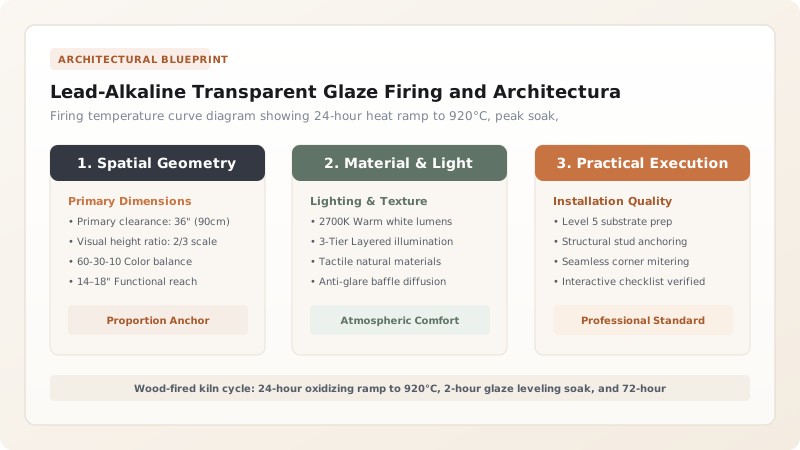
Ignite dry pine wood in the lower firebox. Slowly raise temperature over 12 hours to 600°C to expel all residual moisture, then increase draft to reach 920°C over the subsequent 10 hours under strict oxidizing conditions.
Peak Temperature Soak (The Glass Melt)
Hold temperature steady at 920°C–930°C for 2 hours, allowing the lead-alkaline glaze to melt, de-air, and level out into a flawless, mirror-smooth liquid glass coat.
Sealed Annealing and Controlled 72-Hour Cooling
Cease stoking, seal all firebox doors and chimney flues airtight with clay mortar, and allow the kiln to cool undisturbed for 3 full days, annealing the glass to eliminate internal thermal stresses.
Common Mistakes & Countermeasures
Avoid these costly errors that compromise aesthetics, ergonomics, and budget:
Using modern opaque white tin glazes instead of transparent lead-alkaline glaze
Opening kiln inspection doors prematurely while chamber temperature is above 150°C
Over-firing beyond 960°C in an attempt to achieve higher glaze gloss
Project Execution Checklist
Track your physical progress. Checkboxes persist automatically on this device:
Frequently Asked Questions
Why did Iznik potters use lead in their glazes instead of lead-free alternatives?
Lead oxide (minium) is an extraordinary fluxing agent in ceramic chemistry. It melts at low temperatures (below 900°C), has exceptionally low surface tension (which smooths out bubbles and pinholes into a mirror-like finish), and possesses an exceptionally high refractive index (n ≈ 1.60). This high optical refraction bends and magnifies light like fine lead crystal glass, giving Iznik tiles their legendary liquid depth and jewel-like brilliance.
What is a 'saggar' and why were tiles fired inside them?
A saggar is a heavy cylindrical box made of refractory fireclay. In traditional wood-fired updraft kilns, open flames carry flying wood ash, soot, and direct sulfur gases that would stick to wet, melting glazes and ruin delicate paintings. Tiles were loaded vertically inside closed saggars, protecting them from direct flame while allowing radiant thermal heat to melt the glaze cleanly.
Why did Ottoman potters fire kilns exclusively with mountain pine wood?
Dry mountain red pine (Pinus brutia) was the mandated fuel for Iznik kilns. Pine contains natural resins that burn with a long, clean, bright flame, generating intense radiant heat without excessive dark soot. The clean, oxidizing flame was critical for keeping iron-red pigments brilliant and copper turquoise transparent.
What makes Iznik tiles so resilient to thermal shock and moisture?
Iznik tiles combine an 85% quartz body with a matched lead-alkaline glaze. Because both the body and the glaze are predominantly silica glass, their thermal expansion coefficients are nearly identical. When temperatures cycle between cold winter nights and hot summer days in architectural courtyards, the glaze and tile expand and contract in total harmony, preventing the micro-crazing cracks that cause ordinary tiles to absorb water and spall.