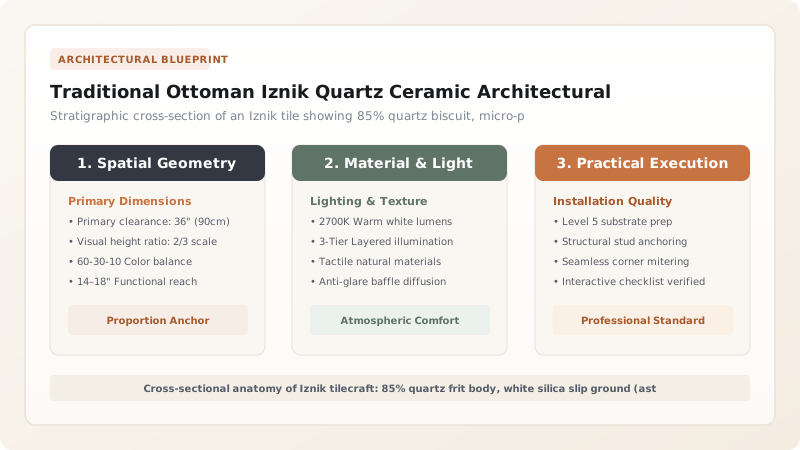
Iznik quartz ceramic tiles (İznik çinisi) represent the artistic and technological pinnacle of Ottoman architectural ceramics. Developed in the historic town of Iznik (ancient Nicaea) under royal court patronage during the 15th and 16th centuries, these tiles reached their zenith under Sultan Süleyman the Magnificent and imperial architect Mimar Sinan, adorning the Rüstem Pasha Mosque, the Blue Mosque, and Topkapı Palace. Engineered with a unique 85% powdered quartz frit body, a brilliant white silica slip (astar), vibrant underglaze pigments (including legendary raised coral red / mercan kırmızısı), and a diamond-clear lead-alkaline glaze, Iznik tiles deliver unmatched thermal durability, acoustic reflection, and eternal chromatic brilliance.
At a Glance: Key Takeaways
- Imperial Guild Center: İznik (Nicaea), Anatolia, Ottoman Empire (Zenith 1550–1600)
- Ceramic Body Composition: Up to 80%–85% pure crushed quartz / silica frit & 10% white clay
- Signature Pigment: Raised Coral Red (Mercan Kırmızısı / Armenian bole iron impasto)
- Glaze Formulation: Ultra-transparent, lead-alkaline high-refractive glass glaze
- Architectural Collaborator: Imperial Ottoman Architect Mimar Sinan (Topkapı, Rüstem Pasha, Selimiye)
In-Depth Guides in this Directory
Explore specialized subtopic blueprints, technical dimensions, and execution checklists:
Eighty-Five Percent Quartz-Frit Ceramic Body and Micro-Porous Silica Slip (Astar)
Technical guide to the material science of Iznik quartz fritware: 85% silica-frit body synthesis, micro-porous astar slip application, and zero-shrinkage firing.
Cobalt Blue, Turquoise, and Relief Coral Red (Mercan Kırmızı) Underglaze Pigments
Technical guide to Iznik underglaze polychrome pigments: cobalt blue, copper turquoise, chrome emerald, black tahrir, and raised coral red (mercan kırmızısı).
Lead-Alkaline Transparent Glaze Firing and Architectural Thermal Shock Durability
Technical guide to lead-alkaline transparent glazes and wood-kiln firing of Iznik quartz tiles: thermal shock durability, saggar stacking, and glaze optics.
The Golden Age of Iznik Tilecraft: Imperial Ottoman Patronage
During the sixteenth century, as the Ottoman Empire expanded across three continents to become the preeminent superpower of the Mediterranean world, the historic Anatolian town of İznik (ancient Nicaea, located on the shores of Lake Ascanius) became the crucible for one of the greatest ceramic achievements in human history. Under the patronage of the imperial court in Istanbul (Saray), the master potters of Iznik transformed architectural tilework into a sublime visual language of imperial sovereignty, sacred metaphor, and horticultural paradise.
Driven by the visionary court design atelier (Nakkaşhane) under master painters such as Şahkulu and Kara Memi, and deployed on an unprecedented scale by the empire’s supreme architect Mimar Sinan, Iznik tiles revetted the sacred interiors of Topkapı Palace, the Süleymaniye Mosque, the Rüstem Pasha Mosque, and the Mausoleum of Selim II. These walls were not treated as mere brick barriers; they were transformed into luminous, eternal gardens of paradise (cennet bahçesi), where stylized tulips, hyacinths, carnations, weeping cypress trees, and serrated saz leaves shimmered beneath clear crystal glazes.
The 85% Quartz Revolution: Recreating Porcelain Through Fritware
The technical revolution that separated Iznik tiles from all other Mediterranean and European ceramics was its radical raw material formulation. Common ceramics throughout Europe and the Islamic world were made from red or yellow alluvial clay (earthenware). However, Ottoman sultans were passionate collectors of Chinese Ming dynasty blue-and-white porcelain, prized for its snow-white, resonant, ringing hardness.
Lacking natural deposits of true white kaolin clay in Anatolia, Iznik potters performed an extraordinary chemical synthesis: they developed fritware (also known as stonepaste or quartz ceramic). Rather than clay, the body of an Iznik tile consists of up to 80% to 85% pure crushed crystalline quartz, combined with 10% finely ground glass frit (a melted and quenched mixture of quartz and potash flux) and only 5% to 10% white plastic bentonite clay to provide minimal cohesive handling. The result was an artificial porcelain: a dense, pure white, vitreous ceramic body of extraordinary structural stiffness and high thermal shock durability.
The Polychrome Miracle: From Cobalt Monochrome to Relief Coral Red
The aesthetic evolution of Iznik tilecraft is a chronology of triumphs over pyrochemical color. In its early phase (circa 1480–1520), potters mastered brilliant cobalt blue on pure white grounds, followed by the introduction of lush turquoise (copper oxide) and delicate sage greens. However, around 1555, Iznik masters achieved the holy grail of underglaze ceramic chemistry: raised coral red (mercan kırmızısı).
Iron oxide reds are notoriously unstable in high-temperature kilns, tending to burn into muddy browns or dissolve into the molten glaze. Iznik chemists formulated a thick, slip-like impasto made from iron-rich Armenian bole clay. When painted onto the white silica slip, this red sat proud in tactile physical relief. When sealed beneath the transparent lead glaze, it fired into a vibrant, brilliant sealing-wax scarlet that rose three-dimensionally above the surface of the tile, catching grazing daylight with the sumptuous glow of real Mediterranean coral beads.
Acoustics, Structural Durability, and Modern Scientific Revival
Beyond ornamental beauty, Iznik quartz tiles performed profound architectural and microclimatic functions in Ottoman monumental architecture. When Mimar Sinan lined the prayer halls of his imperial mosques with thousands of quartz tiles, he created high-performance acoustic reflection surfaces. The dense, glassy quartz faces reflected vocal frequencies without absorption, allowing the voice of the imam and the reciters of the Quran to carry clearly to thousands of worshippers beneath monumental stone domes.
Today, historic Iznik tiles stand as miracles of material preservation. While contemporary ceramic glazes often craze and yellow over decades, 500-year-old Iznik tiles retain their original high-gloss crystal clarity and vibrant saturation. Modern preservation foundations—such as the Iznik Training and Education Foundation—have revived the authentic 85% quartz recipe, preserving this royal Ottoman craft as an enduring beacon of global ceramic excellence.
Architectural Ceramic Tile Traditions: Iznik vs Zellige vs Delftware
Use this reference table to calculate exact physical dimensions, ratios, and specifications before purchasing:
| Ceramic Tradition | Body Composition | Glaze Technology | Decorative Application | Thermal & Acoustic Performance |
|---|---|---|---|---|
| Ottoman Iznik (İznik Çini) | 85% quartz/silica frit + 10% plastic clay | Transparent lead-alkaline glass glaze over white slip | Underglaze polychrome (cobalt, turquoise, relief red) | Exceptional thermal shock resistance; crisp acoustic reflection |
| Moroccan Zellige | 100% natural Fez grey/tan alluvial clay | Opaque tin-opacified glaze, hand-chiseled to mosaics | Monochrome glazed terracotta tesserae assembled into mosaic | Porous terracotta backing; acoustic diffusion from irregular facets |
| Dutch Delftware | Yellow/red marl clay body with calcium carbonate | Opaque white tin-glaze (maiolica technique) | In-glaze monochrome cobalt blue over raw tin ground | Moderate thermal shock resistance; prone to surface crazing |
| Modern Industrial Porcelain | Feldspar, kaolin, and quartz pressed at 400 bar | Digital inkjet printing with satin ceramic glaze | Photographic printed surface replication (flat printed ink) | Dense and vitrified; cold industrial touch; lacks artisanal depth |
Practical Constraints
Every successful decoration project must account for physical and environmental constraints:
Extreme Shrinkage Mismatch Between Pure Quartz and Common Clays
Unequal contraction during drying causes raw quartz tile biscuits to warp, bow, or snap in half. Mitigation: Incorporate fine pre-fired quartz frit into the dough to neutralize drying shrinkage to less than 1.5%.
Severe Volatility of Copper and Iron Oxides in Unstable Kiln Drafts
Fluctuations between reducing and oxidizing kiln atmospheres alter vibrant red into black and turquoise into dull green. Mitigation: Operate clean-burning dry pine wood firing with calibrated updraft flues to maintain continuous excess oxygen.
Execution Blueprint & Craftsmanship Sequence
Execute this professional sequence to achieve flawless results without backtracking:
Quartz Calcining and Water-Mulling
Heat raw white quartz river cobbles to red heat (800°C) and quench in cold water to shatter crystalline bonds. Grind the shattered quartz in a stone water-mill for 72 hours to achieve microscopic flour fineness.
Glass Frit Synthesis (The Frit Flux)
Melt 70% pure quartz powder with 30% potash/soda ash in a furnace at 1100°C. Pour molten glass into cold water to form crystalline frit (cam macunu), then grind to fine powder.
Quartz Dough Compounding and Mold Pressing
Knead 85% ground quartz and frit with 10% fine white plastic clay (bentonite) and organic tragacanth binder. Press the stiff dough firmly into oiled pear-wood tile molds (typically 24.5 cm × 24.5 cm).
Silica Slip (Astar) Engineering
Brush an ultra-pure white slip—composed of 90% quartz powder, white clay, and water—over the leather-hard biscuit, creating a snow-white reflective ground that masks any core color variations.
Cartoons, Pricking, and Charcoal Pounce Transfer
Prick master botanical cartoons (saz leaves, tulips, carnations, hyacinths) with fine needles. Pounce willow charcoal dust through the holes onto the dry slip to transfer razor-sharp guide lines.
Outlining (Tahrir) and Underglaze Polychrome Painting
Outline all motifs in crisp black chromite-iron ink using fine sable brushes. Paint interiors with cobalt oxide (dark blue), copper carbonate (turquoise), and thick Armenian bole (raised coral red).
Lead-Alkaline Glaze Dipping
Submerge the painted tile biscuit into a liquid glaze slurry of quartz, red lead (minium), and soda flux suspended in water, depositing a uniform 1 mm powdery veil across the surface.
Single-Fire Updraft Kiln Firing (920°C)
Stack tiles vertically on refractory clay stilts inside saggars in a wood-fired updraft kiln. Fire with dry pine wood slowly to 920°C–940°C over 24 hours, soaking at peak temperature, followed by 3 days of slow sealed cooling.
Common Mistakes & Countermeasures
Avoid these costly errors that compromise aesthetics, ergonomics, and budget:
Substituting common red earthenware or ball clay for the quartz-frit body
Applying coral red (mercan kırmızısı) as a thin watercolor wash rather than thick relief impasto
Firing at excessive temperatures exceeding 1000°C in an uncontrolled atmosphere
Project Execution Checklist
Track your physical progress. Checkboxes persist automatically on this device:
Frequently Asked Questions
Why are Iznik tiles made of quartz rather than common pottery clay?
Ottoman court potters deliberately formulated Iznik tiles with up to 85% quartz (silica) to recreate the luminous, translucent white brilliance of imported Chinese Ming dynasty blue-and-white porcelain. Because pure kaolin clay was unavailable in Anatolia, potters engineered an artificial 'fritware' or stonepaste body from quartz, glass frit, and white clay, yielding a hard, diamond-bright ceramic with extraordinary structural permanence.
What is the famous 'Iznik Coral Red' (Mercan Kırmızısı)?
Iznik coral red is a legendary raised underglaze red pigment introduced around 1555. Unlike flat stains, it was formulated from an iron-rich colloidal clay known as Armenian bole (sil-i ermeni) and applied as a thick, viscous slip. During firing, it maintained its crisp physical volume without bleeding into the glaze, creating a vibrant, tactile 3D relief that catches light like real Mediterranean coral.
How did imperial architect Mimar Sinan utilize Iznik tiles in his mosques?
Mimar Sinan utilized Iznik tiles not merely as decoration, but as integral architectural cladding. In masterworks like the Rüstem Pasha Mosque (Istanbul) and the Selimiye Mosque (Edirne), Sinan lined entire walls, prayer niches (mihrabs), and massive pillars with thousands of interlocking tile panels, creating an optical atmosphere of an eternal paradise garden (cennet bahçesi) while enhancing acoustic voice resonance for the call to prayer.
Why do antique Iznik tiles never fade or lose their vibrant colors?
Iznik colors are completely permanent because they are true underglaze mineral oxides (cobalt, copper, iron, chromium) sealed beneath a thick, transparent layer of lead-alkaline glass glaze. Fired at over 900°C, the glaze melts into an impenetrable, vitreous shield that protects the pigments from ultraviolet radiation, air pollution, acids, and water, preserving 16th-century colors in pristine, museum-grade brilliance today.