Sarooj is an ancient indigenous Omani hydraulic mortar produced by calcining specific iron-rich alluvial clays in low-temperature wood-fired kilns and pulverizing the vitrified clay into a reactive pozzolanic powder. When blended with mature slaked lime (noura) and wadi sand, sarooj undergoes a hydraulic chemical reaction that hardens underwater, creating an impermeable, self-healing, stone-like lining. Used for millennia to waterproof falaj channels, community ablution basins (shari'a), and fortress cisterns, sarooj resists hydrostatic water pressure, extreme desert heat, and chemical sulfate degradation without the brittleness of modern Portland cement.
At a Glance: Key Takeaways
- Pozzolanic Base: Calcined Alluvial Clay (High in Amorphous SiO2 & Al2O3)
- Firing Temperature: 750°C to 850°C in Conical Date-Palm Wood Kilns
- Binder Ratio: 3 Parts Sarooj Pozzolan to 2 Parts Matured Slaked Lime Putty
- Waterproofing Finish: Tat'eem (Pebble-Burnished Glass-Smooth Surface)
- Submerged Life Expectancy: 150+ Years under Constant Hydrostatic Immersion
The Ancient Chemistry of Omani Sarooj Pozzolan
In the arid civilizations of the Arabian Peninsula, ordinary non-hydraulic lime mortar presented a fatal engineering limitation: pure lime requires atmospheric carbon dioxide to carbonate and harden, a chemical process that cannot take place beneath standing water. To waterproof the vital channels of the aflaj, deep fortress cisterns, and community washing basins (shari'a), ancient Omani builders developed sarooj—an indigenous artificial pozzolan that revolutionized hydraulic masonry construction.
Sarooj is produced by harvesting fine, iron-rich alluvial clay deposited along wadi floodplains. When this clay is subjected to controlled thermal calcination between 750°C and 850°C, the water chemically bound within the clay minerals (primarily kaolinite and illite) is driven off. This causes the crystalline lattice to collapse, leaving behind highly disordered, amorphous silicon dioxide (SiO2) and aluminum oxide (Al2O3). When finely ground and combined with calcium hydroxide (slaked lime) in the presence of water, these amorphous oxides react spontaneously to synthesize insoluble calcium silicate hydrates (C-S-H), curing into an impermeable, rock-hard binder directly underwater.
The Kiln Calcination Ritual: Fuel and Thermal Dynamics
The traditional manufacture of sarooj was a monumental community undertaking that occurred only once or twice a decade in major oasis towns like Bahla and Nizwa. The process began by kneading raw wadi clay with water, adding dried dung and crushed date pits to create microscopic voids that ensured uniform heat penetration. The clay was flattened into circular discs known as tabuqa and dried in the sun.
Artisans then constructed a temporary conical kiln (atun) up to five meters in diameter. Massive date-palm trunk logs were laid at the foundation to form a deep firebox, overlaid with alternating concentric layers of clay discs and dry palm fronds (sa'af). Once ignited, the kiln burned continuously for ten to fourteen days under the watchful eye of a master artisan (ustad). Regulating the combustion rate was critical: if the kiln was under-fired (below 700°C), the clay remained unreactive; if over-fired (above 900°C), the minerals vitrified into inactive glass. The resulting brick-red chunks were subsequently crushed by heavy stone millstones and passed through fine brass sieves to yield pure pozzolanic flour.
The Tat'eem Technique: Pebble Burnishing Mechanics
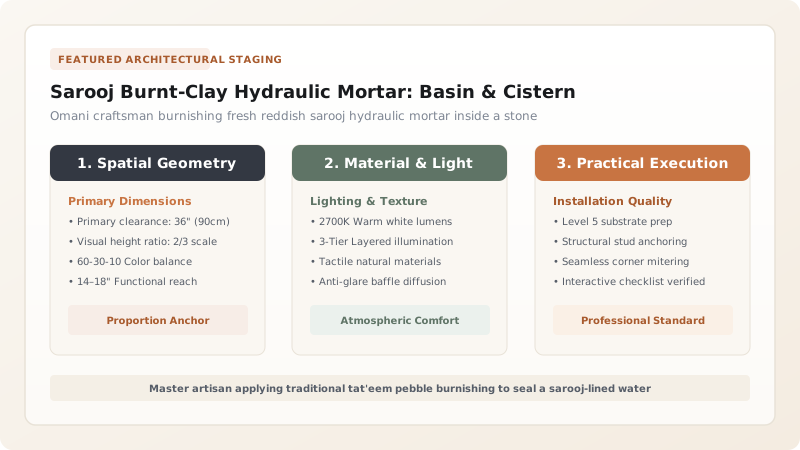
While the hydraulic chemistry of sarooj provides immense compressive strength and water resistance, the ultimate barrier against water penetration is achieved through the mechanical finishing technique known as tat'eem. After the sarooj-lime mortar is troweled onto the stone basin walls in two successive coats, it is allowed to firm up to the leather-hard plastic state over several hours.
The craftsman then takes hand-selected, ultra-smooth wadi quartz pebbles and burnishes the damp surface with firm, circular strokes. This burnishing action exerts extreme localized compaction on the mortar. It collapses internal air pockets, drives coarse sand grains deeper into the bedding layer, and brings an ultra-fine, creamy slurry of pure lime and pozzolanic gel to the exterior surface. As the pebble polishes this surface, it forms a mirror-smooth, vitreous skin that eliminates capillary suction, enabling sarooj basins to hold thousands of gallons of water under continuous hydrostatic pressure with zero weeping.
Longevity, Autogenous Healing, and Preservation Standards
Centuries of continuous exposure have demonstrated that authentic sarooj outperforms modern Portland cement in historic hydraulic environments. Portland cement contains rigid, brittle crystalline phases and soluble alkali sulfates that react destructively with historic limestone, leading to spalling, cracking, and structural failure. Furthermore, cement lacks flexibility, fracturing whenever seasonal thermal cycles cause masonry to expand and contract.
In contrast, sarooj possesses remarkable autogenous self-healing capacity. Because traditional formulations contain an excess reserve of uncarbonated calcium hydroxide, any microscopic fracture that develops within a sarooj channel allows water to dissolve free lime. As this lime-rich water migrates through the crack, it reacts with dissolved atmospheric carbonates and active pozzolanic silica to precipitate fresh calcite and C-S-H gels, sealing the crack organically from within. In modern heritage conservation projects supervised by Oman's Ministry of Heritage and Tourism, sarooj remains the mandatory, irreplaceable standard for preserving ancient aflaj infrastructure.
Waterproofing Mortars: Omani Sarooj vs Roman Pozzolana vs Portland Cement
Use this reference table to calculate exact physical dimensions, ratios, and specifications before purchasing:
| Mortar Characteristic | Omani Sarooj Mortar | Roman Pozzolanic Mortar | Modern Portland Cement |
|---|---|---|---|
| Pozzolanic Component | Calcined iron-rich alluvial wadi clay | Volcanic ash (pulvis puteolanus) | Synthetic pulverized clinker minerals |
| Curing Mechanism | Hydraulic (Underwater) + Carbonation | Hydraulic (Underwater) + Carbonation | Hydraulic (Tricalcium Silicate Hydration) |
| Flexural Modulus & Elasticity | High elasticity; accommodates stone movement | Moderate elasticity; ductile micro-cracking | Extremely rigid; brittle fracture under stress |
| Autogenous Self-Healing | Exceptional; free lime re-precipitates in cracks | High; calcite crystallization seals micro-voids | Poor to negligible; cracks require synthetic grouting |
| Chemical Compatibility | 100% compatible with limestone & adobe | 100% compatible with tuff & brick | Causes severe salt efflorescence & stone spalling |
Practical Constraints
Every successful decoration project must account for physical and environmental constraints:
Labor-Intensive 14-Day Manual Calcination and Grinding Process
High production time and scarcity of master sarooj artisans (ustads) creates supply bottlenecks for restoration projects. Mitigation: Establish centralized community calcining kilns and utilize solar-powered mechanical ball mills for standardized particle grading.
Long Curing Duration Required for Full Hydraulic Compressive Strength
Water channels must remain dry and dewatered for up to 28 days during application and curing phases. Mitigation: Construct temporary timber bypass flumes to maintain continuous municipal water flow while sections cure.
Execution Blueprint & Craftsmanship Sequence
Execute this professional sequence to achieve flawless results without backtracking:
Raw Alluvial Clay Harvesting and Preparation
Harvest silty alluvial clay from deep wadi beds. Knead the clay with water, adding dried donkey manure and date-palm fibers to increase internal porosity, and shape into 20 cm circular discs (tabuqa).
Kiln Stacking and Low-Temperature Calcination
Construct a conical stone field kiln. Stack dry palm trunk logs at the base, overlaying with alternating tiers of clay discs and palm fronds. Ignite and fire steadily for 10 to 14 days, maintaining internal kiln heat at 800°C.
Crushing, Sifting, and Pozzolanic Grading
Extinguish the kiln and extract the burnt, reddish-brown sarooj cakes. Crush the brittle clay using heavy stone rollers or animal-drawn millstones, passing the powder through fine mesh sieves to eliminate coarse granules.
Hydraulic Slurry Batching and Blending
Measure 3 parts sifted sarooj powder, 2 parts matured calcium hydroxide lime putty (noura), and 1 part washed quartz sand. Blend thoroughly in a wooden trough with water, hoeing repeatedly until reaching a stiff, plastic consistency.
Substrate Wetting and Basecoat Application
Scrub the stone masonry basin with stiff bristle brushes and saturate thoroughly with water. Apply a 15 mm basecoat of sarooj mortar, pressing firmly into all stone joints with an iron trowel.
Topcoat Laydown and Compaction
Apply a secondary 10 mm finishing coat while the basecoat is leather-hard. Tamp the surface with flat wooden floats to eliminate air pockets and consolidate the mortar matrix.
Tat'eem Pebble Burnishing Finish
Take hand-selected, ultra-smooth wadi quartz pebbles and burnish the wet mortar in tight circular motions. Continue burnishing until the mortar surface takes on a mirror-like, silky sheen and water drops bead without absorbing.
Moist Curing and Water Re-Commissioning
Cover the burnished basin with wet date-palm mats, misting with water three times daily for 21 days to complete the hydraulic pozzolanic cure before filling with falaj water.
Common Mistakes & Countermeasures
Avoid these costly errors that compromise aesthetics, ergonomics, and budget:
Over-firing clay cakes above 900°C during kiln calcination
Using un-aged, hot quicklime directly in the sarooj mortar slurry
Allowing freshly applied sarooj mortar to dry rapidly in direct desert sun
Project Execution Checklist
Track your physical progress. Checkboxes persist automatically on this device:
Frequently Asked Questions
How does Sarooj mortar chemically harden underwater?
During kiln calcination at 800°C, the crystal lattice of the clay minerals (kaolinite and illite) collapses, transforming into amorphous, highly reactive silica (SiO2) and alumina (Al2O3). When mixed with water and slaked lime (calcium hydroxide), these amorphous oxides react chemically with the lime to synthesize calcium silicate hydrates (C-S-H) and calcium aluminate hydrates (C-A-H). These hydrated mineral compounds crystallize directly in water, curing into an insoluble, stone-like matrix without requiring atmospheric carbon dioxide.
Why does pebble burnishing (tat'eem) make sarooj waterproof?
Pebble burnishing exerts intense mechanical shear pressure across the plastic mortar surface. This action accomplishes two crucial physical effects: it compresses the microscopic capillary pores between aggregate particles, and it forces a rich slurry of pure calcium-pozzolan paste to the exterior surface, forming a dense, pore-free, vitreous skin that repels hydrostatic water penetration.
Can sarooj repair itself if it develops small cracks?
Yes. Sarooj possesses remarkable autogenous self-healing properties. If a micro-crack develops due to minor structural movement, unreacted slaked lime within the mortar dissolves in infiltrating groundwater and migrates into the crack. Upon contact with dissolved atmospheric carbon dioxide and reactive sarooj silicates, the lime precipitates fresh calcite crystals and C-S-H gels, sealing the crack naturally from within.