The architectural majesty of Mitla relies on two extraordinary technological components: brilliant red hematite mineral stucco grounds and monumental monolithic floating trachyte lintels. The geometric volcanic stone fretwork was historically projected against a deep crimson fresco ground formulated from fine slaked lime burnished with natural ferric oxide (hematite) and cinnabar pigments, creating an intense chromatic contrast that made the stone carvings visually vibrate in tropical sunlight. Spanning the monumental entryways beneath these friezes are massive single-block trachyte lintels weighing up to 20 metric tons and measuring up to 8 meters in length. Engineered without mortar, these colossal lintels rest on un-mortared friction planes atop stone door jambs, functioning as seismic shock absorbers that slide harmlessly during major earthquakes.
At a Glance: Key Takeaways
- Pigment Chemistry: Natural red hematite (Fe₂O₃ / ferric oxide) and cinnabar (HgS / mercuric sulfide)
- Stucco Binder: High-calcium slaked lime putty burnished with smooth river pebbles (fresco-secco)
- Monolithic Lintels: Single-block porphyritic trachyte weighing 15 to 20 metric tons (up to 8 m long)
- Seismic Mechanism: Mortarless floating friction plane allowing lateral slip without shear fracturing
- Chromatic Optical Effect: Cream volcanic stone frets projected 50 mm forward against deep crimson shadow ground
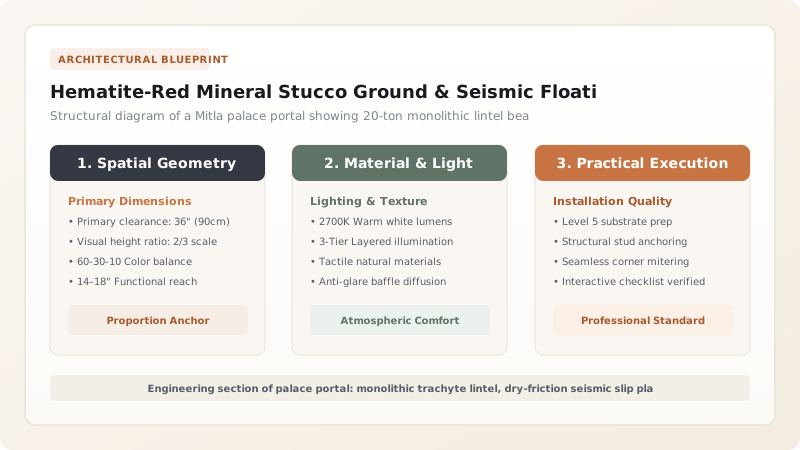
Monumental Megaliths: The Trachyte Lintels of Mitla
While the intricate geometric stone mosaics of Mitla are justly famous for their delicate, lace-like precision, the architecture is underpinned by an astounding display of megalithic engineering. Spanning the monumental entryways into the Palace of the Columns and the Hall of the Columns are massive single-block stone lintels that rank among the largest pre-Columbian architectural monoliths ever carved and transported in the Americas.
Hewn from dense porphyritic trachyte extracted from mountain quarries kilometers away, the largest of these lintels measures over seven meters in length, nearly one and a half meters in height, and more than a meter in depth, weighing between eighteen and twenty metric tons. Without draft animals, wheeled wagons, or iron tools, Zapotec engineers dragged these immense volcanic monoliths across rugged, canyon-strewn topography using greased timber rollers, inclined earthen ramps, and the coordinated manual labor of hundreds of workers pulling thick ropes braided from wild maguey agave fibers.
Seismic Physics: The Mortarless Friction Plane
The installation of these twenty-ton lintels represents a masterclass in ancient earthquake engineering. In modern or Western historical masonry, stone lintels were typically bedded in thick lime or cement mortar to bond them securely to the underlying door jambs. At Mitla, however, the bearing seats atop the door piers were pecked and abraded to absolute planar flatness, and the massive trachyte lintels were set directly onto the stone jambs completely dry, with zero mortar in the horizontal joint.
This mortarless contact created what modern structural engineers designate as a seismic friction isolation plane. Oaxaca lies directly along the devastatingly active Pacific subduction trench, experiencing frequent high-magnitude earthquakes. When violent lateral ground accelerations shake the palace, the rigid bonding of a mortared lintel would induce immense bending moments and shear stresses at the portal corners, snapping the stone in half. At Mitla, the colossal gravitational dead load keeps the lintel stable during normal conditions, but allows it to micro-slip along the smooth, dry stone interface during catastrophic tremors, effectively decoupling the roof and lintel mass from ground vibrations and dissipating earthquake energy safely.
Mineral Chemistry: Hematite & Cinnabar Stucco Grounds
The chromatic experience of Mitla was inseparable from the sophisticated chemical formulation of its mineral stuccos. Before the volcanic fretwork tablets were dry-mortised into the recessed tableros, the back wall of the panel was plastered with a fine, three-to-five-millimeter base coat of high-calcium slaked lime putty (cal apagada), produced by calcining pure limestone in wood-fired earthen kilns.
While this lime plaster was still moist and chemically receptive, artisans applied a concentrated mineral wash composed of natural red hematite (óxido férrico; Fe₂O₃), occasionally enriched with precious crystalline cinnabar (mercuric sulfide; HgS). Using smooth, water-worn river pebbles of dense jadeite or basalt, craftsmen burnished the damp mineral surface with intense circular pressure. This burnishing process forced the microscopic hematite pigment crystals deep into the carbonating calcium hydroxide matrix, producing a glass-smooth, durable fresco-secco ground with an intensely saturated, velvet-crimson luster that was completely impervious to water wash-off.
Optical Dynamics & The Sacred Architecture of Immortality
The visual impact of this polychromatic synthesis was breathtaking. The cream and pale-buff volcanic tuff tablets—projecting approximately fifty millimeters forward from the recessed back wall—stood in sharp three-dimensional relief against the glowing crimson hematite ground. Under the blinding tropical sunlight of the Oaxacan highlands, the bright stone frets reflected intense ambient daylight, while the deep red recesses absorbed light, creating an optical vibration where the geometric step-frets seemed to float in mid-air independently of the masonry wall.
This optical effect had profound religious resonance for the Zapotec elite. In the shadowy interior chambers and subterranean cruciform tombs of Mitla—where high priests conducted ancestral divination and royal burials—the combination of indestructible volcanic stone, un-mortared seismic joints, and permanent blood-red hematite symbolized the victory of life and ancestral memory over physical death. The palaces stood not merely as administrative halls, but as indestructible monuments designed to withstand earthquakes, wars, and the passage of centuries, preserving the sacred soul of the Zapotec nation in everlasting stone.
Material Performance & Structural Role: Mitla Lintels vs Mineral Polychromy
Use this reference table to calculate exact physical dimensions, ratios, and specifications before purchasing:
| Component | Raw Material | Weight / Physical Dimension | Engineering / Decorative Function | Seismic Response |
|---|---|---|---|---|
| Grand Entrance Lintel | Porphyritic Volcanic Trachyte | 18–20 metric tons (7.8 x 1.4 x 1.1 m) | Spans monumental palace entrance; carries upper stone roof dead load | Massive inertia; slides on dry friction plane without cracking |
| Secondary Room Lintel | Hard Limestone / Trachyte | 8–12 metric tons (4.5 x 1.1 x 0.9 m) | Spans interior portal between patio court and private chamber | Independent gravity stabilization isolates individual room movements |
| Hematite Stucco Ground | Pure Slaked Lime + Ferric Oxide | 3–5 mm thickness (burnished finish) | Provides intense visual contrast behind protruding stone fretwork | Micro-flexible lime matrix absorbs minor wall deflections |
| Door Jamb Piers | Triple-stone ashlar masonry | 1.6 x 1.4 m cross-section | Carries concentrated point loads from monolithic lintels down to bedrock | Broad footprint prevents compressive crushing of underlying soil |
| Protective Cornice | Overhanging Trachyte Slabs | 100–150 mm projection past facade | Sheds driving rainwater away from red hematite plaster ground | Anchors top of mosaic panels under gravitational compression |
Practical Constraints
Every successful decoration project must account for physical and environmental constraints:
Immense dead weight and gravitational point loads exerted by 20-ton lintel monoliths
Can crush soft foundation subsoils or cause door jamb masonry to tilt under localized bearing stress. Mitigation: Erect broad multi-block composite stone jambs resting on massive bedrock-tamped foundation platforms.
Degradation and photochemical fading of mineral pigments under intense tropical ultraviolet radiation
Centuries of direct sun exposure have bleached and chalked the historic red hematite grounds in unroofed palaces. Mitigation: Install breathable, UV-filtering fabric shelters above exposed palace tableros and monitor mineral crystallization.
Execution Blueprint & Craftsmanship Sequence
Execute this professional sequence to achieve flawless results without backtracking:
Monolithic Lintel Quarry Extraction
Locate an 8-meter-long continuous volcanic trachyte boulder at the Rio Grande quarries, driving wooden swelling wedges into natural fissures to split the 20-ton monolith away from the bedrock.
Overland Roller Haulage & Lever Transport
Roll the 20-ton block across timber skidways on greased oak log rollers, pulled by coordinated teams of hundreds of workers using thick braided maguey agave ropes.
Earthen Ramp Construction & Hoisting
Construct inclined earthen ramps leading up to the tops of the palace door jambs, leveraging the lintel up the ramp with heavy timber poles until positioned over the portal.
Dry-Friction Jamb Seating
Lower the lintel directly onto the pre-dressed, level stone jambs without mortar, aligning bearing surfaces to ensure uniform compressive contact across the entire joint.
Mineral Hematite Pigment Preparation
Grind dense red hematite iron ore and crystalline cinnabar on basalt metates into sub-micron crimson powder, blending with rainwater and slaked lime putty.
Slaked Lime Stucco Application
Apply a fine, multi-coat slaked lime plaster over the recessed tablero back wall, smoothing the surface with wooden floats to receive the mineral wash.
Crimson Pigment Burnishing (Fresco-Secco)
Brush the hematite pigment slurry over the damp lime plaster, burnishing the surface with smooth jadeite or quartz river pebbles to lock the mineral particles into the carbonating matrix.
Mosaic Tablet Insetting & Final Inspection
Insert the dry-friction volcanic stone tablets into the panel, verifying that the deep crimson ground recedes dramatically behind the clean, protruding cream-colored stone frets.
Common Mistakes & Countermeasures
Avoid these costly errors that compromise aesthetics, ergonomics, and budget:
Grouting the contact plane between monolithic lintels and stone door jambs with modern cement mortar
Using synthetic iron oxide or modern synthetic acrylic paints to touch up faded red stucco grounds
Drilling structural anchor pins into monolithic lintels to hang protective tourist awnings
Project Execution Checklist
Track your physical progress. Checkboxes persist automatically on this device:
Frequently Asked Questions
What is a 'seismic floating lintel' and how does it protect the palaces of Mitla?
A floating lintel is a monumental single-block stone beam that rests upon its supporting door jambs purely under its own gravity weight, without binding mortar or mechanical metal dowels. During an earthquake, ground accelerations cause the building to sway; instead of transmitting rigid shear stresses that would crack the stone, the mortarless bearing joint acts as a friction slip plane, allowing the 20-ton lintel to slide micro-fractions of a millimeter, dissipating seismic energy safely.
Where did the ancient Zapotecs obtain the red hematite and cinnabar pigments?
Red hematite (ferric oxide) was mined from abundant local iron-rich mineral outcrops in the mountains surrounding the Valley of Oaxaca. Cinnabar (mercuric sulfide)—a rarer, toxic mineral prized for its intense, luminous vermilion hue—was obtained through long-distance Mesoamerican trade networks from highland mines in central Mexico and Guerrero.
Why was red the dominant background color for Zapotec palace fretwork?
In Zapotec and Mesoamerican religion, red was the sacred color of the east—the direction of the rising sun, life, blood, vitality, and royal resurrection. Painting the background of the funerary and administrative palaces red symbolized the cosmic womb and the underworld from which life continuously emerges, providing a sacred backdrop for the genealogical step-fret motifs.