The geometric stone fretwork mosaics of Mitla (Zapotec: Lyobaa; Nahuatl: Mictlan) in Oaxaca, Mexico, represent one of the supreme achievements of pre-Columbian architectural masonry. Constructed during the Postclassic period (c. 1000–1521 CE) as the primary religious and funerary sanctuary of the Zapotec civilization, the palaces feature monumental exterior facades and interior chambers enveloped in intricate geometric mosaics (grecas). Composed of over one hundred thousand individually chiseled volcanic tuff and trachyte tablets fitted into recessed wall panels (tableros) without binding mortar, these step-fret (xicalcoliuhqui) designs were backed by brilliant red hematite mineral stucco and anchored beneath monumental 20-ton floating trachyte lintels engineered to dissipate violent Pacific seismic shocks.
At a Glance: Key Takeaways
- Archaeological Epicenter: Mitla (Lyobaa / 'Place of Rest'), Tlacolula Valley, Oaxaca, Mexico
- Cultural Tradition: Late Postclassic Zapotec and Mixtec monumental palace masonry (c. 1000–1521 CE)
- Lithic Medium: Quarried volcanic ignimbrite tuff (ignimbrita) and porphyritic trachyte (traquita)
- Mosaic Mechanism: Dry-friction keyed mortise insets fitted into recessed tableros without mortar
- Chromatic Palette: Cream/buff stone frets projected against brilliant hematite red (óxido férrico) stucco ground
In-Depth Guides in this Directory
Explore specialized subtopic blueprints, technical dimensions, and execution checklists:
Quarried Volcanic Tuff & Trachyte Precision-Chiseled Tablets at Mitla
Geological extraction, lithic tooling, and precision chisel masonry of volcanic ignimbrite tuff and trachyte tablets for Mitla mosaic panels.
Dry-Friction Mortised Step-Fret Mosaic Insets of Zapotec Palaces
Engineering and assembly mechanics of dry-friction mortised step-fret (xicalcoliuhqui) mosaic insets in recessed stone tableros at Mitla.
Hematite-Red Mineral Stucco Ground & Seismic Floating Lintels of Mitla
Architectural analysis of brilliant hematite-red mineral stucco grounds and 20-ton seismic floating trachyte lintels engineered at Mitla palaces.
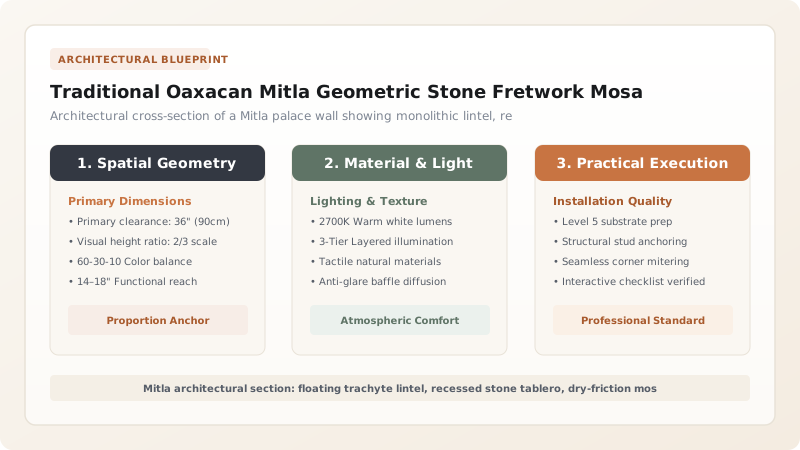
Mitla: The City of the Dead & Postclassic Architectural Zenith
Nestled within the semi-arid Tlacolula arm of the Central Valleys of Oaxaca in southern Mexico, the archaeological complex of Mitla—known to the Zapotec as Lyobaa ('Place of Rest') and to the Nahuas as Mictlan ('Place of the Dead')—served as the supreme religious, administrative, and mortuary center of the Zapotec people during the Postclassic period (c. 1000–1521 CE). While earlier Zapotec capitals like Monte Albán were defined by monumental earthen and lime-plastered pyramidal platforms, Mitla represents a radical architectural revolution: a palace city celebrated worldwide for its astonishing geometric stone fretwork mosaics (grecas).
Unlike any other pre-Columbian site in the Americas, the monumental palaces of the Group of the Columns (Grupo de las Columnas) and the Church Group are completely enveloped in geometric stone relief. Built around grand interior courtyards, the quadrangular palaces feature thick, load-bearing composite masonry walls punctured by monumental entryways spanned by single-block trachyte lintels weighing up to twenty metric tons. The exterior facades and interior chambers are subdivided into horizontal recessed stone panels (tableros), each displaying distinct, continuous variations of stepped frets, swastikas, spiral meanders, and interlocking rhomboids executed entirely in stone.
Lithic Sourcing & Chisel Masonry Without Iron
The realization of Mitla's geometric mosaics demanded an extraordinary mastery of geology, stone extraction, and precision lithic reduction. In the absence of bronze or iron masonry tools, Zapotec craftspeople exploited two distinct regional volcanic rocks: porous, fine-grained volcanic ignimbrite tuff (ignimbrita) for the delicate mosaic tablets, and dense, durable porphyritic trachyte (traquita) for the monumental lintels and structural column drums.
Quarried from the vertical volcanic cliffs flanking the nearby Rio Grande valley, stone blocks were cleaved using natural columnar cooling fractures and dry wooden wedges saturated with water. Once extracted, the stones were shaped through progressive percussion flaking using dense diorite and flint hammerstones (percutores). Master stonecarvers then dressed the individual mosaic elements using sharp obsidian blades and chert chisels, polishing the bearing faces with volcanic pumice and quartz sand slurry to achieve sub-millimeter tolerances. Tens of thousands of individual stone tablets, shaped as stepped L-brackets, rectangular blocks, and tapered prisms, were manufactured with identical dimensions to enable seamless modular assembly.
Dry-Friction Insetting & Seismic Shock Dissipation
The mechanical genius of the Mitla mosaics lies in their method of installation. In conventional Western or Islamic mosaic traditions, tesserae are bedded permanently into thick, wet adhesive mortar or mastic. At Mitla, the stone tablets were installed without a single drop of binding mortar between adjacent stone faces. Instead, they were dry-friction mortised directly into the recessed stone panels (tableros), held together solely by lateral compression, precision geometric interlocking, and gravity.
The back tails of each stone tablet were tapered and keyed directly into a soft, resilient backing core composed of slaked lime putty, river sand, and crushed volcanic aggregate. This construction technique was a brilliant, deliberate response to the extreme seismic activity of southern Mexico, which sits directly above the subduction zone of the Cocos and North American tectonic plates. During violent earthquakes that would fracture and crumble rigid mortared walls, the un-mortared stone tablets at Mitla micro-slipped against one another, absorbing and dissipating seismic ground energy through internal friction without snapping or detaching from the wall.
Polychromy: The Red Hematite Fresco Ground & Sacred Iconography
Today, visitors to Mitla see pale cream and buff-colored volcanic stone mosaics standing against weathered grey stone backgrounds. Historically, however, the architecture was a symphony of intense, saturated polychromy. Before the stone tablets were inserted into the recessed panels, the back wall and surrounding stone moldings were coated with a brilliant fresco ground of pure slaked lime plaster burnished with natural red hematite (óxido férrico) and cinnabar mineral pigments.
When the cream-colored volcanic stone step-frets were placed into the panels, the deep recesses behind the relief were intensely red, while the protruding stone faces were kept clean or painted white. This created an extraordinary optical contrast: under the harsh tropical Oaxacan sun, the geometric stone frets seemed to hover weightlessly above a glowing crimson field. Iconographically, the fourteen distinct geometric step-fret patterns—centered on the sacred xicalcoliuhqui motif—embodied the feathered serpent, swirling storm clouds, genealogical royal bloodlines, and the eternal passage of ancestors through the underworld, transforming the royal palaces of Mitla into a living cosmic text written in everlasting stone.
Architectural Components & Material Systems in Mitla Palace Construction
Use this reference table to calculate exact physical dimensions, ratios, and specifications before purchasing:
| Architectural Zone | Primary Geological Medium | Fabrication / Masonry Method | Structural Function | Seismic Performance |
|---|---|---|---|---|
| Monumental Lintels | Porphyritic Trachyte (18–20 tons) | Single-block quarry extraction, hand-pecked dressing | Spans wide palace doorways (up to 4.5 m) | Dry friction plane dissipates horizontal earthquake acceleration |
| Recessed Tableros | Hard Limestone Frame | Deeply recessed rectangular wall panels (30–60 cm depth) | Houses dry-friction stone fretwork mosaic compositions | Frame corners resist lateral wall racking forces |
| Mosaic Fret Tablets | Soft Volcanic Ignimbrite Tuff | Precision chisel-cut into stepped, meander, and spiral profiles | Forms 14 distinct geometric xicalcoliuhqui mosaic patterns | Independent tablets slide micro-millimeters without fracturing |
| Wall Core Masonry | River Boulders & Caliche Lime | Rammed stone-and-lime composite core (1.2–1.8 m thick) | Primary vertical gravity load-bearing wall mass | Massive inertia dampens seismic vibrations |
| Hematite Stucco Ground | Slaked Lime + Ferric Oxide | Polished fresco-secco ground behind protruding stone frets | High-contrast visual relief and moisture barrier | Flexible micro-crystalline matrix absorbs building micro-movements |
Practical Constraints
Every successful decoration project must account for physical and environmental constraints:
High seismic vulnerability located along the Cocos-North American subduction zone
Frequent severe earthquakes (magnitude 7.0–8.2) generate catastrophic lateral shear and ground acceleration. Mitigation: Incorporate massive mortarless sliding lintels and thousands of independent micro-mosaic tablets that absorb shock.
Friable, porous nature of volcanic ignimbrite tuff exposed to torrential summer rains
Acidic rainfall and capillary water absorption can dissolve mineral binders and erode carved step edges. Mitigation: Recess mosaic panels deeply within overhanging stone cornices and maintain sacrificial lime stucco washes.
Execution Blueprint & Craftsmanship Sequence
Execute this professional sequence to achieve flawless results without backtracking:
Quarry Sourcing & Columnar Joint Cleaving
Locate high-density volcanic ignimbrite tuff and trachyte beds along the Rio Grande cliffs, driving wet oak wedges into natural columnar stress fractures to split massive uniform stone blocks.
Primary Block Reduction & Hammerstone Percussion
Rough-shape quarried blocks on site using spherical diorite hammerstones (percutores), flaking away irregular waste rock to produce portable tablet blanks.
Precision Chisel-Cutting & Step-Fret Profiling
Dress tablets to exact architectural tolerances (<1 mm variation) using sharp obsidian and flint chisels, cutting stepped notches, trapezoids, and rectangular interlocking prisms.
Massive Wall Core Masonry Erection
Construct 1.5-meter-thick load-bearing palace walls from round river boulders, crushed limestone aggregate, and slaked lime mortar, framing deep rectangular recessed panels (tableros).
Hematite Red Stucco Ground Application
Trowel a fine base coat of slaked fat lime putty over the recessed panel backings, burnishing pulverized natural hematite (ferric oxide) into the damp plaster to create a brilliant crimson fresco ground.
Dry-Friction Mosaic Tablet Insertion
Insert stone tablets individually into the recessed panels without mortar, interlocking the stepped tabs under dry friction and keying the tapered stone tails into the soft lime-gravel backing.
Monolithic Trachyte Lintel Transport & Hoisting
Haul 20-ton trachyte lintel blocks on wooden rollers from mountain quarries, hoisting them atop door jambs using earthen ramps and timber levers without mortar bedding.
Surface Polishing & Cornice Alignment
Rub protruding stone mosaic faces with fine pumice stones and sand slurry to achieve a uniform planar projection, sealing perimeter joints against rainwater intrusion.
Common Mistakes & Countermeasures
Avoid these costly errors that compromise aesthetics, ergonomics, and budget:
Using modern Portland cement mortar to re-point or bed loose volcanic fretwork tablets during restoration
Applying synthetic siloxane or acrylic water-repellent sealers over historic greca panels
Rigidly pinning monolithic stone lintels to underlying door jambs with modern steel anchors
Project Execution Checklist
Track your physical progress. Checkboxes persist automatically on this device:
Frequently Asked Questions
What is the symbolic meaning of the geometric 'greca' step-fret motifs at Mitla?
The geometric step-fret—known in Nahuatl as the 'xicalcoliuhqui'—is one of the most profound Mesoamerican sacred symbols. Combining a stepped pyramid profile with a swirling spiral or meander, it represents the cosmic serpent (Quetzalcoatl / Coo Dzavui), the movement of life-giving clouds and rain, lightning, solar cycles, and the genealogical continuity of Zapotec and Mixtec royal lineages.
Why are the stone mosaic tablets at Mitla fitted together without mortar?
The mortarless dry-friction assembly was an intentional structural and seismic design. In seismically active Oaxaca, rigid mortared mosaics would crack, shear, and shatter during violent earthquakes. Because each tablet was dry-fitted independently with slight micro-tolerances, the entire mosaic panel could flex, slide, and absorb seismic wave energy without a single stone snapping.
How did ancient Zapotec masons quarry and move 20-ton trachyte lintels without draft animals or iron tools?
Zapotec engineers exploited natural columnar cooling fractures in volcanic trachyte cliffs, driving dry hardwood wedges into cracks and soaking them with water to expand and split monolithic blocks. To transport blocks weighing up to 20 metric tons over several kilometers of rugged terrain, hundreds of workers rolled the stones on lubricated logs, utilizing earthen inclined ramps, levers, and braided maguey agave ropes.