The step-fret mosaic insets of Mitla are an unparalleled marvel of dry-joint masonry engineering. Rather than adhering stones to walls with wet mortar, ancient Zapotec builders fitted individually carved volcanic tuff tablets into deeply recessed rectangular wall panels (tableros) using dry friction, gravity, and mechanical compression. The mosaic compositions—incorporating over 14 distinct geometric variations of the sacred xicalcoliuhqui (stepped spiral), meanders, and swastikas—were keyed into a resilient lime-gravel backing without mortar between adjacent stone joints. This dry-friction design permitted micro-sliding under intense earthquake ground shaking, preventing brittle stress fractures and preserving the delicate geometric relief intact through major seismic events.
At a Glance: Key Takeaways
- Assembly Method: Mortarless dry-friction insetting with mechanical keying into lime-gravel wall core
- Framing Device: Recessed stone tableros framed by massive protruding lintels and baseline moldings
- Motif Count: 14 distinct geometric patterns (stepped frets, meanders, triangles, and swastikas)
- Sacred Emblem: Xicalcoliuhqui: stepped spiral representing Quetzalcoatl, rain, and cosmos
- Seismic Behavior: Energy-dissipating dynamic micro-friction; individual stones slide without cracking
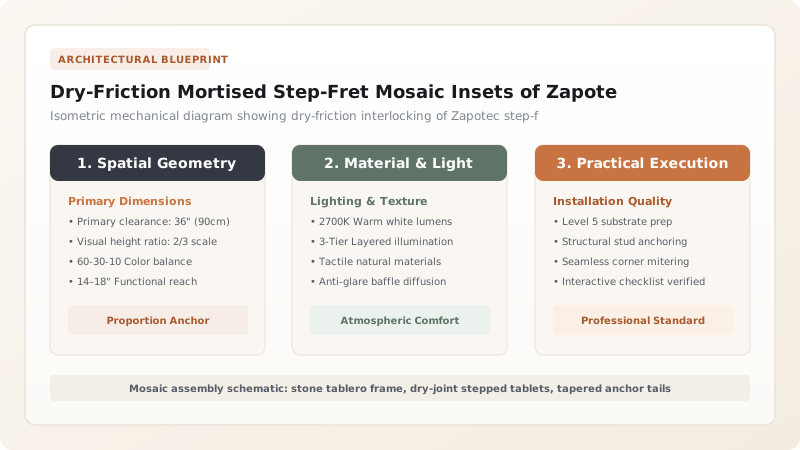
The Tablero as an Architectural Frame
In Mesoamerican monumental architecture, the relationship between wall and ornamentation reached its zenith at Mitla through the refined articulation of the tablero. While earlier Classic-period cultures—such as Teotihuacan and Monte Albán—utilized the talud-tablero system (an inclined slope surmounted by a framed vertical panel), Zapotec architects at Mitla eliminated the sloping talud entirely, elevating the rectangular tablero into a self-contained, deeply recessed frame dedicated to geometric stone relief.
Constructed from massive, finely dressed limestone or trachyte blocks, the perimeter frame of the tablero projected 20 to 40 centimeters outward from the interior wall plane. This deep recess served both aesthetic and structural functions. Visually, the protruding upper cornice cast deep horizontal shadows across the top of the panel, enhancing the three-dimensional drama of the relief. Structurally, the rigid outer frame acted as a non-deforming structural ring that contained the dry-friction stone mosaic tablets under lateral compression, preventing out-of-plane displacement during seismic shaking.
The Mechanics of Dry-Friction Insetting
The assembly of Mitla's mosaic panels represents a radical departure from Old World mosaic techniques. In Byzantine, Roman, or Persian mosaics, small stone tesserae were pressed into a wet bedding mortar that cured to form a rigid, monolithic bond. At Mitla, by contrast, the vertical and horizontal joints between adjacent stone tablets contain zero mortar, lime putty, or adhesive resin. The assembly is entirely dry-jointed (a hueso seco), relying upon friction, gravity, and geometric interlocking.
Masons began by laying a perfectly horizontal course of base tablets along the bottom stone molding. Subsequent courses were stacked dry, sliding the stepped tabs and meander hooks of each tablet into the corresponding notches of its neighbors. Crucially, the posterior back of each tablet was hewn into an elongated, rough-hewn trapezoidal tail that penetrated 10 to 20 centimeters into a compliant backing bed composed of slaked lime, crushed pumice, and sand. This soft backing matrix allowed masons to adjust the depth of each stone with micro-taps of a wooden mallet, achieving an absolutely flat, planar facade projection across panels spanning over thirty meters in length.
The Xicalcoliuhqui: Mathematics & Iconography
The governing geometric motif of the Mitla mosaics is the xicalcoliuhqui—a compound Mesoamerican symbol combining a stepped staircase (pyramid) with a spiral meander. In Zapotec cosmology, this was not mere abstract decoration; it was a sacred ideological script. The stepped profile signified the sacred mountain, the pyramid platform, and the physical earth, while the swirling spiral represented the cosmic feathered serpent, swirling hurricane clouds, lightning bolts, and the celestial descent of life-giving rain.
The execution of this motif in stone required profound mathematical sophistication. Because the panels were strictly rectangular and bounded by rigid frame dimensions, master builders had to calculate modular ratios so that repeating geometric waves terminated symmetrically at corner jambs without broken or truncated motifs. Across the five palace groups, archaeologists have identified fourteen distinct modular variations: continuous labyrinthine meanders, interlocking swastika crosses representing the four cosmic cardinal directions, nested concentric diamonds, and undulating sawtooth zigzags, each carrying specific sacred and genealogical associations.
Seismic Resilience: The Floating Micro-Slip Envelope
Southern Mexico is one of the most seismically active zones on Earth, subjected to frequent megathrust earthquakes generated along the Middle America Trench. If the intricate stone fretworks of Mitla had been bonded with rigid mortar, the intense lateral shear forces and ground accelerations of an 8.0-magnitude earthquake would have shattered the thin, brittle volcanic tablets within seconds.
The dry-friction insetting system was an ingenious seismic survival mechanism. When seismic P-waves and S-waves ripple through the massive palace walls, the thousands of independent stone tablets do not fight the ground movement with brittle resistance. Instead, each tablet undergoes microscopic sliding along its un-mortared stone-on-stone contact planes. This micro-slippage transforms destructive kinetic earthquake energy into frictional heat and micro-displacements, acting as a massive, distributed structural damper. Once the tremor subsides, the gravitational compression of the upper stone cornices settles the tablets back into their interlocking positions, preserving the geometric facades intact across seven centuries of relentless tectonic activity.
Geometric Motifs & Structural Typologies of Mitla Step-Fret Mosaic Panels
Use this reference table to calculate exact physical dimensions, ratios, and specifications before purchasing:
| Motif Typology | Zapotec / Nahuatl Concept | Geometric Configuration | Modular Tablet Count | Architectural Location |
|---|---|---|---|---|
| Stepped Spiral (Xicalcoliuhqui) | Coo Dzavui / Cloud Serpent | Alternating 3-step staircases terminating in spiral hooks | 36–48 tablets per repeating module | Primary exterior palace facades and grand patio courts |
| Continuous Meander (Grecas) | Labyrinth of Ancestors | Interlocking square-bracket maze paths | 24–32 tablets per repeating module | Interior royal residential and council chambers |
| Stepped Diamond / Rhombus | Heart of the Mountain | Nested concentric diamond stepped pyramids | 16–24 tablets per repeating module | Subterranean cruciform tombs beneath the Hall of Columns |
| Swastika / Broken Cross | Four Quarters of the Cosmos | Four interlocking stepped arms radiating from center | 32–40 tablets per repeating module | Upper frieze panels beneath projecting roof cornices |
| Triangular Sawtooth | Flint Blade / Ray of Sun | Linear rows of acute interlocking serrated triangles | 12–16 tablets per linear meter | Baseline decorative trim and frieze dividing bands |
Practical Constraints
Every successful decoration project must account for physical and environmental constraints:
Complex geometric drift caused by slight dimensional variations in hand-carved stone tablets
Across a 20-meter panel, minor errors of 0.5 mm accumulate, threatening to misalign repeating fret symmetry. Mitigation: Incorporate flexible spacer tablets and adjust tail seating depth into the lime backing to absorb minor tolerances.
Violent seismic ground shaking (P-waves and S-waves) causing out-of-plane panel bulging
Earthquake shockwaves can push un-mortared stone tablets outward, spilling mosaics onto courtyard floors. Mitigation: Recess panels 20–40 cm behind projecting frame cornices and taper tablet tails with an upward hook angle.
Execution Blueprint & Craftsmanship Sequence
Execute this professional sequence to achieve flawless results without backtracking:
Tablero Stone Frame Construction
Construct massive protruding stone cornices and baseline moldings from dense limestone or trachyte, defining a rigid, deeply recessed rectangular panel opening (tablero).
Compressible Lime-Aggregate Backing Preparation
Trowel a 10 cm thick backing bed of slaked fat lime putty, crushed volcanic pumice aggregate, and river sand against the interior boulder core wall.
Baseline Alignment & Centerline Marking
Snap charcoal reference lines across the recessed panel base, establishing exact pattern repetition centers to ensure symmetrical termination at panel corners.
First Course Dry-Friction Tablet Seating
Press the bottom row of L-shaped and rectangular stone tablets onto the base molding, driving the tapered posterior tails firmly into the soft lime-aggregate backing.
Step-Fret Interlocking & Progression
Stack subsequent tablet courses dry, fitting stepped notches into matching overhangs with zero mortar in the joints, tapping tablets horizontally with wooden mallets.
Tail Wedging & Mechanical Keying
Drive small wedge-shaped stone flakes behind the tablet tails into the lime backing, locking each stone under compression against its adjacent neighbors.
Top Frieze Compression & Cornice Locking
Insert the final top course of specialized capping tablets beneath the upper projecting stone lintel, wedging the assembly tight to prevent vertical displacement.
Planar Surface Alignment & Cleaning
Check the finished mosaic face with a straightedge, tapping proud stones flush and brushing dust from the dry joints to reveal the crisp geometric relief.
Common Mistakes & Countermeasures
Avoid these costly errors that compromise aesthetics, ergonomics, and budget:
Applying wet mortar or cement slurry between the vertical joints of mosaic tablets during installation
Installing tablets into a rigid, non-yielding concrete or stone back wall
Failing to align horizontal baseline moldings to exact water levels across the entire room length
Project Execution Checklist
Track your physical progress. Checkboxes persist automatically on this device:
Frequently Asked Questions
What is the mechanical advantage of dry-friction joints over mortared joints at Mitla?
Dry-friction joints eliminate rigid stress concentrations. When subjected to violent seismic ground accelerations, mortared masonry cracks along rigid joint lines, shattering stone faces. In Mitla's dry-friction system, each independent tablet micro-slips along its stone-on-stone contact plane, converting destructive kinetic earthquake energy into safe friction heat.
How do the stone tablets stay inside the wall without falling out?
Tablets are restrained by three complementary forces: first, their elongated, tapered posterior tails are embedded deep into the semi-resilient lime-and-gravel wall core; second, the geometric step-frets interlock mechanically in three dimensions; and third, the entire panel is held under permanent vertical gravity compression by the heavy projecting stone cornices above.
Are the mosaic panels at Mitla all identical, or do they vary from room to room?
The panels exhibit extraordinary variety: archaeologists have documented at least fourteen distinct geometric patterns across the palace complexes. While one patio court features running stepped spirals (xicalcoliuhqui), an adjacent council hall features interlocking Greek meanders, and subterranean royal tombs feature concentric stepped diamonds.