
The centuries-long durability of Norwegian log cabins depends on the chemical synergy of Malfuru pine and mountain moss. Malfuru is slow-grown Scots pine whose heartwood is naturally saturated with pinosylvin and resin acids, rendering it impervious to wood rot. Between horizontal log courses, carpenters pack 'Husmose' (mountain feather moss), an elastic biological chinking material that compresses under wall deadweight while releasing natural antimicrobial humic acids that prevent fungal decay.
At a Glance: Key Takeaways
- Chinking Moss Species: Hylocomium splendens (Husmose) & Sphagnum moss
- Growth Rate: Sub-millimeter annual rings (<0.8mm per ring)
- Heartwood Proportion: Minimum 80% heartwood ratio across trunk cross-section
- Timber Category: Malfuru / Tyri (Resin-saturated Scots pine heartwood)
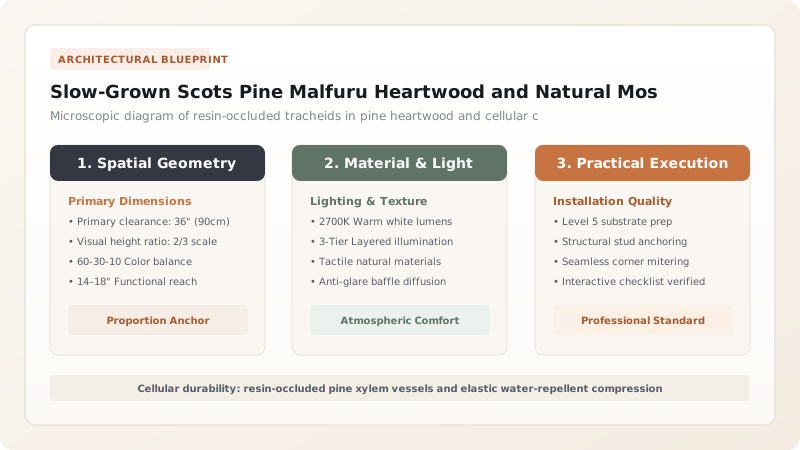
Botany of Malfuru: Slow Growth and Natural Resinification
In the high mountain valleys of Østerdalen and Røros, Scots pine (Pinus sylvestris) grows in cold, nutrient-poor rocky soil with brief summer growing seasons. Trees take 150 to 250 years to reach structural diameter, producing dense wood with annual growth rings often less than 0.5mm thick.
Historic foresters actively enhanced this wood through katting (resinification). Decades before harvest, foresters stripped the bark from the lower trunk or lopped the tree’s crown. In response to stress, the pine pumped vast quantities of natural terpenes, pinosylvin, and rosin into the heartwood, turning the core into a golden-amber, resin-occluded stone wood called Malfuru or tyri.
Natural Chemical Biocides: Pinosylvin and Resins
Modern pressure-treated lumber relies on toxic copper or arsenate chemicals that leach into soils. Malfuru carries nature's most sophisticated internal preservative. The heartwood contains up to 20% resin by dry weight, rich in abietic acid and pinosylvin—a natural stilbenoid fungitoxin.
Pinosylvin permanently blocks the enzymatic pathways of brown-rot and white-rot wood decay fungi (such as Coniophora puteana). Furthermore, the microscopic cell lumens (tracheids) are completely clogged with solid crystallized resin, preventing capillary moisture absorption even during prolonged rainy autumns.
Husmose Chinking: Biological Elasticity and Antimicrobial Chemistry
To seal horizontal seams against biting mountain winds, builders packed the internal mosefar groove with Husmose (mountain feather moss, Hylocomium splendens or Sphagnum capillifolium). Sourced from shaded boulder fields, moss was harvested in late summer and lightly dried.
Unlike modern synthetic foams or oakum which dry out and crumble, moss fibers possess exceptional spring elasticity. Under the weight of settling logs, the moss compresses to a dense felt, expanding automatically if seasonal changes cause logs to contract. Furthermore, sphagnic and humic acids present in the moss create an acidic micro-environment (pH 4.0–4.5) that halts bacterial decay.
Flax Shives, Sheep Wool, and Interior Thermal Comfort
In agricultural lowlands where mountain moss was less accessible, builders utilized unwashed greasy sheep's wool (saueull) or coarse flax tow (stry). Raw sheep wool contains natural lanolin, which repels liquid water while allowing water vapor to diffuse naturally.
The combination of dense pine heartwood (thermal mass) and compressible moss chinking creates an exceptional hygroscopic building envelope. The walls naturally absorb indoor humidity during cooking and sleeping, releasing it during dry periods while maintaining draft-free comfort without vapor barrier membranes.
Timber & Chinking Material Property Matrix
Use this reference table to calculate exact physical dimensions, ratios, and specifications before purchasing:
| Material Type | Moisture Absorption | Fungal Resistance Mechanism | Elastic Recovery | Service Life |
|---|---|---|---|---|
| Malfuru Pine Heartwood | <8% (capillary closed) | Natural pinosylvin & rosin saturation | Rigid structural timber | 500+ years without rotting |
| Standard Pine Sapwood | >28% (open tracheids) | None (susceptible to fungal attack) | High shrinkage / warping | 15 to 25 years if exposed |
| Mountain Feather Moss (Husmose) | Buffers vapor without rot | Acidic humic polymers (pH 4.2) | 95% elastic recovery under load | Centuries inside sealed mosefar |
| Greasy Sheep's Wool | Hydrophobic exterior surface | Natural lanolin wax barrier | High resilient bounce | Indefinite if kept dry |
Practical Constraints
Every successful decoration project must account for physical and environmental constraints:
Scarcity of True Old-Growth Scots Pine Forests
Industrial forestry clear-cutting has made 200-year-old Malfuru rare; restoration carpenters must source logs from specialty heritage timber stands.
Long Natural Air-Drying Times for Heavy Log Timbers
Logs must air-dry for a minimum of 24 months to reach equilibrium moisture content below 18% before final precision scribing.
Execution Blueprint & Craftsmanship Sequence
Execute this professional sequence to achieve flawless results without backtracking:
Forest Heartwood Grading and Selection
Core standing pine trees with an increment borer; select logs showing growth rings narrower than 1mm and heartwood diameter exceeding 80%.
Winter Logging and Spring Barking
Fell selected pines during mid-winter when sap flow is dormant; strip outer bark in early spring, seasoning logs under open-sided timber sheds for 2 years.
Husmose Gathering and Cleaning
Rake mountain feather moss from granite forest floors; clean away twigs, pine needles, and soil, air-drying in shaded lofts until pliable.
Mosefar Groove Pre-Wetting and Packing
Lightly mist dry moss with water to restore springiness; pack a uniform 40mm thick bed of moss into the concave underside of the log.
Log Seating and Moss Compression
Lower the upper log into place using timber levers; drive down with wooden heavy beetles (jomfru) to compress the moss bed into a 5mm gasket.
Seam Inspection and Lip Trimming
Check horizontal seams to ensure zero moss protrudes past the outer feather edges, preventing exterior rain from wicking into the wall.
Common Mistakes & Countermeasures
Avoid these costly errors that compromise aesthetics, ergonomics, and budget:
Leaving Moss Protruding Past the Exterior Log Seam
Using Chemical Caulk or Expanding Polyurethane Foam
Project Execution Checklist
Track your physical progress. Checkboxes persist automatically on this device:
Frequently Asked Questions
What gives Malfuru pine heartwood its dark reddish-amber color?
The rich color is caused by oxidized pinosylvin, polyphenols, and concentrated abietic resin acids that crystallize inside the wood cell walls as the tree matures, acting as natural petrifying agents.
Does mountain moss need to be replaced periodically inside the walls?
No. Sealed inside the dark, dry, pressurized mosefar cavity away from sunlight and running water, authentic husmose moss remains intact and elastic for hundreds of years without rotting or crumbling.


