
Torvstokk Eave Logs and Wooden Peg Anchorage provide the critical structural abutment that holds the massive living turf blanket on a Nordic roof. Sawn or broadaxe-hewn from dense heartwood Scots pine (malmfuru), the torvstokk is a heavy horizontal log running continuously along the eave line. Supported by naturally curved juniper tree brackets (kroker) or wrought-iron knees, the log withstands tons of downhill sliding pressure from water-saturated sod and snowpacks while incorporating engineered bottom drainage slots that allow water to cascade off the birch bark without eroding the soil.
At a Glance: Key Takeaways
- Torvstokk Heavy Timber Beam: Continuous squared pine log (150x200mm) arresting downhill sliding turf mass.
- Juniper Knee Brackets (Kroker): Naturally grown L-curved branch knees harnessing natural wood grain strength.
- Malmfuru Heartwood Sourcing: Slow-grown, resin-saturated pine heartwood resisting rot for over 80 years at the eave.
- 15mm Bottom Drainage Gap: Elevating the log slightly to allow clean runoff water to drain off the birch bark.
- Treenail Peg Anchorage: Fastening brackets into principal rafters with dry oak or birch trenails (treplugger).
- Glacial Creep Resistance: Neutralizing downward thrusts exceeding 15 kN per meter of eave run during spring thaws.
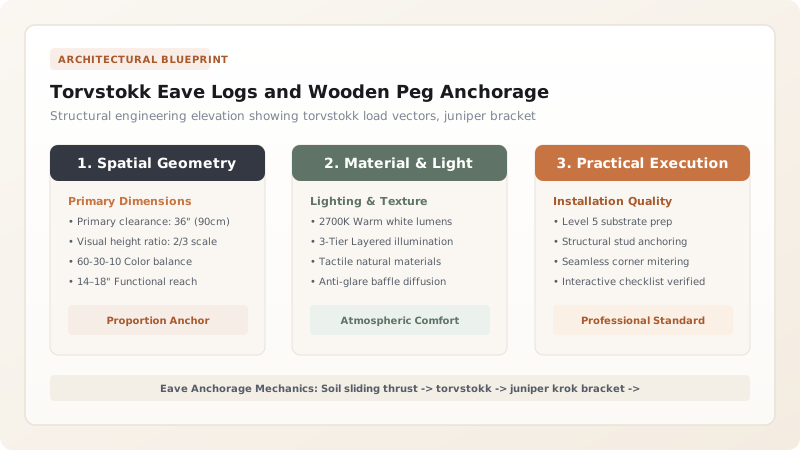
1. Vector Physics: The Downhill Glacier of the Sod Roof
A typical 100 m² turf roof carries up to 25 metric tons of wet soil and winter snow. On a 25° pitch, gravity resolves this weight into two vector components: a perpendicular compressive load that presses down on the rafters, and a parallel shear load that pushes downhill toward the eaves.
This shear thrust exerts over 15 kiloNewtons of horizontal force per linear meter of eave. Without an immovably anchored retaining abutment, the saturated soil would slide off the slippery, suberin-rich birch bark like a miniature glacier. The torvstokk (turf log) is the structural brake that holds this massive living ecosystem in place.
2. Dendrology: The Natural Engineering of Juniper Kroker
To anchor the heavy torvstokk against the downhill thrust, traditional Scandinavian carpenters did not use fragile forged iron brackets, which rusted away in damp soil. Instead, they used kroker (grown wooden brackets).
Carpenters combed mountain forests for naturally curved common juniper (Juniperus communis / einer) or Scots pine roots and branches where the grain naturally bent at a 90° to 100° angle. Because the cellulose grain fibers flow continuously around the bend without being severed by sawing, grown timber knees possess extraordinary shear and tensile strength. Driven into mortises in the rafter ends and pinned with seasoned oak pegs, a single juniper krok can support over 1,000 kg of lateral thrust.
3. Hydrology: The 15mm Eave Drainage Gap
The greatest vulnerability of a turf roof eave is trapped standing water. If the torvstokk were bolted flush against the pine roof deck, water draining off the birch bark would be blocked by the log, turning the eave into a permanent swamp that rots both the eave log and roof boards within a decade.
Master builders elevate the torvstokk 15mm to 20mm above the birch bark on notched drainage risers or wooden spacing pads. The lowest layer of birch bark extends 50mm past the deck, curling cleanly downward over the eave. Rainwater filtering through the sod reaches the slick birch bark, cascades under the torvstokk through the drainage slot, and drips cleanly into the rain gutters or stone drip trenches on the ground below.
Torvstokk Eave Log & Bracket Sizing Standards
Use this reference table to calculate exact physical dimensions, ratios, and specifications before purchasing:
| Structural Member | Preferred Timber Species | Dimensions (mm) | Fastening System | Design Shear Capacity |
|---|---|---|---|---|
| Torvstokk (Log) | Heartwood Scots Pine (Malmfuru) | 150 x 200mm squared | Notched over krok brackets | Resists 18 kN/m soil thrust |
| Krok Bracket | Naturally curved Juniper (Einer) | 80mm - 100mm limb diameter | Through-rafter tenon + birch peg | Supports 12 kN per bracket |
| Iron Replacement Knee | Hand-forged wrought iron strap | 50 x 8mm curved bar | 3/8-inch galvanized coach screws | Supports 15 kN per bracket |
| Treenail Peg | Split seasoned European Oak | 20mm - 25mm octagonal | Draw-bored through mortise | High shear pin connection |
| Drainage Shim | Rot-resistant Juniper heartwood | 100 x 50 x 18mm thick | Friction fitted beneath log | Maintains 18mm continuous flow slot |
Craft & Weather Constraints
Every successful decoration project must account for physical and environmental constraints:
Finding Curved Juniper Knees
Locating matching pairs of natural 90° juniper brackets for a 12-meter roof requires extensive foraging across rocky coastal islands.
Winter Snow Avalanches
In early spring, heavy ice slabs can violently shear brackets if the log is not mounted with sufficient structural through-pegs.
Protocol for Shaping and Mounting a Torvstokk Eave Assembly
Execute this professional sequence to achieve flawless results without backtracking:
Malmfuru Pine Log Sourcing
Select slow-grown Scots pine with > 80% resin-saturated heartwood (malmfuru); broadaxe four faces to 160x200mm rectangular beam.
Juniper Krok Selection & Peeling
Harvest naturally curved juniper limb-crotches; peel bark; hew the mounting leg flat with drawknife to match rafter tail width.
Bracket-to-Rafter Mortising
Notch the long leg of each krok into the top edge of each rafter tail; drill 22mm holes through both members; drive dry oak trenails.
Torvstokk Receiving Notches
Chisel square pockets into the underside of the torvstokk log where it rests atop the upward-turned hook of each krok.
Drainage Clearance Calibration
Insert 18mm juniper spacer blocks under the torvstokk at 1-meter centers; ensure continuous water exit gap across entire eave.
Pine Tar Hot-Wash Treatment
Coat the completed torvstokk and exposed bracket faces with boiling-hot Stockholm pine tar (milebrent tjære) mixed with raw linseed oil.
Common Mistakes & Countermeasures
Avoid these costly errors that compromise aesthetics, ergonomics, and budget:
Using modern sapwood dimensional spruce timber for the torvstokk eave log
Blocking the bottom 15mm drainage gap with packed soil or cement
Project Execution Checklist
Track your physical progress. Checkboxes persist automatically on this device:
Frequently Asked Questions
How long does a traditional pine heartwood torvstokk last?
When crafted from high-resin Scots pine heartwood (malmfuru) and treated periodically with pine tar, a torvstokk typically lasts between 50 and 80 years. Because it is mounted on external brackets with wooden pegs, a decayed eave log can be unbolted and replaced without disturbing the main roof turf or underlying birch bark.
Why is Stockholm pine tar used on the exterior of the torvstokk?
Stockholm pine tar (milebrent furutjære) is produced by destructive distillation of pine stumps in charcoal kilns. Rich in natural terpenes, phenolic compounds, and rosin acids, it penetrates deep into the wood cells, repelling liquid moisture, killing wood-decay fungi, and providing protection against the severe freeze-thaw cycles of the Scandinavian climate.


