
Multi-Layer Birch Bark Neve Waterproof Membranes represent nature's most resilient architectural waterproofing technology. Harvested from living downy birch trees during the brief late spring sap window (sevjetiden), the outer bark is rich in suberin and betulin, hydrophobic biopolymers completely immune to fungal decay and water penetration. Laid across wooden roof decking in six to eight shingled layers with precise headlap and side-lap tolerances, the natural curl of the bark is oriented to channel drainage safely downward, creating an impervious membrane that lasts over a century beneath living turf.
At a Glance: Key Takeaways
- Spring Sap Harvesting (Sevjetiden): Peeling outer bark in June when cambium moisture allows effortless separation without harming the tree.
- Suberin & Betulin Chemistry: Naturally synthesized waxes and triterpenes conferring total resistance to rotting fungi and moisture.
- Natural Curl Orientation: Positioning bark with white outer surface facing down so curling tendencies press edges tight against the deck.
- Six-to-Eight Layer Overlap: Creating a continuous laminated shingle envelope with 150mm–200mm overlaps on all joints.
- Zero Nails in the Field: Bark held entirely by gravitational compression of the turf ballast without penetrating fastener holes.
- 100+ Year Service Life: Outlasting modern asphalt shingles and synthetic roofing membranes under harsh sub-arctic weathering.
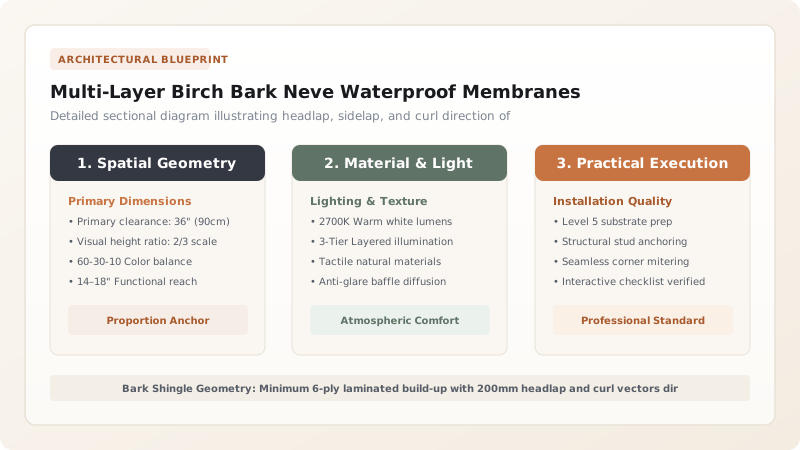
1. Forestry & Harvesting: The Sacred Rhythm of Sevjetiden
Birch bark cannot be harvested year-round. If stripped in winter, the bark clings tenaciously to the wood, and tearing it strips the living inner cambium (bast), which girdles and kills the tree. Harvesting must occur during sevjetiden (the sap season), a fleeting two- to three-week period in late spring (typically early June in Scandinavia) when sap surges between the outer bark and inner living bark.
Using a bone or dull wooden spud (never a sharp steel knife), the forester makes a single vertical slit through the outer white bark. With gentle thumb pressure, the sheet of bark separates with a crisp tearing sound, popping off in a large, flexible sheet measuring up to 600mm wide by 1,000mm long. The tree survives unharmed, forming a protective dark secondary bark within seasons.
2. Polymer Science: Suberin, Betulin, and Rot Resistance
Birch bark is a biological marvel. Up to 30% of its dry weight consists of betulin, a triterpenoid crystal that gives the outer bark its brilliant white chalky color, protecting the tree from solar thermal shock in winter. The structural matrix is made of suberin, a polyester network of long-chain fatty hydroxy-acids and glycerol.
Suberin exhibits zero water absorption. Furthermore, betulin and suberin possess powerful antimicrobial, anti-fungal, and insecticidal properties. Even in warm, permanently damp conditions beneath 150mm of wet acidic peat soil, birch bark does not rot. It remains supple, pliable, and completely impermeable for well over a century.
3. Installation Stereotomy: Managing the Natural Curl
When birch bark dries, it naturally curls tightly along the circumference of the tree trunk. The master roofer (tekker) exploits this physical tension to ensure total watertightness:
Bark sheets are installed with the white outer bark facing DOWNWARD against the pine deck, and the yellow-amber inner suberin side facing UPWARD toward the sod. Because the bark tends to curl toward the white side, this downward orientation causes the edges of each sheet to curl firmly down against the roof deck, preventing water from siphoning underneath. Sheets are laid like fish scales with minimum 150mm headlap and 100mm sidelap, building a dense, 6- to 8-layer laminate across the entire roof envelope.
Birch Bark Grading & Shingling Parameters
Use this reference table to calculate exact physical dimensions, ratios, and specifications before purchasing:
| Roof Zone | Bark Thickness (mm) | Minimum Layer Count | Lap Dimension (mm) | Curl Orientation Vector |
|---|---|---|---|---|
| Eaves / Drip Edge | 2.5mm - 3.5mm (Heavy prime) | 8 - 10 layers | 200mm overlap; 50mm overhang | Curled tightly down over eave log |
| Field / Mid-Slope | 1.5mm - 2.5mm (Standard) | 6 - 8 layers | 150mm headlap / 100mm sidelap | White side down; curl toward decking |
| Ridge / Mønsås | 2.0mm - 3.0mm (Wide sheets) | 8 - 10 layers | 300mm saddle wrap across ridge | Straddles ridge with equal overhangs |
| Valley / Skottrenne | 3.0mm+ (Pliable prime) | 10 - 12 layers | 250mm continuous trough lap | Centered in valley with zero cuts |
Resource & Ecological Constraints
Every successful decoration project must account for physical and environmental constraints:
Tremendous Tree Quantity
Roofing a standard 100 m² cabin requires peeling bark from 300 to 500 mature birch trees, requiring sustainable regional forestry cooperation.
Weather Sensitivity during Laying
High winds can lift loose birch bark sheets off the roof like kites before the sod layer is placed; work must proceed in calm weather.
Protocol for Shingling a Multi-Layer Birch Bark Membrane
Execute this professional sequence to achieve flawless results without backtracking:
Bark Sorting & Grading
Sort peeled bark sheets by thickness and size; reserve the heaviest, widest sheets for eaves, ridges, and valleys.
Bark Softening
If bark has dried and curled into tight rolls, soak in warm water for 2 hours until pliable; press under flat boards to flatten.
Eave Starter Course (Neveneve)
Lay the first course of heavy bark along the eave log, allowing the sheets to extend 50mm past the wood to form a natural drip apron.
Field Course Shingling
Ascend the roof slope, laying subsequent courses with 150mm headlap; ensure at least 6 overlapping sheets cover every square centimeter of deck.
Ridge Saddle Crossing
Lay wide sheets straddling the ridge beam, overlapping both sides by 300mm to seal the apex against wind-driven snow.
Temporary Weight Securing
Lay loose pine battens and stones over the bark immediately to hold it flat against wind gusts until the sod layer is placed.
Common Mistakes & Countermeasures
Avoid these costly errors that compromise aesthetics, ergonomics, and budget:
Nailing birch bark sheets to the timber deck to keep them from blowing away
Laying the yellow inner side facing downward against the roof boards
Project Execution Checklist
Track your physical progress. Checkboxes persist automatically on this device:
Frequently Asked Questions
How long does harvested birch bark remain usable before installation?
If kept in a cool, shaded barn pressed flat between boards with stone weights, harvested birch bark can be stored for years without degrading. If bark rolls dry into stiff cylinders, they can be rejuvenated at any time simply by soaking them in a lake or tank of warm water for a few hours until they become completely pliable again.
Can birch bark be used on roofs without turf covering it?
No. When exposed to direct sunlight, the intense ultraviolet radiation and summer heat cause thin birch bark to dry out, curl violently, become brittle, and catch fire from chimney sparks. Birch bark requires the heavy, damp, continuous ballast of a turf layer to press it flat and shield it from UV light.


