
Moroccan Zouaq unifies two contrasting decorative systems: Hasba (sacred geometric construction governed by compass and straightedge) and Tawq (fluid biomorphic arabesques). Hasba establishes the polyhedral lattice—octagrams, dodecagrams, and 16-point rosettes—while Tawq fills the star polygons with stylized split-palmettes, acanthus tendrils, and floral flourishes transferred using pierced parchment templates.
At a Glance: Key Takeaways
- Geometric System: Hasba (Euclidean geometry, star polygons, proportion lattices)
- Biomorphic System: Tawq / Tashjir (floral arabesques, split-palmettes, foliate scrollwork)
- Key Star Symmetries: 8-point (Tsamniya), 12-point (Tnaashriya), and 16-point (Sbaatashriya)
- Transfer Tool: Pierced vellum / zinc pounce patterns dusted with powdered charcoal
- Brush Technology: Extra-long squirrel hair rigger brushes (*Qalam*) for continuous line flow
- Symbolic Resonance: Harmonious union of celestial mathematical order and earthly natural beauty
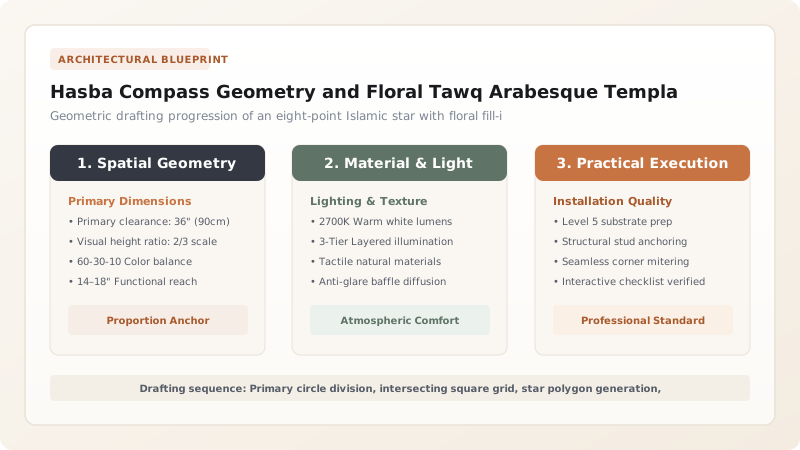
Mathematical Principles and Euclidean Construction of Hasba
The foundation of all Zouaq ceiling compositions is Hasba (measuring/calculating). In the Islamic architectural tradition, geometry represents divine cosmic harmony. Master draughtsmen never employ freehand estimation for architectural star grids; everything is constructed from a single initial circle using only a compass and straightedge:
- The Seed Circle: A central circle represents unity. By dividing the circumference into four, six, or eight equal arcs, the master establishes the symmetry system.
- Star Polygon Generation: In an eight-point star (Tsamniya), two interlaced squares rotated 45 degrees generate the primary star octagram. In a sixteen-point star, four interlaced squares produce dynamic rotating vertices.
- Radial Expansion: Star points extend outward into secondary satellite polygons—kites, saftas, and hexagonal braids—creating infinite, self-repeating tessellations across expansive ceiling spans.
Tawq Arabesque Dynamics and Pounce Pattern Transfer
While Hasba provides the rigorous crystalline armature, Tawq (the necklace or garland) introduces life, movement, and vegetative beauty. Stylized leaves, lotus blossoms, split-palmettes, and spiraling tendrils (tashjir) wind gracefully through the geometric fields.
Because symmetry across hundreds of ceiling bays must be absolute, master artisans create permanent templates (qarqas):
- The design is drafted onto heavy vellum, goatskin parchment, or thin zinc plate.
- A fine needle punches continuous microscopic holes along every curve and contour (approximately 20–30 holes per centimeter).
- The template is laid against the cedar plank, and a muslin bag filled with powdered charcoal or gypsum dust is gently tapped across the surface.
- Removing the template reveals razor-sharp dotted guide lines that the painter traces with liquid distemper and a fine brush.
Hasba Compass Geometry and Floral Tawq Arabesque Templates in Zouaq Architectural Decision Matrix
Use this reference table to calculate exact physical dimensions, ratios, and specifications before purchasing:
| Motif Element | Design Tradition | Drafting Tool | Execution Brush | Symmetry Class |
|---|---|---|---|---|
| Central Rosette | Hasba (Geometry) | Steel compass & straightedge | Flat sable brush | C8 or C16 rotational |
| Foliate Tendril (Tashjir) | Tawq (Floral) | Perforated pounce template | Long squirrel rigger (Qalam) | Mirror bilateral symmetry |
| Interlaced Ribbon | Hasba / Strapwork | Dividers & parallel rule | Double-line striping brush | Continuous 2D knotwork |
| Border Palmette Frieze | Tawq | Segmental zinc stencil | Fine round sable #1 | Translational frieze group (p11m) |
Practical Constraints
Every successful decoration project must account for physical and environmental constraints:
Perspective Foreshortening from Floor Level
Hand Steadiness and Brush Control
Creating and Painting a Hasba-Tawq Ceiling Panel
Execute this professional sequence to achieve flawless results without backtracking:
Grid Scribing
Snap plumb and level centerlines; strike main concentric circles with a beam compass onto the primed cedar board.
Star Polygons Scribing
Construct the 16-point star geometry using dividers; score faint pencil or bone stylus lines for all interlocking strapwork.
Pounce Transfer of Tawq
Position the perforated floral template inside each star quadrant; pounce charcoal dust to transfer the intricate vine motifs.
Under-Painting Fields
Fill the geometric star polygons with pure color washes (lapis blue, cinnabar red, or emerald green).
Floral Detailing
Paint foliate motifs with multi-toned highlights (e.g., light green over dark emerald, vermilion over ochre).
Graphic White/Black Outlining
Paint unbroken calligraphic white and bone-black contour pinstripes around all elements to give the design graphic pop when viewed from 5 meters below.
Common Mistakes & Countermeasures
Avoid these costly errors that compromise aesthetics, ergonomics, and budget:
Pouncing with coarse or damp charcoal dust
Miscalculating star polygon radial divisions
Painting floral outlines with blunt brushes
Project Execution Checklist
Track your physical progress. Checkboxes persist automatically on this device:
Frequently Asked Questions
Why are black and white pinstripes always painted between adjacent colors?
In Zouaq, adjacent saturated colors (such as deep red and rich green) cause optical vibration and visual clash when placed side-by-side. Fine black or white contour lines (known as *al-farkh*) visually separate the fields, maximizing brilliance and graphic clarity.
Can digital vinyl cutters produce authentic Zouaq stencils?
While modern CAD plotters can cut accurate vinyl stencils, master craftsmen maintain that vinyl creates lifeless, mechanical edges that lack the subtle hand-drawn vitality and calligraphic character of traditional pounce templates.


