
Successful Zouaq painting relies on the balance between Atlas cedarwood natural resins and mineral distemper binders. Cedarwood must be seasoned for years to stabilize its volatile aromatic oils. Mineral pigments are bound with refined animal hide glue (Ghira) or whole egg emulsions that bond to the porous wood fibers while resisting peeling against cedar tannins.
At a Glance: Key Takeaways
- Timber Species: Atlas Cedar (Cedrus atlantica Manetti / Al-Arz)
- Essential Oils: High concentrations of cedrol, thujopsene, and phenolic tannins
- Seasoning Cycle: Shade air-drying for 24 to 36 months (1 year per inch of timber)
- Distemper Binder: Clarified rabbit-skin / animal collagen glue (Ghira)
- Alternative Binder: Whole egg tempera emulsified with oil of cloves as natural biocide
- Bond Mechanism: Microporous capillary interlock with open cellulose lumen
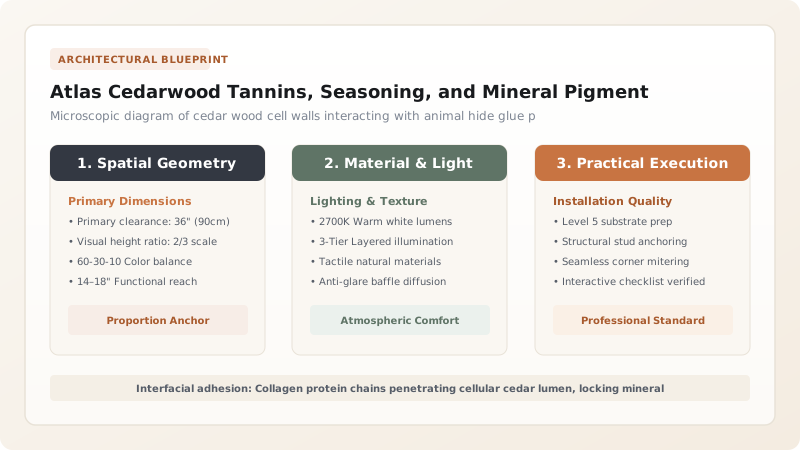
Cedarwood Biochemistry and Tannin Stabilization
Atlas cedar is one of the most chemically complex softwoods on earth. Its heartwood contains up to 5% by weight of natural essential oils and phenolic tannins. While these resins provide unmatched biological resistance against termites (Coptotermes) and fungal decay, they present serious adhesion challenges if wood is improperly seasoned.
If fresh green cedar is painted, volatile terpenes leach to the surface, breaking down water-based binders and causing greasy yellow bleed-through. Traditional Moroccan carpenters air-seasoned cedar logs in shaded, ventilated mountain yards for at least two years. This seasoning allows volatile lighter terpenes to evaporate while the denser aromatic resins stabilize into a solid, inert matrix inside wood tracheids.
Animal Collagen Glue and Egg Tempera Formulations
To achieve rich, matte opacity without flaking, Maâlems developed two master binder systems:
- Ghira (Rabbit Skin / Bone Collagen Glue): Produced by simmering connective tissue scraps at controlled temperatures (never exceeding 60°C). The strained gel provides high tensile bond strength, flexibility under subtle wood movements, and reversibility for future conservators.
- Egg Tempera Emulsion: Used primarily on delicate corbels and muqarnas vaults. Fresh egg yolks are separated, punctured, and mixed 1:1 with clean water and a drop of clove oil (acting as a natural antimicrobial preservative). The egg yolk lipids dry into an insoluble, flexible protein-oil film that withstands atmospheric humidity swings.
Atlas Cedarwood Tannins, Seasoning, and Mineral Pigment Binders in Zouaq Architectural Decision Matrix
Use this reference table to calculate exact physical dimensions, ratios, and specifications before purchasing:
| Binder Medium | Source Material | Working Temp | Elasticity | Recommended Painting Zone |
|---|---|---|---|---|
| Ghira (Hide Glue) | Collagen from rabbit/bovine hide | 40–50°C (Warm bath) | High tensile flexibility | Large flat ceiling boards (Tatao) |
| Egg Yolk Tempera | Gallus gallus domesticus yolk | Ambient room temp | Medium elasticity | Fine arabesque linework and corbels |
| Gum Arabic | Acacia senegal sap resin | Room temp | Brittle if thick | Under-drawing ink and gold leaf sizing |
| Casein Binder | Precipitated milk curd protein | Room temp | Extremely tough, water-resistant | Exterior overhanging eave corbels |
Practical Constraints
Every successful decoration project must account for physical and environmental constraints:
Temperature-Dependent Workability
Color Shift on Drying
Formulating and Testing Zouaq Distemper Paint
Execute this professional sequence to achieve flawless results without backtracking:
Glue Soaking
Submerge dry rabbit-skin glue granules in distilled water (1:10 ratio by weight) for 12 hours until fully swollen.
Gentle Bain-Marie Melting
Heat the swollen glue in a double boiler to 55°C, stirring until completely dissolved into a clear, golden syrup.
Pigment Slurrying
Pre-wet dry mineral powder with a few drops of alcohol and water to create a smooth, lump-free paste.
Binder Blending
Gradually incorporate warm glue liquid into the pigment paste, testing brush consistency on a cedar off-cut.
Rub Resistance Test
Allow test swatch to dry 30 minutes; rub firmly with dry white linen. If color transfers, increase glue content; if the paint cracks, dilute with warm water.
Common Mistakes & Countermeasures
Avoid these costly errors that compromise aesthetics, ergonomics, and budget:
Boiling animal hide glue above 65°C
Painting directly on unseasoned resin-rich cedar knots
Storing mixed glue paint without natural biocides
Project Execution Checklist
Track your physical progress. Checkboxes persist automatically on this device:
Frequently Asked Questions
Can acrylic paints be used for authentic Moroccan Zouaq restorations?
No. Heritage authorities strictly prohibit acrylics on historic Zouaq ceilings. Acrylic forms an impermeable plastic film that traps moisture inside the cedar, accelerating rot and preventing traditional reversible conservation.
Why is Atlas cedar so uniquely resistant to termites?
Atlas cedar contains high concentrations of natural sesquiterpenes (alpha- and beta-cedrene) and thujopsene, which are highly toxic to subterranean termites and wood-boring larvae.


