
Moroccan Zouaq is the centuries-old artisanal craft of hand-painting elaborate polychrome geometric and floral arabesques onto structural Atlas cedarwood (Cedrus atlantica) ceilings, beams, and doors. Practiced primarily in Fes, Marrakech, and Meknes, Zouaq integrates strict geometric drafting (Hasba), natural mineral pigments bound with animal glues or egg tempera, and protective varnishes of sandarac resin and linseed oil.
At a Glance: Key Takeaways
- Origin Centers: Fes, Marrakech, Meknes, and Rabat (Kingdom of Morocco)
- Primary Substrate: Aromatic Atlas Cedar (Cedrus atlantica / Al-Arz)
- Painting Medium: Distemper / tempera using rabbit skin glue, egg yolk, and mineral earths
- Ornamental Systems: Tawq (intertwined floral arabesques) and Hasba (geometric star polyhedra)
- Protective Sealant: Sandarac resin dissolved in grain alcohol and refined linseed oil
- Architectural Role: Ornamentation of palace ceilings, riad corbels, and madrasa coffering
In-Depth Guides in this Directory
Explore specialized subtopic blueprints, technical dimensions, and execution checklists:
Atlas Cedarwood Tannins, Seasoning, and Mineral Pigment Binders in Zouaq
Wood chemistry, seasoning protocols, and natural distemper binder preparation for authentic Moroccan Zouaq cedar painting.
Hasba Compass Geometry and Floral Tawq Arabesque Templates in Zouaq
Mathematical compass drafting of Hasba geometric stars and organic floral Tawq templates in traditional Moroccan Zouaq ceiling painting.
Protective Sandarac Varnish and Linseed Oil Conservation in Zouaq Ceilings
Varnish chemistry, sandarac resin harvesting, non-yellowing transparent finishes, and conservation cleaning of historic Moroccan painted cedar ceilings.
Historical Evolution and the Zouaqa Guild Tradition
Moroccan painted woodwork, known as Zouaq (from the Arabic zwwq, meaning to embellish or adorn), reached its zenith under the Marinid, Saadian, and Alaouite dynasties. In the imperial capitals of Fes and Marrakech, the craft was governed by strict artisanal guilds led by an elected master (Amin al-Zouaqa). Zouaq was conceived not merely as surface decoration, but as an architectural necessity to bring warmth, color, and spiritual transcendence into the upper realms of palace courtyards, grand mosques, and scholarly madrasas.
The craft developed alongside Morocco's famous ceramic zellige and carved plaster (stucco), forming a tripartite harmony of materials: cool, glazed zellige at human eye level; white, deeply carved stucco across middle wall registers; and richly polychromed, aromatic cedar ceilings suspended above, mirroring the celestial canopy.
Atlas Cedar Substrate and Joinery Engineering
True Zouaq requires Atlas cedarwood (Al-Arz), harvested from the ancient high-altitude forests of the Middle and High Atlas mountains. Cedarwood is chosen for unique mechanical and biochemical properties:
- Natural Insect & Fungus Immunity: Atlas cedar is rich in aromatic thujopsene, cedrol, and natural tannins that repel wood-boring beetles and resist dry rot indefinitely in semi-arid North African climates.
- Dimensional Stability: When properly air-seasoned in shady lumber yards for 2 to 3 years, cedarwood exhibits minimal tangential shrinkage, preventing painted panel seams from opening during extreme seasonal temperature shifts.
- Ceiling Typologies: Zouaq is applied across diverse wooden structures, including Tatao (coffered paneled ceilings), Muqarnas (honeycomb stalactite vaults), Bratel (heavy structural cross-beams), and Karchba (cantilevered carved corbels).
The Mineral Palette and Tempera Chemistry
Traditional Zouaq relies on natural mineral pigments ground by hand on porphyry slabs. Master painters (Maâlem Zouaq) reject synthetic modern acrylics because they lack the optical depth, velvety matte refraction, and chemical compatibility with wood resins:
- Mineral Pigments: Cobalt and lapis blues, cinnabar and red iron ochres, malachite greens, orpiment and yellow ochres, calcined bone black, and chalk whites.
- Binder Formulation: Pigments are bound using natural distemper—either refined rabbit-skin glue (ghira) warmed in water baths, or egg yolk tempera. This water-based binder penetrates microscopic wood capillaries, establishing a tenacious mechanical lock.
- Gold Embellishment: High-status ceilings incorporate genuine 24-karat gold leaf applied over a red Armenian bole ground, reflecting ambient candle or lantern light with luminous brilliance.
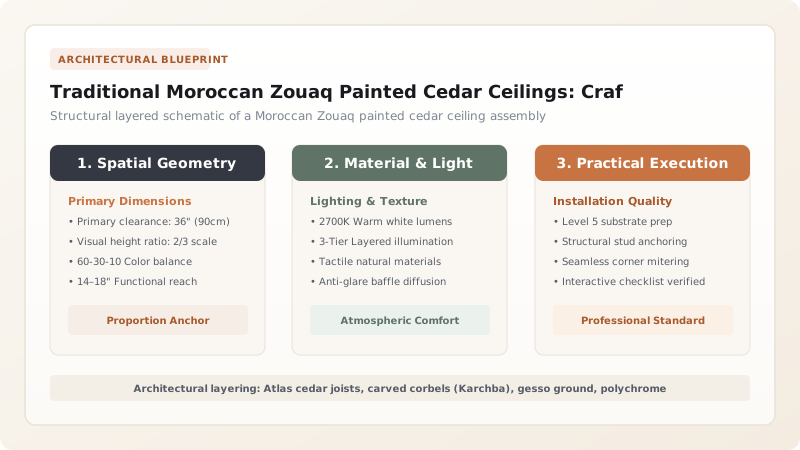
Traditional Moroccan Zouaq Painted Cedar Ceilings: Craft Heritage & Techniques Architectural Decision Matrix
Use this reference table to calculate exact physical dimensions, ratios, and specifications before purchasing:
| Pigment / Component | Natural Mineral Origin | Binding Medium | Lightfastness | Application Zone |
|---|---|---|---|---|
| Moroccan Red Ochre | Natural hematite iron oxide | Animal skin glue (Ghira) | Permanent | Background fields and structural beam reveals |
| Lapis / Cobalt Blue | Smalt / ground cobalt oxide | Egg tempera emulsion | High UV stability | Intertwined floral arabesques (Tawq) |
| Malachite Green | Basic copper carbonate | Gum arabic / animal glue | Excellent indoors | Foliate vine leaves and palmettes |
| 24k Gold Leaf | Beaten elemental gold leaf | Armenian bole / oil size | Permanent, zero oxidation | Central star rosettes and corbel tips |
| Sandarac Varnish | Tetraclinis articulata resin | Grain alcohol + linseed oil | Non-yellowing crystal clear | Final protective sealant over tempera |
Practical Constraints
Every successful decoration project must account for physical and environmental constraints:
Overhead Ergonomics and Site Painting
Scarcity of Atlas Cedar
Traditional Master Execution of a Zouaq Ceiling Panel
Execute this professional sequence to achieve flawless results without backtracking:
Timber Planing and Seasoning
Hand-plane aged Atlas cedar planks to silky smoothness; burnish away loose grain fibers with dried shark skin or horsetail reeds.
Gesso Priming (Zouana)
Apply two ultra-thin coats of slaked plaster/chalk ground mixed with weak animal hide glue to seal wood pores without obscuring fine carved reliefs.
Geometric Compass Layout
Draft master geometric grids directly onto the primed wood using iron dividers, rulers, and compasses, establishing 8, 12, or 16-point star lattices.
Base Tone Blocking
Lay down rich, opaque background fields of red ochre, deep cobalt blue, or emerald green using flat ox-hair brushes.
Arabesque Outlining (Tashjir)
Paint fine black or white calligraphy-like contour lines around all floral tendrils and geometric stars using fine-tipped squirrel hair brushes.
Sandarac Resin Glazing
After full drying of tempera, apply two coats of warmed sandarac resin and boiled linseed oil to seal pigments against dust and moisture.
Common Mistakes & Countermeasures
Avoid these costly errors that compromise aesthetics, ergonomics, and budget:
Applying modern synthetic polyurethane varnishes
Using unseasoned green cedar timber
Overly thick gesso priming
Project Execution Checklist
Track your physical progress. Checkboxes persist automatically on this device:
Frequently Asked Questions
How long does a traditional Zouaq ceiling survive without fading?
Because natural mineral pigments and Atlas cedar are chemically inert and UV-stable indoors, undisturbed Zouaq ceilings regularly survive between 300 and 600 years with minimal color loss, requiring only gentle surface dust removal.
What is the difference between Tawq and Hasba in Zouaq?
Hasba refers to the mathematical, compass-derived geometric star system (Euclidean polyhedra), while Tawq refers to the free-flowing, botanical arabesque vocabulary (stylized leaves, palmettes, and lotus flowers) painted within or framing the geometric fields.


