
Restoring antique Moroccan Qadria doors requires stabilizing decayed cedar with localized Dutchmen timber patches, treating active insect galleries with permethrin in mineral spirits, and forging authentic low-carbon wrought iron hardware. Traditional round-headed studs (jouta) and circular or Hamsa ring knockers (halaqa) are hot-forged by blacksmiths, quenched in oil, and clenched through the thick door leaves.
At a Glance: Key Takeaways
- Hardware Typology: Hand-hammered faceted dome studs (jouta) and heavy ring/hamsa door knockers.
- Metal Chemistry: Low-carbon wrought iron or ductile mild steel forged over charcoal embers.
- Fastening Technique: Through-bolting with clenched shanks bent at 90 degrees on interior door face.
- Wood Stabilization: Reversible hide-glue consolidation and matched heartwood Atlas cedar Dutchmen inserts.
- Pest Eradication: Deep localized injection of pyrethroid insecticides into historic beetle flight holes.
- Surface Preservation: Hand-rubbed beeswax and boiled linseed oil finish to nourish century-old cedar.
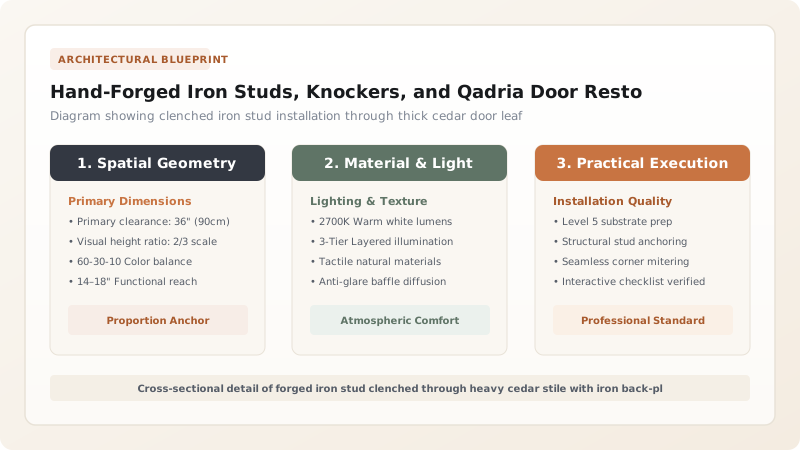
Wrought Iron Hardware: Jouta Studs and Halaqa Knockers
In Moroccan portal design, iron hardware is not merely decorative; it serves vital structural and defensive functions. The face of a Qadria door is studded with hundreds of hand-forged iron clouts known as jouta. These heavy, multi-faceted mushroom or pyramidal studs physically armor the wood against battleaxe chopping attacks and bind external planking to the heavy structural backing frame.
The traditional door knocker consists of either a massive circular forged ring (halaqa) striking against a raised iron anvil boss or a stylized open-palm talisman (Hamsa / Hand of Fatima). Blacksmiths forge these elements by hand from scrap rail iron or wrought iron billets, hot-punching hinge eyes and quenching the finished pieces in spent olive oil to produce a durable, rust-resistant blackened magnetite finish.
Restoration Methodology: Dutchmen Repairs and Consolidation
Antique Qadria portals frequently suffer severe decay at the bottom 300mm of the leaves due to street splashes, donkey urine, and ground moisture wick. Standard restoration requires sawing away completely degraded spongy sapwood with clean geometric cuts along the grain lines.
Conservators craft tight-fitting replacement blocks ('Dutchmen') from salvaged antique Atlas cedar possessing matching growth ring density and grain direction. These patches are bedded in animal hide glue or reversible non-expanding epoxy (such as West System with microfibers) and pinned with hand-carved cedar dowels, leaving the original historic carved upper panels fully intact.
Hardware Clenching and Final Oil Consolidation
Historically, Moroccan craftsmen never used threaded machine nuts or modern woodscrews to secure heavy iron studs. Each stud features a square-tapered forged iron shank 120mm to 180mm long. The maalem drives the stud through a pre-drilled pilot hole in the front face until the faceted head seats against the timber.
On the back of the door, the projecting iron tip is heated or cold-hammered with a ball-peen hammer, bending it over at 90° and driving the sharp tip back into the interior cedar grain—a technique known as 'clenching'. Once all ironwork is secured, the door receives three coats of warm boiled linseed oil rubbed by hand with sheep fleece, restoring deep amber luster and water-shedding resilience.
Restoration Treatment Protocols for Historic Qadria Door Components
Use this reference table to calculate exact physical dimensions, ratios, and specifications before purchasing:
| Defect / Damage | Historic Root Cause | Acceptable Conservation Protocol | Prohibited Invasive Method |
|---|---|---|---|
| Rotted Bottom Rail / Plinth | Alley splash water and rising damp | Spliced quarter-sawn Atlas cedar Dutchman | Filling with synthetic bondo or polyester putty |
| Loose Rusted Iron Studs | Tannin acid corrosion and wood shrinkage | Careful extraction, forge-annealing, re-clenching | Gluing in place with construction adhesive |
| Powderpost Beetle Galleries | Infestation by Anobium punctatum | Localized permethrin injection into exit holes | Indiscriminate surface bleach drenching |
| Flaking Zouaq Pigment | Desiccation of organic glue binder | Consolidation with 5% sturgeon or hide glue mist | Coating with modern clear acrylic spray varnish |
Practical Constraints
Every successful decoration project must account for physical and environmental constraints:
Door leaves weigh over 300 kg and must be removed through narrow medina alleyways
Mitigation: Erect temporary A-frame timber hoists with manual chain falls and transport door leaves vertically on padded hand trolleys.
Execution Blueprint & Craftsmanship Sequence
Execute this professional sequence to achieve flawless results without backtracking:
Document and Number All Iron Hardware
Photograph portal grid and tag each iron stud, knocker, and back-plate before careful non-destructive extraction.
Eradicate Active Wood-Boring Insects
Inject systemic permethrin insecticide solution into beetle exit holes and wrap door in airtight poly sheeting for 72 hours.
Excise Decayed Timber and Fit Cedar Dutchmen
Route out decayed base wood to sound timber. Shape matching seasoned Atlas cedar blocks and glue with reversible binder.
Consolidate and De-Rust Wrought Iron Hardware
Submerge iron studs in electrolytic de-rusting bath or wire-brush manually. Heat to 300°C and quench in beeswax/linseed mixture.
Re-Install and Clench Iron Studs Through Door Leaf
Reinsert forged studs through original holes and clench tail shanks tightly into rear door face timber.
Recondition Portal Surfaces with Linseed and Beeswax
Buff entire door with heated blend of 70% pure boiled linseed oil and 30% melted unbleached beeswax.
Common Mistakes & Countermeasures
Avoid these costly errors that compromise aesthetics, ergonomics, and budget:
Pressure washing historic carved cedar doors to strip dirt and alley grime
Replacing rusted original hand-forged studs with cast-iron reproduction nails from hardware stores
Project Execution Checklist
Track your physical progress. Checkboxes persist automatically on this device:
Frequently Asked Questions
Why do Moroccan iron door studs turn black instead of bright silver?
Traditional blacksmiths quench red-hot forged iron in heavy oil or rub it with beeswax while hot, creating a microscopic black iron oxide (magnetite, Fe3O4) barrier that repels atmospheric corrosion.
What is the symbolic meaning of the Hamsa door knocker?
The Hamsa represents the Hand of Fatima, an ancient protective talisman throughout North Africa believed to deflect the evil eye (ayn) and bless the domestic inhabitants.


