
Moroccan architectural cedar carving blends deep-relief geometric strapwork (taourij) with mineral polychromy (zouaq). Carvers lay out intricate multi-pointed star geometries (hasba) using proportional compass dividers, chisel out background grounds to 15–20mm depth, and apply natural pigments—cinnabar, lapis lazuli, malachite, and orpiment—bound in animal glues and sealed under boiled linseed oil.
At a Glance: Key Takeaways
- Geometric Foundation: Compass and straightedge hasba division generating 8, 12, 16, and 24-point rosettes.
- Carving Tools: High-carbon gouges (gouges), skew chisels (fermoirs), and wooden mallets (mabdaza).
- Relief Depth: 12mm to 20mm negative hollowing leaving sharp, bevelled ribbon profiles.
- Pigment Mineral Chemistry: Cinnabar (red), lapis lazuli (ultramarine), malachite (green), minium (orange).
- Binder System: Rabbit-skin glue or egg-tempera emulsion rubbed onto unsealed cedar surfaces.
- Sealing Varnish: Clarified boiled linseed oil blended with natural sandarac tree resin.
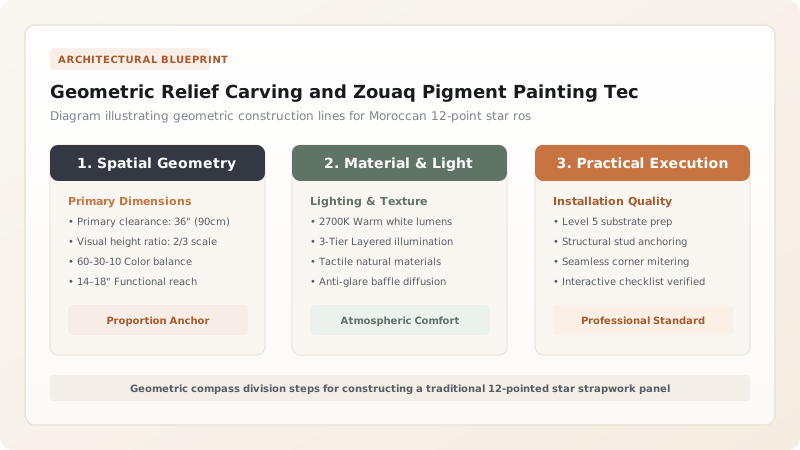
Hasba Geometric Proportions and Compass Scribing
In Moroccan Islamic woodcraft, ornamentation is never arbitrary; it is governed by the hasba system of proportional geometry. Master carvers scribe layouts directly onto the planed cedar panel using fine steel dividers, a brass straightedge, and a scoring knife (scrite). No paper transfers or chemical stencils were historically permitted.
The composition begins from a central circle divided into four, six, or eight quadrants. By intersecting concentric circles and tangents, the carver generates interlocking star rosettes (khatam) and interlacing bands (saft). The width of each ribbon strap is strictly calibrated to the overall panel height to preserve visual harmony across the massive portal face.
Taourij Chiseling: Depth, Bevels, and Textures
Once scribed, carving proceeds in three distinct stages: outlining, grounding, and modeling. First, the carver uses a V-parting chisel (burin) to incise along the scribed lines, severing surface fibers to prevent tearout during rough excavation.
Next, background fields are cleared using straight and curved gouges, establishing an even negative depth of 15mm to 20mm. Finally, the raised ribbons and floral tendrils receive their architectural profile: edges are bevelled at a 45° angle, and central ribbon spines are lightly fluted or stamped with micro-geometric punches (manqash) to catch angled courtyard sunlight.
Zouaq Polychrome: Mineral Pigments and Binder Physics
Where doors or upper lintel friezes receive color, the craft enters the domain of the zouwaq (painter). Unlike modern oil paints that form a thick plastic skin, authentic zouaq utilizes pure inorganic mineral pigments ground with water and bound in warm rabbit-skin glue or egg tempera.
The mineral palette comprises cinnabar (mercuric sulfide) for vermilion red, pulverized Afghan lapis lazuli or copper carbonate for deep blue, malachite for vibrant emerald green, and calcined bone for stark white highlights. Because these pigments are ground finely and applied in thin watery washes, they bond molecularly into the cedar fibers, maintaining vibrant luminosity without peeling under arid heat.
Traditional Moroccan Mineral Pigments vs Modern Synthetic Substitutes
Use this reference table to calculate exact physical dimensions, ratios, and specifications before purchasing:
| Color Hue | Historic Mineral Pigment | Binder Matrix | Lightfastness | Modern Synthetic Risk |
|---|---|---|---|---|
| Imperial Red | Natural Cinnabar / Vermilion | Rabbit-skin glue | Archival (100+ yrs) | Synthetic cadmium shifts dark brown in UV |
| Majestic Blue | Lapis Lazuli / Azurite | Egg-tempera wash | Impervious to fade | Phthalocyanine blue looks garish and artificial |
| Courtyard Green | Ground Malachite / Verdigris | Gum arabic | High lightfastness | Modern acrylic paints trap moisture and rot wood |
| Golden Ochre | Natural Yellow Iron Oxide | Animal glue | Permanent mineral | Synthetic azo pigments wash out in exterior rain |
Practical Constraints
Every successful decoration project must account for physical and environmental constraints:
Toxicity of historic mineral pigments (cinnabar contains mercury, verdigris contains copper acetate)
Mitigation: Wear P100 respirators and nitrile gloves during pigment grinding and paint formulation in well-ventilated studios.
Execution Blueprint & Craftsmanship Sequence
Execute this professional sequence to achieve flawless results without backtracking:
Prepare Scribed Layout with Steel Dividers
Establish centerlines and scribe geometric grid directly into cedar face using compass and layout knife.
Outline Geometric Ribbons with V-Chisel
Cut crisp 3mm stop-cuts along all boundary lines to prevent cross-grain tearing during waste removal.
Hollow Ground Fields to 15mm Depth
Remove negative background wood with heavy gouge, leveling depth against a pre-set wooden depth gauge.
Model Floral Arabesques and Chamfers
Carve 45-degree chamfers on strapwork edges and feather out floral tendril tips with razor-sharp skew chisels.
Apply Zouaq Mineral Paint Washes
Hand-paint pigments bound in animal glue into background voids and ribbon accents using fine goat-hair brushes.
Seal with Boiled Linseed and Sandarac Varnish
Brush warm clarified linseed oil infused with dissolved sandarac resin over entire surface to protect pigments.
Common Mistakes & Countermeasures
Avoid these costly errors that compromise aesthetics, ergonomics, and budget:
Using a rotary CNC router with ball-nose bits to mimic hand-carved taourij
Applying acrylic artist colors directly over unprimed resinous cedar
Project Execution Checklist
Track your physical progress. Checkboxes persist automatically on this device:
Frequently Asked Questions
What is the difference between taourij and zouaq?
Taourij is the physical three-dimensional chiseling and relief carving of the wood, whereas zouaq is the decorative polychrome painting applied to the carved surface.
Why do traditional Moroccan carvers prefer skew chisels over flat chisels?
The angled edge of a skew chisel allows the carver to slice smoothly into deep acute internal corners of geometric star rosettes without bruising adjacent wood fibers.


