
Moroccan Qadria doors are massive monumental cedar portals composed of interlocking structural stiles, carved friezes, and projecting corbelled lintels crafted from fragrant Atlas cedar (Cedrus atlantica). Renowned for intricate geometric relief carving (taourij), floral arabesques (taous), and mineral polychrome painting (zouaq), Qadria portals integrate heavy hand-forged iron clouts and knockers to withstand arid temperature swings while providing defensive prestige to riads and medersas.
At a Glance: Key Takeaways
- Primary Timber: High-altitude Moroccan Atlas cedar (Cedrus atlantica), naturally decay and insect resistant.
- Architectural Typology: Double-leaf swinging portal with integrated wicket door (khoukha) for pedestrian passage.
- Joinery Construction: Heavy mortise-and-tenon structural subframes pinned with dried hardwood dowels.
- Decorative Carving: Deep chiselled taourij geometric knots and taous floral relief panels.
- Surface Pigmentation: Traditional zouaq egg-tempera and natural gum mineral pigments sealed with boiled linseed oil.
- Hardware Integration: Hand-forged iron round-headed studs (jouta), strap hinges, and ring knockers (khamsa/halaqa).
In-Depth Guides in this Directory
Explore specialized subtopic blueprints, technical dimensions, and execution checklists:
Atlas Mountain Cedar Selection and Seasoning for Qadria Doors
Technical guide to selecting, grain-grading, and natural air-seasoning high-altitude Moroccan Atlas cedar for monumental Qadria door construction.
Geometric Relief Carving and Zouaq Pigment Painting Techniques
Master guide to Moroccan taourij deep cedarwood carving and traditional zouaq mineral pigment painting on historic architectural doors.
Hand-Forged Iron Studs, Knockers, and Qadria Door Restoration
Comprehensive guide to restoring antique Moroccan Qadria doors, forging authentic iron jouta clouts, and fitting heavy ring knockers.
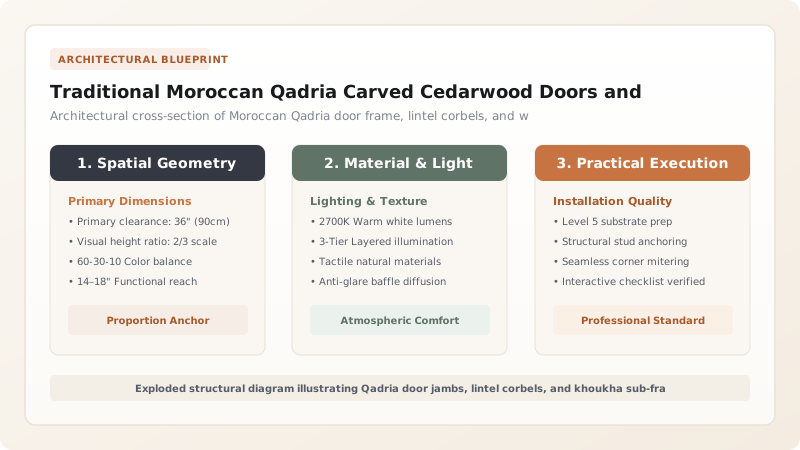
Architectural Anatomy and Historic Role of Qadria Portals
In Moroccan vernacular architecture, the entrance portal represents the threshold between the chaotic public street (derb) and the sacred, tranquil domestic sanctuary of the riad courtyard. The term Qadria designates monumental cedarwood doors characterized by heavy perimeter frames, projecting corbelled lintels (kourssi), and layered architectural friezes that span residential mansions, caravanserai (funduqs), and royal medersas in Fez, Marrakech, and Meknes.
A defining functional innovation of the Qadria door is the incorporation of the khoukha—a smaller, arched pedestrian wicket door cut directly into one of the massive primary door leaves. The main double leaves open fully only for ceremonial processions, pack animals, or bulky cargo, while the low wicket door compels visitors to bow their heads in humility and respect when entering the private domestic realm.
Material Physics: Atlas Cedar Seasoning and Resilience
The structural longevity of Qadria doors relies entirely on Moroccan Atlas cedar (Cedrus atlantica), harvested from high elevations in the Middle Atlas mountains near Azrou and Ifrane. Atlas cedar possesses exceptional natural resistance to subterranean termites, fungal decay, and dry rot due to its high concentration of natural aromatic essential oils, including atlantone and cedrol.
Traditional carpenters (maalems) insist on slow air-seasoning cedar timbers for a minimum of 24 to 36 months under shaded mountain drying sheds before fabrication. Prematurely converting unseasoned green cedar results in severe tangential warping, split stiles, and open mortise joints when exposed to the intense solar radiation and bone-dry winds (chergui) of inland Moroccan climates.
Carving Disciplines: Taourij Relief and Zouaq Polychromy
Surface ornamentation on Qadria portals divides into two master disciplines: three-dimensional relief chiselling (taourij) and vibrant polychrome pigment painting (zouaq). Taourij carving begins with geometric layout executed with compass and straightedge directly onto planed cedar boards, tracing eight-pointed (thamin), twelve-pointed, or sixteen-pointed star rosettes intertwined with continuous strapwork ribbons.
Master carvers utilize gouges (gouges courbes) and skew chisels (fermoirs) to hollow out negative grounds to depths of 12mm to 20mm, leaving sharp, crisp geometric ribbons standing proud. In royal and prestigious palatial installations, carved panels receive zouaq painting: ground mineral pigments—cinnabar red, lapis lazuli ultramarine, malachite green, and orpiment yellow—suspended in egg tempera or gum arabic binders, finally burnished and sealed under clarifying boiled linseed oil.
Comparative Analysis of Moroccan Architectural Cedar Portal Styles
Use this reference table to calculate exact physical dimensions, ratios, and specifications before purchasing:
| Portal Typology | Structural Framework | Carving Depth | Surface Treatment | Typical Application |
|---|---|---|---|---|
| Monumental Qadria | Heavy cedar stiles with khoukha wicket | 15–22 mm relief taourij | Natural oiled or partial zouaq | Riad portals, funduqs, medersas |
| Palatial Zouaq Door | Solid cedar panels with flat framing | Shallow 2–5 mm incised lines | Full polychrome lacquer painting | Interior salon double doors |
| Mashrabiya Porticullis | Turned cedar lattice dowel matrix | None (lathe-turned cylindrical) | Unpainted raw oiled cedar | Overhead loggias and street bay windows |
| Fortified Kasbah Gate | Rough-hewn split cedar log core | Chiselled tribal chevrons (10 mm) | Raw weathered or tallow-rubbed | Southern pre-Saharan earthen fortresses |
Practical Constraints
Every successful decoration project must account for physical and environmental constraints:
Substantial deadweight of solid cedar portal (250–400 kg) exceeding modern masonry wall anchorage
Mitigation: Install heavy structural timber anchor grounds built directly into stone or solid brick masonry reveals during initial structural framing.
Extreme humidity differences between shaded damp medina alleys and scorching sunny courtyard exposures
Mitigation: Allow 5mm expansion floats in panel grooves and treat exterior faces with high-solids penetrating oil annually.
Execution Blueprint & Craftsmanship Sequence
Execute this professional sequence to achieve flawless results without backtracking:
Select and Plane Seasoned Middle Atlas Cedar
Procure quarter-sawn Atlas cedar timbers air-dried below 10% moisture content. Plane jambs, stiles, and lintel beams to flat, true 75mm x 150mm profiles.
Cut Through Mortise and Pinned Tenon Joinery
Layout structural frame joints with mortise and tenons. Drill and draw-bore joint connections with tapered octagonal cedar dowels driven dry.
Geometric Layout and Taourij Relief Carving
Scribe geometric star rosettes and arabesques onto panel faces. Chisel out background fields to uniform 15mm depth using hollow gouges.
Frame and Hang the Pedestrian Khoukha Wicket
Cut arched pedestrian portal into primary leaf. Mount wicket using offset pivot pintles and internal wooden sliding drop-bolts (zakkoum).
Mount Hand-Forged Wrought Iron Hardware
Pre-drill and hammer heavy iron round-headed studs (jouta) in diamond patterns. Fasten cast-iron ring knocker and heavy iron backing straps.
Linseed Oil and Wax Penetrating Finish
Apply three saturated coats of heated raw linseed oil mixed with pine turpentine, followed by hand-buffed beeswax for exterior weatherproofing.
Common Mistakes & Countermeasures
Avoid these costly errors that compromise aesthetics, ergonomics, and budget:
Fabricating Qadria frames from kiln-dried plantation timber or green cedar
Applying impermeable modern polyurethane clear coats over exterior cedar
Mounting heavy wrought iron studs with modern zinc-plated drywall screws
Project Execution Checklist
Track your physical progress. Checkboxes persist automatically on this device:
Frequently Asked Questions
What is the architectural purpose of the small khoukha wicket door?
The khoukha wicket door allows pedestrian access without swinging open the massive 300kg primary leaves. Its low height also requires visitors to bow slightly, conferring traditional humility upon entering the domestic home.
Why is Moroccan Atlas cedar specifically chosen for historic Qadria portals?
Cedrus atlantica contains dense concentrations of natural antiseptic oils and terpenes, making it naturally immune to wood-boring beetles and fungal rot under dry and arid Mediterranean climates for centuries.
How do you clean and maintain carved cedar doors without ruining the patina?
Brush away loose dust with a horsehair brush, clean gently with mild olive oil Castile soap diluted in water, allow to dry completely, and rub in a 50/50 blend of boiled linseed oil and mineral turpentine with a soft cotton rag.


