
Conserving historic Moroccan Gebs plaster requires dry, non-dissolving methodologies. Gypsum's slight water solubility (2g/L) strictly forbids liquid water washes. Conservators employ regulated micro-air suction, dry vulcanized latex sponges, ammonium carbonate poultices for soot removal, and barium hydroxide or nano-lime consolidants to strengthen crumbling, friable antique plaster lace without altering historic white porosity.
At a Glance: Key Takeaways
- Conservation Hazard: Gypsum dissolves in water (2.4 g/L at 20°C); liquid washes melt fine carved lace.
- Dust Remediation: Low-pressure regulated micro-air blasting (<1.2 bar) with simultaneous HEPA suction.
- Chemical Soot Removal: Gelled ammonium carbonate or agarose gel packs absorbing urban soot crusts.
- Consolidation Chemistry: Inorganic nano-lime (calcium hydroxide nanoparticles) or barium hydroxide poulticing.
- Structural Anchoring: Threaded non-corroding brass or fiberglass rods anchored in reversible hydraulic lime.
- Microclimate Target: Stable 40% to 55% relative humidity; avoiding water splash from courtyard fountains.
Gypsum Water Solubility and Non-Aqueous Cleaning Protocols
Unlike lime plaster (calcium carbonate), which is insoluble in water, gypsum plaster (calcium sulfate dihydrate) has a significant water solubility of approximately 2.4 grams per liter. Squirting water or aqueous detergents onto historic Gebs dissolves the microscopic razor-sharp chisel facets, turning intricate lace into melted, rounded slush.
Cleaning must be executed entirely dry or with rigid gels. Conservators start with micro-nozzle vacuum extractors fitted with natural horsehair brushes. Oily candle soot, pigeon droppings, and urban vehicle exhaust are lifted using rigid agarose or cyclododecane gel poultices. These gels hold cleaning solvents in a physical lattice, absorbing dirt by capillary action without releasing liquid water into the porous plaster.
Friability Decay and Inorganic Nano-Lime Consolidation
In unconditioned historic riads, centuries of cyclic humidity swings cause gypsum crystals to slowly dissolve and recrystallize, leading to 'sanding' or loss of cohesive bond. The plaster becomes friable and crumbles under the slightest touch.
To consolidate degraded Gebs, modern conservators avoid synthetic acrylics (such as Paraloid B-72), which clog pores and turn yellow in desert heat. Instead, conservators apply nano-lime (sub-micron particles of calcium hydroxide suspended in pure isopropyl alcohol). The ultra-small particles penetrate 20mm into the crumbling plaster. As the alcohol evaporates, the nanoparticles react with indoor carbon dioxide (carbonation), precipitating a micro-crystalline network of insoluble calcium carbonate that permanently knits the crumbling gypsum grains solid.
Re-Anchoring Bulging Friezes with Concealed Brass Pins
Due to moisture intrusion from leaking roof terraces, historic Gebs friezes often delaminate from the brick backing, bulging outward under immense gravitational shear stress.
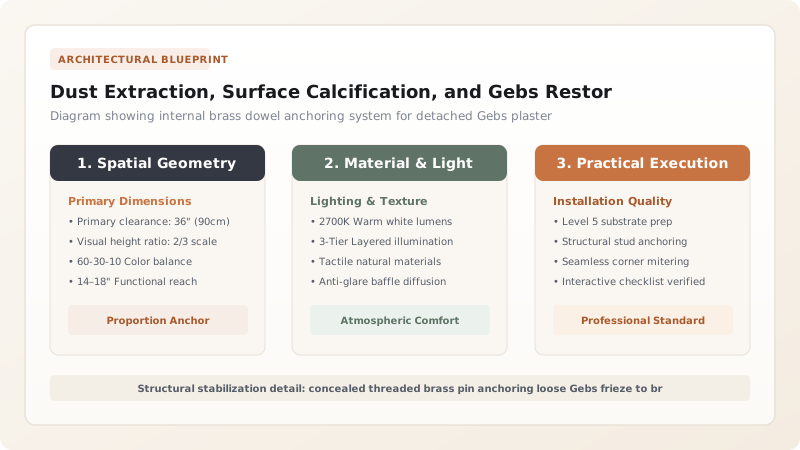
Conservators map void pockets using non-destructive ultrasonic tap testing. Small 3mm pilot holes are drilled through deep, shadowed negative background zones into the masonry. Threaded brass or pultruded fiberglass rods are inserted and bedded into the brick with fluid, non-expansive natural hydraulic lime (NHL 2) micro-grout. The rod head is countersunk beneath the plaster face and capped with matching gypsum paste, invisibly securing the historic plaster without dismantling the irreplaceable lace.
Conservation Treatment Matrix for Historic Moroccan Gebs
Use this reference table to calculate exact physical dimensions, ratios, and specifications before purchasing:
| Degradation State | Historic Root Cause | Approved Conservation Protocol | Prohibited Invasive Method |
|---|---|---|---|
| Superficial Dust & Cobwebs | Atmospheric accumulation | Low-pressure air blast & HEPA suction | Dousing with liquid water hose |
| Black Candle / Lamp Soot | Centuries of open oil lamps | 2% Agarose gel poultice with citrate | Scrubbing with alkaline bleach / ammonia |
| Friable, Sanding Plaster | Desiccation and crystal dissolution | Nano-lime alcohol suspension misting | Coating with modern polyurethane varnish |
| Bulging Delaminated Frieze | Terrace roof water leak behind wall | Concealed threaded brass pins & lime grout | Driving iron masonry nails through face |
Practical Constraints
Every successful decoration project must account for physical and environmental constraints:
Courtyard fountains splashing fine water droplets onto low carved Gebs friezes
Mitigation: Install subtle tempered glass or acrylic protective splash screens and regulate fountain water pressure.
Execution Blueprint & Craftsmanship Sequence
Execute this professional sequence to achieve flawless results without backtracking:
Document and Map Surface Pathologies
Photograph frieze under angled raking light; map cracks, missing lace sections, and bulging delaminations on CAD elevation.
Extract Dry Dust with Micro-Nozzle Vacuum
Trace deep carved hollows with fine goat-hair brush while running micro-nozzle HEPA vacuum to extract particulate dust.
Apply Agarose Gel Poultice to Soot Stains
Warm 2% agarose gel to 45°C; cast flexible sheet conforming to carved contours, leaving 30 minutes to draw out soot.
Mist Friable Gypsum with Nano-Lime Consolidant
Spray alcohol-based calcium hydroxide nanoparticle suspension; allow 14 days for complete carbonation and hardening.
Install Concealed Threaded Brass Anchors
Drill 3mm pilot hole through shadowed background into brick; secure threaded brass pin with injected micro-lime grout.
Infill Losses with Matched Mountain Gypsum
Infill chipped edges with pure High Atlas gypsum paste; hand-chisel repairs to blend seamlessly with 16th-century work.
Common Mistakes & Countermeasures
Avoid these costly errors that compromise aesthetics, ergonomics, and budget:
Pressure washing historic carved Gebs plaster with a garden hose
Painting historic Gebs with modern synthetic white vinyl or emulsion paint
Project Execution Checklist
Track your physical progress. Checkboxes persist automatically on this device:
Frequently Asked Questions
Can missing sections of antique Gebs be replicated accurately?
Yes. Master maalems in Fez and Marrakech still practice traditional hand-chiseling; they can carve matching replacement segments in situ directly into fresh mountain gypsum beds to seamlessly restore damaged historic friezes.
Why does iron nail corrosion destroy Moroccan plaster?
When iron nails corrode, iron oxide expands to three times the original volume of the metal. This immense expansive force shatters the brittle surrounding gypsum plaster, creating large jagged blowout holes.


