
Moroccan Gebs (also spelled Ghibs) is an ancient monumental plastercraft perfected in the imperial medinas of Fez, Marrakech, and Meknes. Artisans apply thick beds of pure, locally calcined mountain gypsum plaster (CaSO4·0.5H2O) directly to brick and cedar substrates, hand-carving breathtaking multi-layered geometric strapwork, Arabic calligraphy, and delicate floral arabesques directly into the damp plaster using specialized curved chisels (minkash) during a strictly controlled 4-to-6 hour curing window.
At a Glance: Key Takeaways
- Primary Raw Material: High-purity Moroccan mountain gypsum stone calcinated in traditional wood-fired kilns.
- Artistic Working Window: Direct in-situ carving during the 'leather-hard' state (3 to 6 hours after troweling).
- Master Carving Tools: Hand-forged steel gouges and skew chisels known collectively as minkash (or manqash).
- Multi-Tiered Depth: 3 to 4 stepped spatial planes reaching relief depths of 20mm to 35mm with dramatic undercuts.
- Design Geometry: Hasba proportional compass geometry generating 8, 16, and 24-pointed Islamic star mandalas.
- Architectural Zones: High-relief friezes, arch spandrils, squinches, and vaulted ceilings in historic riads and medersas.
In-Depth Guides in this Directory
Explore specialized subtopic blueprints, technical dimensions, and execution checklists:
Moroccan Mountain Gypsum Slaking and Open-Carving Formulation
Technical chemistry guide to Moroccan Gebs plaster: High Atlas gypsum calcination, mechanical crystal-breaking slaking, and carveable open-time kinetics.
Minkash Chisel Geometry and Multi-Layer Fretwork Undercutting
Master guide to Moroccan plaster carving: minkash chisel profiling, 3-tier relief depths, reverse-angle undercutting, and calligraphic execution.
Dust Extraction, Surface Calcification, and Gebs Restoration
Architectural conservation guide for Moroccan Gebs: dry dust extraction, non-invasive soot removal, gypsum consolidation, and structural repair.
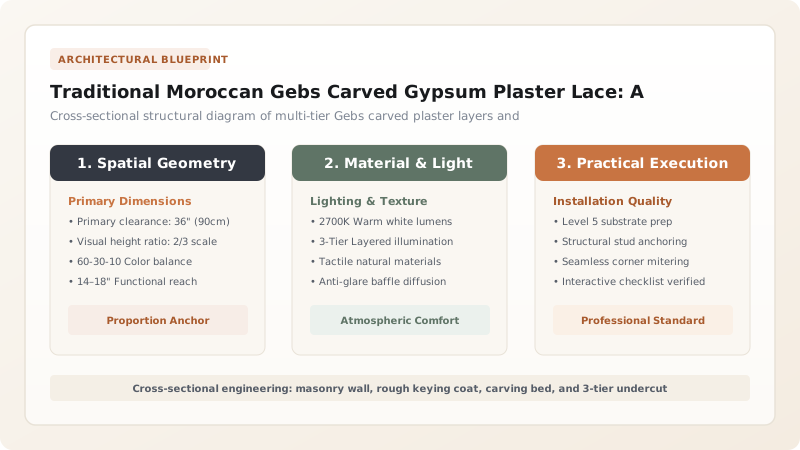
Historical Heritage and Sacred Geometry of Moroccan Gebs
In Moroccan palatial and sacred architecture—epitomized by the Bou Inania Medersa in Fez and the Saadian Tombs in Marrakech—carved plaster (gebs) holds an exalted position. Sited between the colorful ceramic zellige tile dados at eye level and the fragrant painted cedar ceilings (zouaq) above, gebs forms a luminous white band of spiritual transition.
Unlike Western plasterwork formed by pressing paste into repetitive molds, authentic Moroccan gebs is carved 100% freehand in situ. The master artisan (maalem) traces intricate non-representational geometries, floral arabesques (taous), and cursive Thuluth or angular Kufic Quranic calligraphy directly into the fresh plaster, carving the entire wall like a monumental sculpture.
Mountain Gypsum Chemistry and the Workability Window
Standard modern plaster of Paris flash-sets in 10 minutes and cures rock-hard, making chiseling impossible. Moroccan gebs uses mineral gypsum quarried from natural outcrops in the High Atlas mountains and Safi.
The stone is calcined at low heat (130°C–150°C) in traditional wood-fired kilns and pulverized into a soft, flour-like powder. When mixed with pure water in shallow wooden basins, the plasterer beats the slurry continuously with flat wooden paddles. This mechanical shear breaks the initial needle-like crystalline bonds, keeping the plaster in a plastic, butter-soft 'leather-hard' state for 4 to 6 hours, providing the maalem the exact open window needed to carve delicate undercuts.
The Minkash Chisel: Multi-Tiered Undercuts and Shadow Play
Carving is performed using custom-forged carbon steel tools called minkash. These include curved gouges, skew chisels, and triangular scoring blades fitted with short bulbous palm handles that allow the craftsman to apply fingertip pressure.
The artisan cuts through three distinct depth planes: the highest plane features crisp geometric strapwork ribbons; the intermediate plane contains scrolling floral leaves; and the deepest plane (excavated up to 30mm deep) forms the shadowed negative background. By undercutting the raised ribbons at a 60° reverse angle, the plaster appears to detach from the wall, floating like weightless white lace in the diffused courtyard light.
Moroccan Gebs Plasterwork vs Western Molded Cornice Plaster
Use this reference table to calculate exact physical dimensions, ratios, and specifications before purchasing:
| Craft Metric | Moroccan Carved Gebs | Western Molded Gypsum | Modern Polyurethane Faux Relief |
|---|---|---|---|
| Execution Method | 100% Direct hand-carved in-situ | Liquid casting in rubber molds | High-density polyurethane injection |
| Undercut Capability | Extreme 60° reverse undercuts | Zero or minimal (must release from mold) | Machine-drafted; zero true undercuts |
| Surface Texture | Crisp, hand-faceted chisel planes | Smooth, sterile, rounded mold skin | Flat, synthetic plastic skin |
| Acoustic Performance | Scatters high-frequency echo sound | Reflects hard sound waves | Poor mass; hollow acoustic resonance |
| Historic Longevity | 500 to 800+ years in dry interiors | 100 to 200 years | 20 to 30 years (brittle degradation) |
Practical Constraints
Every successful decoration project must account for physical and environmental constraints:
Rapid ambient drying in hot desert climates (e.g. Marrakech summer at 42°C) hardening plaster prematurely
Mitigation: Seal windows with damp canvas sheets and mist ambient air with fine water sprayers to maintain 80% humidity during carving.
Execution Blueprint & Craftsmanship Sequence
Execute this professional sequence to achieve flawless results without backtracking:
Prepare and Score Masonry Substrate
Rake brick or stone joints 15mm deep and hack surface with mason's adze to create aggressive mechanical key.
Apply Coarse Scratch Coat with Chopped Hemp
Trowel 15mm base coat of gypsum reinforced with natural hemp fiber; scratch horizontal grooves with comb.
Formulate and Trowel Slow-Setting Carving Bed
Mix fine mountain gypsum with water; paddle for 30 minutes and trowel smooth 20mm layer over base coat.
Scribe Hasba Geometric Grid and Calligraphy
Transfer layout directly onto damp plaster using brass dividers, straightedges, and fine scoring awls.
Execute Deep Chisel Carving with Minkash
Excavate negative grounds to 25mm depth, slicing floral chamfers and undercutting strapwork before plaster hardens.
Clean Micro-Cuttings with Bellows and Soft Brush
Blow loose gypsum dust from deep cavities using manual leather bellows; gently brush relief rims with horsehair.
Common Mistakes & Countermeasures
Avoid these costly errors that compromise aesthetics, ergonomics, and budget:
Adding chemical retarders like vinegar or sugar in excessive doses to delay setting
Using a mechanical power rotary tool (Dremel) to carve historic Gebs motifs
Project Execution Checklist
Track your physical progress. Checkboxes persist automatically on this device:
Frequently Asked Questions
Why is authentic Moroccan Gebs left unpainted and unsealed?
Pure calcined mountain gypsum possesses a soft, luminous matte white quality that softly scatters light without harsh glare. Leaving it uncoated preserves its microscopic porosity, allowing it to regulate interior humidity naturally.
How do conservators clean centuries of dust from delicate Gebs lace without breaking it?
Conservators use gentle dry air micro-blasting (under 1.5 bar) combined with high-efficiency HEPA vacuum suction hoods and dry vulcanized rubber smoke sponges, strictly avoiding liquid water washes that dissolve gypsum.


