
Boiled linseed oil saturation and carnauba wax buffing represent the time-honored finishing system for Mexican Saltillo terracotta floors. Raw Saltillo is an open, porous clay sponge that absorbs stains and allows subfloor salts to erupt in white efflorescence blooms. Applying a traditional penetrating saturation treatment—consisting of 2 to 3 successive coats of boiled linseed oil (BLO) thinned with mineral spirits—penetrates up to 5mm into the clay capillaries. Through atmospheric oxygen cross-linking, the oil cures into an insoluble, waterproof amber polymer that deepens the terracotta into a warm, glowing Spanish leather tone. Once fully polymerized, the floor is protected with hand-buffed Mexican carnauba and beeswax paste, providing a renewable satin sheen that repels spills and patinates beautifully.
At a Glance: Key Takeaways
- Penetrating Oil Chemistry: Boiled linseed oil (polymerized flaxseed oil) cross-linking with oxygen into linoxyn resin.
- Solvent Dilution Ratio: 50% BLO + 50% odorless mineral spirits on coat 1; 75/25 on coat 2; 100% BLO on coat 3.
- Substrate Moisture Prerequisite: Tile and mortar must be thoroughly dry (< 12% moisture) to prevent white curing clouding.
- Efflorescence Barrier: Oil polymer fills capillary pores, blocking water from transporting soluble sub-slab salts to the surface.
- Carnauba-Beeswax Paste: Hard Brazilian/Mexican carnauba wax blended with beeswax providing scratch-resistant satin luster.
- Spontaneous Combustion Safety: All oil-soaked rags must be immersed in water-filled metal cans to prevent fire.
- Renewable Maintenance: Worn traffic paths refreshed with a light buff of paste wax without stripping base oil coats.
1. Boiled Linseed Oil Chemistry and Linoxyn Polymerization
Raw flaxseed oil takes weeks to dry and remains tacky. Boiled Linseed Oil (BLO) is flaxseed oil that has been heated with metallic driers (manganese and cobalt compounds), which drastically accelerate the oxidation and cross-linking of polyunsaturated linolenic acid chains.
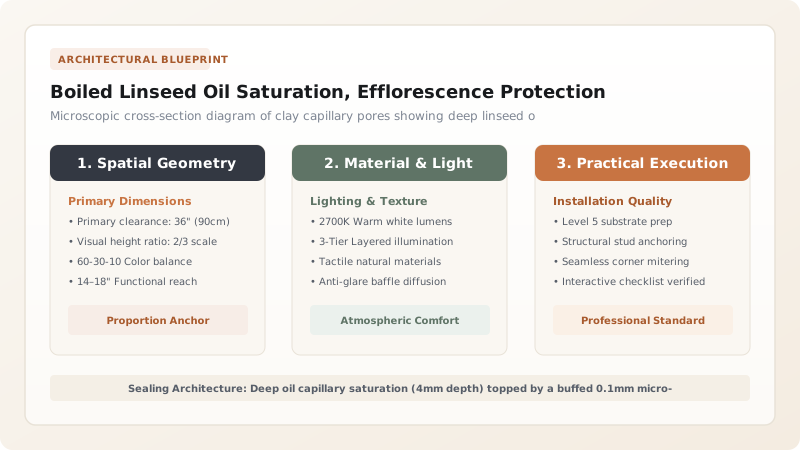
When applied to raw Saltillo terracotta, BLO is sucked deep into the microporous clay matrix by capillary action. Over 24 to 48 hours, the oil absorbs atmospheric oxygen, expanding slightly in volume and transforming from a liquid into a flexible, rubbery solid known as linoxyn. This solid polymer permanently fills the capillary pores of the terracotta, locking out water, grease, and wine, while shifting the refractive index of the clay to reveal deep, translucent amber and chestnut undertones.
2. Efflorescence Protection and Critical Moisture Thresholds
Efflorescence is the primary curse of improperly sealed Saltillo floors. Concrete slabs and mortar beds contain soluble calcium, sodium, and potassium salts. If liquid water moves through the slab, it dissolves these salts, carries them upward through the porous tile, and deposits them on the surface as powdery white crystals as the water evaporates.
Crucially, BLO sealing cannot be applied until the entire tile and mortar installation is bone dry (typically 10 to 14 days after grouting). If oil is applied over damp tile, trapped moisture prevents the oil from penetrating, causing the surface to turn a milky, opaque cloudy white. Once properly cured, the deep linoxyn barrier blocks moisture liquid movement, permanently stopping efflorescence in its tracks.
3. Carnauba and Beeswax Buffing and Long-Term Maintenance
While boiled linseed oil provides deep structural waterproofing, its cured surface can feel slightly tacky under rubber soles and can attract ambient dust. The traditional hacienda solution is to top the cured oil with a protective layer of paste wax.
Authentic tile paste wax blends hard carnauba wax (derived from the leaves of Copernicia prunifera) with soft, fragrant beeswax. Carnauba is the hardest natural wax known, with a high melting point (82°C–86°C). Applied thinly with cotton cloths and buffed at 175 RPM with natural horsehair or union-fiber floor pads, the friction generates heat that melts the wax into a mirror-smooth, hard micro-crystalline film. Spills bead up instantly, and everyday scuffs are buffed away in seconds.
Application Schedule for Boiled Linseed Oil and Paste Wax
Use this reference table to calculate exact physical dimensions, ratios, and specifications before purchasing:
| Application Stage | Chemical Mixture Ratio | Coverage Rate (sq ft / gal) | Drying / Cure Interval | Surface Visual Appearance |
|---|---|---|---|---|
| Primer Penetration Coat | 50% BLO + 50% Mineral Spirits | 250 – 300 | 24 hours with good ventilation | Deep darkening; dry matte finish |
| Intermediate Build Coat | 75% BLO + 25% Mineral Spirits | 350 – 400 | 24–36 hours | Rich amber luster; low-satin sheen |
| Finish Saturation Coat | 100% Pure Boiled Linseed Oil | 450 – 500 | 48 hours (tacky excess wiped off) | Warm translucent glowing sheen |
| Initial Paste Waxing | Carnauba + Beeswax paste | 600 – 800 | Wait 15 min to haze; buff immediately | Silky smooth satin luster |
| Annual Maintenance Buff | Pure carnauba paste wax | 1,000+ | Spot-buff high-traffic paths | Refreshed scratch-resistant gloss |
Practical Constraints
Every successful decoration project must account for physical and environmental constraints:
Strong Solvent and Linseed Odor
Routine Wax Maintenance Requirement
Complete Sealing and Buffing Protocol for Saltillo Flooring
Execute this professional sequence to achieve flawless results without backtracking:
Substrate Dryout Verification
Allow newly grouted Saltillo floor to cure for 14 days; tape clear plastic sheet to floor for 24h to verify zero condensation under sheet.
Deep Vacuuming and Surface Dust Removal
Vacuum floor thoroughly with HEPA commercial vac; tack-mop floor with dry microfiber to ensure zero grit or dust particles remain.
First Primer Oil Coat Application
Mix 50% BLO and 50% mineral spirits; apply generously using lamb's wool applicator or natural bristle brushes, keeping joints saturated.
Wiping Excess Surface Oil
After 30 minutes of soaking, wipe all unabsorbed surface puddles with dry cotton towels; do not allow standing oil to pool on tile faces.
Second Intermediate Oil Application
After 24 hours of curing, apply second coat (75% BLO / 25% solvent); allow to penetrate 30 minutes, wiping surface dry.
Curing Window and Ventilation
Run fans to circulate fresh air for 48 to 72 hours, allowing atmospheric oxygen to fully polymerize the linoxyn oil matrix.
Carnauba Paste Wax Application
Apply thin, even haze of carnauba-beeswax paste using circular motion with terrycloth applicators, working in 10x10 ft sections.
High-Speed Mechanical Buffing
Buff hazed wax with commercial rotary floor machine fitted with natural union-fiber or white polishing pads to produce a deep satin glow.
Common Mistakes & Countermeasures
Avoid these costly errors that compromise aesthetics, ergonomics, and budget:
Leaving excess boiled linseed oil puddles on the tile face to 'dry on their own'
Discarding crumpled oil-soaked cotton rags in a trash can or bucket
Applying linseed oil over damp tiles with active subfloor moisture
Project Execution Checklist
Track your physical progress. Checkboxes persist automatically on this device:
Frequently Asked Questions
Can I use synthetic water-based acrylic sealer instead of boiled linseed oil?
Yes, many modern homeowners use water-based acrylic or polyurethane sealers. However, synthetic plastic sealers form a film *on top* of the tile that can scratch white, peel in high-traffic zones, and look like plastic laminate. Boiled linseed oil penetrates *inside* the clay, producing an authentic, breathable, warm leather patina that never peels.
Why did my oil-sealed Saltillo floor turn cloudy and milky white?
Cloudiness occurs when linseed oil is applied over damp tiles. Water trapped beneath or within the oil film prevents proper oxidation and creates a microscopically dispersed water-in-oil emulsion, which scatters light as a milky haze. The floor must be chemically stripped and dried completely.
Why is disposing of linseed oil rags so dangerous?
Boiled linseed oil hardens by reacting with oxygen from the air. This chemical oxidation reaction releases heat (exothermic). If crumpled rags are bunched in a pile, the heat cannot escape; temperatures can reach 300°C within hours, causing the rags to catch fire spontaneously without an open flame.


