Low-profile mun-gap stationery desks and seoan writing tables represent the ergonomic pinnacle of traditional Korean floor-sitting (jwasik) furniture. Specifically calibrated to the human body seated on an ondol heated floor, the mungap is an elongated, low-slung cabinet (typically 280 to 380 mm in height) positioned beneath paper-latticed window sills. Housing secret document drawers, writing brushes, inkstones, and letters, its horizontal proportions preserve panoramic sightlines into private courtyard gardens while offering effortless reach to the seated scholar.
At a Glance: Key Takeaways
- Furniture Category: Low-Profile Stationery Cabinet (Mungap) & Study Desk (Seoan)
- Standard Height: 280 mm to 380 mm (calibrated to seated elbow height)
- Standard Length: 1,200 mm to 2,400 mm (elongated modular horizontal span)
- Hardware Material: White brass (baekdong) or hand-forged patinated black iron
- Special Feature: Hidden secret document chambers (bimil-seorap) for official seals
The Ergonomics of Jwasik: Seated Floor Culture
In modern industrial design, furniture ergonomics is almost universally calculated for standing or chair-seated human bodies. In traditional Joseon Korea, however, furniture design was governed by an entirely different ergonomic paradigm: jwasik (floor-sitting). Because the floor was heated from beneath by the ondol flue system, daily human life occurred on a horizontal plane barely an inch above the floorboards.
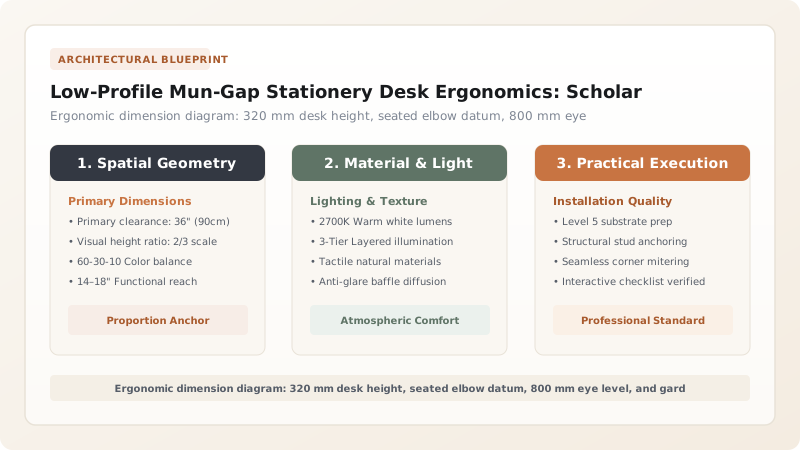
When a scholar was seated cross-legged on a floor mat, their center of gravity, eye level, and kinetic reaching envelope were lowered dramatically. Eye level dropped from five feet (standing) to approximately 800 to 900 millimeters. The elbow rested naturally at 250 to 300 millimeters above the floor. To design furniture that forced a seated person to reach upward or crane their neck was considered an unforgivable breach of harmony. Master carpenters engineered an entire suite of micro-scale furnishings whose dimensions were exquisitely calibrated to the seated human frame.
Anatomy and Spatial Role of the Mungap
The signature furniture piece of this floor architecture is the mungap (stationery cabinet). Unlike Western desks or Chinese credenzas, which stand between 750 and 900 millimeters high, a typical Joseon mungap stands between 280 and 380 millimeters tall—barely knee-high to a standing adult—while extending horizontally for 1.5 to 2.4 meters along the room wall.
This extreme horizontal proportion served a profound architectural purpose. In a traditional Hanok, exterior walls are composed largely of low-silled sliding paper windows (changho). The mungap was placed directly beneath these sills. Its low top surface aligned seamlessly with the window transom, ensuring that a seated scholar gazing up from their writing desk had an unobstructed panoramic view across the courtyard garden, the distant tiled eaves, and the mountain ridge beyond. By keeping the furniture low, the room retained an expansive, airy sense of spaciousness despite its modest physical footprint.
The Scholar's Desk: The Seoan
Positioned in the center of the Sarangbang was the scholar's personal altar of study: the seoan (or seosang). Measuring typically 250 to 320 millimeters in height, 300 to 400 millimeters in depth, and 600 to 800 millimeters in length, this compact low table was designed for kneeling or cross-legged writing.
The table is characterized by structural minimalism and subtle grace. The top board is supported by two solid wooden end-board legs (pan-dari) or four gracefully curved cabriole legs (hojok-dae, resembling the legs of a tiger). At either end of the top board, master carvers shaped small, upturned wooden ridges known as gwijabi (ear-stops). When the scholar unrolled long paper scrolls or laid down bamboo writing brushes, these upturned ends prevented delicate scrolls from sliding off the desk onto the heated floor, demonstrating an exquisite union of functional ergonomics and aesthetic poise.
Secret Chambers and Symbolic White Brass Hardware
Because the Sarangbang was the administrative office of the household head, the mungap frequently incorporated sophisticated security mechanisms. Behind seemingly ordinary sliding doors, master carpenters installed bimil-seorap—secret concealed drawers. These hidden compartments had no visible handles or keyholes; they were released by sliding a concealed wooden locking pin hidden within an adjacent drawer cavity. Here, the scholar kept private clan genealogies (jokbo), inheritance deeds, and the personal family seal (dojang).
The furniture was adorned with hand-chiseled metal hardware (jangseok) made of baekdong (white brass) or patinated black iron. In keeping with Confucian modesty, the hardware was small and flat. Rather than aggressive heraldry, the plates were shaped into auspicious poetic talismans: butterflies (symbolizing marital happiness and longevity), bats (whose Chinese character homophone signifies good fortune), and stylized swallowtail hinges (jebikkori) that reinforced structural wood joints while blessing the scholar's home with domestic harmony.
Sarangbang Floor Furniture Ergonomics & Dimensional Metrics
Use this reference table to calculate exact physical dimensions, ratios, and specifications before purchasing:
| Furniture Typology | Optimal Height | Optimal Depth | Human Body Datum | Ergonomic Function |
|---|---|---|---|---|
| Mungap (Stationery Chest) | 280–380 mm | 250–320 mm | Seated waist/elbow level | Storage of inkstones, scrolls; top displays seasonal ceramics |
| Seoan (Writing Desk) | 250–320 mm | 300–400 mm | Seated mid-chest level | Calligraphy execution, manuscript reading, and tea bowl placement |
| Sabangtakja (Display Rack) | 1,100–1,400 mm | 350–450 mm | Standing/seated eye line | Open vertical display of philosophical texts and bronze censers |
| Seoham (Document Box) | 180–220 mm | 220–280 mm | Kneeling hand reach | Secure personal storage for family seals and inheritance deeds |
| Yeongyeong (Mirror Stand) | 220–280 mm | 200–260 mm | Seated head angle | Adjustable tilted mirror for morning scholar hair topknot grooming |
Practical Constraints
Every successful decoration project must account for physical and environmental constraints:
Concentrated thermal air plume rising immediately around the perimeter of the ondol floor
Can induce localized shrinkage in long horizontal mungap top boards (often >2 meters). Mitigation: Utilize breadboard end joints (mitered tongue-and-groove caps) on long top planks to allow expansion.
Floor level irregularities in historic clay-and-stone ondol floors
Can cause long four-legged cabinets to wobble or rack, jamming sliding door tracks. Mitigation: Design mungap with continuous longitudinal plinth runners (jok-dae) rather than isolated point feet.
Execution Blueprint & Craftsmanship Sequence
Execute this professional sequence to achieve flawless results without backtracking:
Window Sill Height and Spatial Survey
Measure the elevation of the lower window sill and determine the full length of the outer wall, ensuring the mungap length harmonizes with the room's tatami-like grid.
Primary Frame Joinery (Siku-Magi)
Dimension straight-grained pine or zelkova frame stiles, cutting hidden mortise-and-tenon joints with mitered shoulders (gwi-bomi) to create a rigid horizontal box.
Longitudinal Top Board Preparation
Select a flawless 2-meter plank of zelkova or pine for the top surface, capping ends with transverse breadboard ends to prevent cross-grain cupping.
Internal Compartmentalization & Runner Routing
Route smooth, parallel guide tracks for sliding paper or wooden doors, dividing the interior into central open niches, small drawers, and book cubbies.
Secret Drawer Mechanism (Bimil-Seorap) Insertion
Fabricate a hidden spring-tensioned secret drawer concealed behind a false rear panel in the central document bay, accessible only via a concealed sliding pin.
Plinth Runner (Jok-Dae) Shaping
Hew two continuous longitudinal support runners with gracefully arched center cutouts, attaching them beneath the cabinet base to elevate it 40 mm off the floor.
White Brass (Baekdong) Hardware Dressing
Hand-chisel decorative white brass butterfly hinges (nabi-gyeongjeop), corner reinforcing angles (gwangdu-jeong), and ring pulls, securing with brass rivets.
Surface Oiling and Floor Seating
Apply four coats of warm, raw walnut oil to unlacquered exterior surfaces, placing the finished mungap beneath the window on the oiled paper ondol floor.
Common Mistakes & Countermeasures
Avoid these costly errors that compromise aesthetics, ergonomics, and budget:
Building the mungap taller than 450 mm in an authentic Hanok room
Placing solid flat cabinet bottoms directly flush against the ondol paper floor
Project Execution Checklist
Track your physical progress. Checkboxes persist automatically on this device:
Frequently Asked Questions
What is the primary architectural function of the mungap in a Sarangbang?
The mungap is an elongated, low-profile stationery cabinet designed to sit along the outer wall directly beneath low window sills. It served two functions: functionally, it organized the scholar's stationery (the 'Four Friends of the Study': paper, brush, inkstick, and inkstone); architecturally, its low, clean horizontal top surface maintained an unobstructed visual line connecting the seated scholar to the garden outside.
Why do Korean writing desks (seoan) have upturned ends?
The writing desk (seoan or seosang) features small, elegant upturned wooden lips at either end of the top board, known as 'gwijabi.' These lips prevented long paper scrolls and ink brushes from rolling off the table onto the floor while the scholar was reading or practicing calligraphy.
What is 'Baekdong' and why was it preferred over yellow brass or gold?
Baekdong is a traditional Korean white brass or cupronickel alloy composed of copper, nickel, and zinc. It produces a soft, silvery-platinum luster that does not tarnish easily. Unlike flashy yellow brass or ostentatious gold leaf, baekdong possessed an understated, cool, moon-like elegance that perfectly aligned with the Neo-Confucian aesthetic of scholarly modesty.