Traditional Korean Sarangbang scholar room woodwork represents the physical embodiment of Joseon dynasty (1392–1910) Neo-Confucian philosophy. Located within the male quarters (sarangchae) of the traditional Korean house (hanok), the room was designed for contemplation, literary study, and hosting guests. Characterized by austere restraint, unpainted natural timber (baekgol), and ergonomic harmony with underfloor heating (ondol), Sarangbang furnishings feature charred paulownia wood, ink-flame black persimmon veneers, low-profile stationery chests (mungap), writing desks (seoban), and sliding lattice doors sheathed in layered mulberry paper (hanji).
At a Glance: Key Takeaways
- Philosophical Foundation: Joseon Neo-Confucian Seonbi (Literati) Austerity & Restraint
- Spatial Setting: Sarangbang (Men's Study / Reception Room) in traditional Hanok
- Primary Tonewoods: Charred Paulownia (Odong-namu) & Black Persimmon (Meokgam-namu)
- Ergonomic Datum: Floor-sitting (Jwasik) posture calibrated to heated Ondol floor
- Surface Philosophy: Baekgol (unlacquered natural grain) finished with walnut/camellia oil
In-Depth Guides in this Directory
Explore specialized subtopic blueprints, technical dimensions, and execution checklists:
Paulownia and Persimmon Wood Natural Flame-Grain Matching: Somokjang Artistry
Artisan woodworking guide to Korean flame-grain matching: scorched paulownia (jijigi), black persimmon (meokgam-namu) book-matching, and natural oil finishing.
Low-Profile Mun-Gap Stationery Desk Ergonomics: Scholar Floor Architecture
Ergonomic and architectural analysis of the Korean low-profile mungap stationery chest and seoan desk: floor-sitting metrics, secret drawers, and brass hardware.
Layered Mulberry Hanji Sliding Door and Wall Papering: The Breathing Hanok Interior
Craft guide to Korean papering in Sarangbang interiors: paper mulberry Hanji, lattice sliding screens (changhoji), oiled floor paper (ondoljang), and hygroscopic breathing.
The Seonbi Ideal: Neo-Confucianism and Interior Space
In the architectural culture of the Joseon dynasty (1392–1910), the Sarangbang was far more than an ordinary residential study; it was the spiritual and intellectual sanctuary of the Korean literati scholar, the seonbi. Situated within the sarangchae (the male domain of the traditional aristocratic hanok residence), the room functioned as a private library for philosophical contemplation, calligraphy, and poetry, as well as an intimate salon where scholars gathered to debate statecraft, ethics, and metaphysics.
The spatial design of the Sarangbang was strictly governed by Neo-Confucian morality, which championed austerity, self-restraint, and an organic communion with the natural world. While royal palaces and feminine inner quarters (anbang) occasionally embraced colorful lacquer and mother-of-pearl inlay, the Sarangbang was an exercise in deliberate material modesty. Lavish ornamentation, carved gilding, and bright artificial pigments were strictly shunned. Instead, the room celebrated baekgol—the raw, unpainted beauty of native timbers, celebrated for their natural grain, subtle tactile warmth, and organic imperfections.
The Ondol Matrix: Floor-Sitting Ergonomics (Jwasik)
The unique physical proportions of Korean furniture cannot be understood without examining the architectural physics of the Ondol (or gudeul). Invented over two thousand years ago, Ondol is an underfloor heating system where smoke and hot thermal flue gases from an exterior kitchen hearth travel through subterranean stone channels beneath the living room floor before exiting through an outdoor chimney.
Because heat radiates directly from the massive stone-and-clay floor slabs, the floor is the warmest, cleanest, and most therapeutic location in the house. This thermodynamic reality fostered jwasik—a comprehensive floor-sitting cultural lifestyle. Unlike Western or Chinese interiors that elevated human bodies on high chairs, sofas, and dining tables, the Korean scholar lived, studied, dined, and slept directly on the floor. Consequently, master woodworkers calibrated all furniture heights to the eye level and arm reach of a person seated cross-legged on a silk floor mat (bangseok), creating furnishings of astonishingly low, slender, and horizontal proportions.
The Timber Harmony: Paulownia, Persimmon, and Pine
Korean master woodworkers (somokjang) developed an intimate, poetic understanding of native tree species, pairing different timbers according to their physical behavior and symbolic resonances. The primary structural framing of Sarangbang cabinets was typically crafted from sturdy, straight-grained Korean red pine (jeok-song) or dense, golden-figured zelkova (goe-mok), which carried structural loads without twisting.
For interior shelves, drawer boxes, and book storage, craftsmen selected paulownia wood (odong-namu). Lightweight, highly porous, and naturally resistant to insect attack, paulownia was subjected to jijigi—a traditional process of scorching the wood with red-hot iron plates and brushing away the charred soft fibers with stiff straw brushes, creating a raised, tactile relief grain with a warm charcoal-tobacco tone. For decorative door panels and drawer fronts, artisans prized black persimmon (meokgam-namu), whose natural black heartwood patterns resemble mountain ridges, cascading waterfalls, and ink-wash paintings, transforming furniture panels into miniature metaphysical contemplation screens.
The Living Envelope: Hanji Paper and Light Modulation
The visual serenity of the Sarangbang is completed by its living skin of paper mulberry Hanji. In a traditional Hanok, walls and sliding lattice doors (changho) are not solid barriers; they are porous, translucent diaphragms made of paper. Hand-beaten from the inner bast fibers of the paper mulberry tree, Hanji possesses immense tensile strength, natural acoustic dampening, and remarkable hygroscopic breathability.
When morning sun strikes the geometric wooden lattice of the sliding door, the Hanji filters the harsh glare into a soft, milky, shadowless ambient luminosity that illuminates the scholar's desk without straining the eyes. At the same time, the paper absorbs excess humidity during damp mornings and releases it during dry afternoons, acting as an unpowered, carbon-neutral indoor air conditioner. Enclosed within these breathing paper walls, surrounded by unpainted aromatic timbers, the Joseon scholar achieved an environment of profound sensory stillness, where the boundaries between human intellect and the natural universe quietly dissolved.
Sarangbang Furniture Typologies & Architectural Placement
Use this reference table to calculate exact physical dimensions, ratios, and specifications before purchasing:
| Furniture Piece | Korean Name | Primary Timber | Dimensional Height | Sarangbang Spatial Function |
|---|---|---|---|---|
| Low Stationery Chest | Mungap | Charred Paulownia / Persimmon | 280–380 mm (Low) | Placed along low window sills; stores writing brushes, inkstones, and letters |
| Scholar's Low Desk | Seoan / Seosang | Zelkova (Goe-mok) / Pine | 250–320 mm (Kneeling) | Central study desk for calligraphy, book reading, and tea ceremonies |
| Multi-Tier Bookcase | Chaekjang / Sabangtakja | Pine frame with Paulownia shelves | 1,100–1,400 mm (Slender) | Open-sided display of rare philosophical texts, porcelain, and scholar stones |
| Floor Document Chest | Seoham | Black Persimmon / Walnut | 180–240 mm (Compact) | Portable document box for official seal, lineage genealogies, and scrolls |
| Armrest & Backrest | Boyo & Janggi | Silk over cotton / Lacquered pine | 200–260 mm (Lateral) | Provides ergonomic lateral posture support during prolonged seated study |
Practical Constraints
Every successful decoration project must account for physical and environmental constraints:
Intense localized thermal heat cycling from the beneath-floor Ondol flues
Can cause differential wood warping, plank splitting, and joint opening in floor-level furniture. Mitigation: Equip all floor furniture with raised plinth runners (jok-dae) to allow convective air circulation.
Extreme humidity swings between bone-dry Korean winters (20% RH) and humid monsoon summers (85% RH)
Induces seasonal expansion and contraction across solid hardwood panels. Mitigation: Install floating door and side panels within grooved frame rails without glue, allowing movement.
Execution Blueprint & Craftsmanship Sequence
Execute this professional sequence to achieve flawless results without backtracking:
Ondol Floor Grid & Sightline Layout
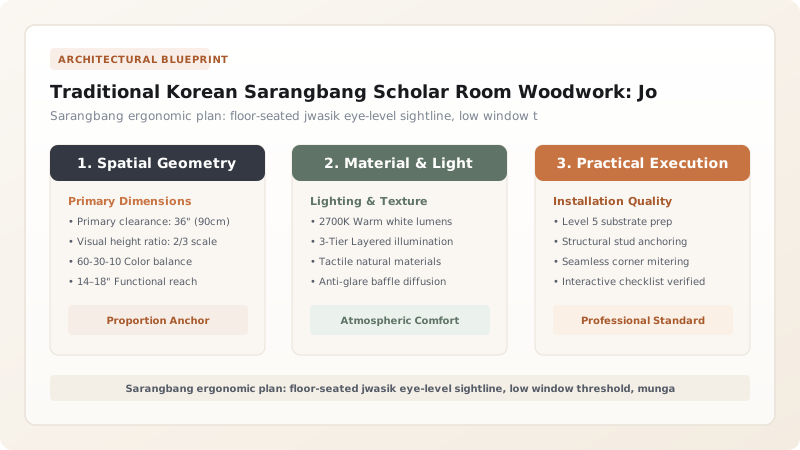
Establish the floor-seated human eye level (approx. 800 mm above floor), planning furniture heights so that seated scholars maintain an unobstructed view through low window sills.
Tonewood Harvesting and Radial Curing
Select slow-grown Korean pine (red pine / jeok-song), zelkova, paulownia, and black persimmon, naturally air-drying boards for two years to equilibrate cell structure.
Charred Paulownia Surface Processing (Jijigi)
Scorch dry paulownia boards with hot iron plates or blowtorches to char soft summerwood growth rings, immediately brushing with stiff rice-straw brushes to create raised relief grain.
Joinery Cutting and Floating Panel Grooving
Cut intricate traditional joints—half-lap blind dovetails (yeonnip-jjim) and mortise-and-tenons—routing perimeter grooves to house floating book-matched persimmon veneer panels.
Hand-Forged Brass Hardware Mounting
Fabricate custom white brass (baekdong) or patinated iron corner brackets (gwangdu-jeong), swallowtail hinges (jebikkori), and bat-shaped lock plates, pinning with copper brads.
Mulberry Hanji Sliding Screen Fabrication (Changho)
Assemble fine wooden lattice frames (sal-chang) from straight-grained pine, pasting sheets of long-fiber mulberry paper (hanji) using natural fermented wheat starch paste.
Oiled Paper Floor Finishing (Ondoljang)
Layer heavy floor hanji over the stone-and-clay ondol floor, coating with repeated applications of raw perilla seed oil (deulkireum) and polishing to a warm golden amber sheen.
Natural Oil Rubbing and Assembly Integration
Rub all unlacquered woodwork with cold-pressed walnut or camellia oil, allowing the natural grain to breathe while installing furnishings in the Sarangbang sanctuary.
Common Mistakes & Countermeasures
Avoid these costly errors that compromise aesthetics, ergonomics, and budget:
Applying high-gloss modern synthetic polyurethane varnishes over Sarangbang woodwork
Designing tall, Western-height desks or elevated chairs for an authentic Hanok interior
Using machine-made wood-pulp paper instead of traditional mulberry Hanji on sliding screens
Project Execution Checklist
Track your physical progress. Checkboxes persist automatically on this device:
Frequently Asked Questions
What is the philosophical meaning behind the austere design of Sarangbang woodwork?
Sarangbang woodwork reflects the core values of Joseon dynasty Neo-Confucian scholars (seonbi): frugality, integrity, moral purity, and reverence for nature. Bright lacquers, ornate gold leaf, and ostentatious carvings were seen as vulgar distractions that corrupted the scholar's mind. Furniture was intentionally simple, unpainted (baekgol), and harmoniously proportioned to celebrate the natural grain of the wood.
How did the traditional underfloor heating system (Ondol) dictate furniture design?
Ondol heats the room via radiant stone flues beneath the floor, meaning the warmest and most comfortable zone is directly on the paper-covered floor. Consequently, Koreans developed a floor-sitting culture (jwasik). All Sarangbang furniture was designed with ultra-low profiles—stationery chests, writing desks, and armrests are barely 200 to 350 mm high—so that a seated scholar could reach everything without standing.
What is 'Meokgam-namu' and why was it prized by Korean scholars?
Meokgam-namu is Black Persimmon wood (Diospyros kaki). Due to a natural fungal transformation within the heartwood of aged persimmon trees, the wood develops dramatic, irregular jet-black patterns against a pale cream background. These natural black patterns closely resemble traditional ink-wash landscape paintings (sumuk-hwa), making it the most coveted decorative timber for scholar's furniture.
How does paper mulberry Hanji regulate the indoor climate of a Sarangbang?
Handmade Hanji paper is composed of long, porous fibers derived from the inner bark of the paper mulberry tree (Broussonetia papyrifera). It acts as a natural living membrane: during humid monsoon days, the fibers absorb excess airborne moisture; during dry winter months, they release moisture back into the room. It also diffuses harsh sunlight into a soft, tranquil glow ideal for reading.