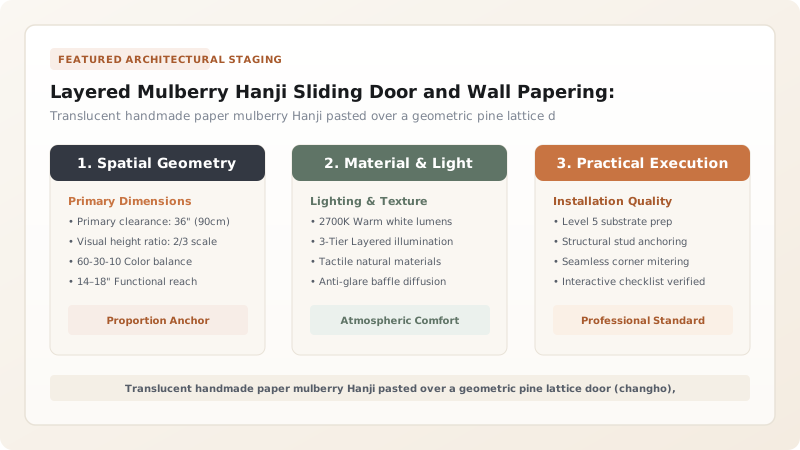
Layered mulberry Hanji sliding door and wall papering forms the living, hygroscopic environmental skin of the traditional Korean Sarangbang. Crafted from the long, resilient inner bast fibers of the paper mulberry tree (Broussonetia papyrifera), Hanji is pasted over delicate pine window lattices (changhoji) and interior masonry walls using natural wheat starch. Simultaneously acting as an acoustic buffer, a natural humidity regulator, and a diffuse solar filter, Hanji transforms the scholar's room into a tranquil, softly illuminated sanctuary of thought.
At a Glance: Key Takeaways
- Paper Material: Handmade Paper Mulberry Hanji (Broussonetia papyrifera / Dak-namu)
- Lattice Screen Name: Changhoji (window & sliding door paper mounted on wooden lattice)
- Floor Papering: Ondoljang (multi-ply heavy paper sealed with boiled perilla seed oil)
- Adhesive Paste: Fermented wheat starch paste (milgaru-pul) without chemicals
- Environmental Role: Hygroscopic moisture buffering, sound absorption, and daylight diffusion
The Living Membrane: Paper as Architectural Envelope
In contemporary Western architecture, paper is categorized as an ephemeral material suited only for sketches, books, and packaging. In traditional Korean architecture, however, paper is an enduring, high-performance structural envelope. The traditional Hanok is an architectural organism wrapped in paper: paper covers the sliding doors (changhoji), paper covers the interior walls (byeokji), paper conceals the ceiling rafters (cheonjangji), and thick, oiled paper forms the warm floor upon which the inhabitants walk, sit, and sleep (jangpanji).
This reliance upon paper was made possible by the miraculous botanical properties of Hanji (literally 'Korean paper'). Handcrafted from the inner bast bark of the paper mulberry tree (Broussonetia papyrifera, known in Korean as dak-namu), Hanji possesses long, flexible, interlocking plant fibers that give it immense tensile durability. Korean historical manuscripts and Buddhist sutras written on Hanji have survived intact for over 1,200 years, outlasting European parchment and Egyptian papyrus.
Optical Diffusion and the Science of Tranquility
The psychological atmosphere of a Joseon Sarangbang is profoundly shaped by the optical physics of Hanji paper windows. Unlike clear glass—which transmits 100% of direct solar radiation, creating blinding hot spots, high glare, and harsh cast shadows—Hanji is a sophisticated optical diffuser.
The multi-directional, interwoven fibers of the paper mulberry trap and refract incoming solar photons in millions of random directions. Direct, aggressive summer sunlight is filtered into a gentle, milky, shadowless ambient glow that fills every corner of the room with uniform luminosity. For a scholar engaged in hours of reading classical Chinese philosophical texts or executing delicate calligraphy, this diffused light completely eliminates eye strain, creating a luminous, serene visual environment that naturally fosters intellectual clarity and meditative peace.
Hygroscopic Physics: The Natural Indoor Lung
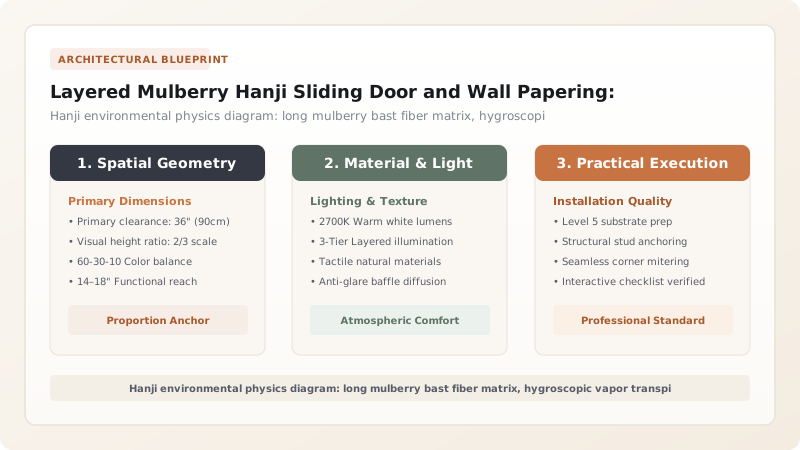
Beyond its optical mastery, Hanji functions as a dynamic, unpowered biological air conditioner and humidity buffer. The inner bast fibers of the paper mulberry tree are highly hygroscopic: they contain microscopic capillary pores that naturally absorb and desorb water vapor in response to ambient atmospheric relative humidity.
During the sweltering, humid weeks of the summer monsoon (jangma), when outdoor humidity exceeds 85%, the Hanji sliding doors and wall coverings absorb immense quantities of airborne moisture, preventing dampness, mold, and clammy indoor air. Conversely, during the bone-dry winter months, when the heated ondol floor dries the indoor air down to an arid 20% relative humidity, the Hanji slowly releases its stored moisture back into the living chamber, naturally humidifying the room and protecting human respiratory tracts and fragile paper manuscripts alike.
The Chemistry of the Oiled Ondol Floor (Jangpanji)
The ultimate technical tour-de-force of Korean paper craft is the Jangpanji (or Ondoljang)—the traditional oiled paper floor. To construct this surface, masons first leveled the clay-and-stone ondol heating flues with smooth lime plaster. Over this base, artisans layered four to six plies of heavy, long-fiber mulberry paper, adhering each course with cooked wheat starch paste.
Once the paper reached bone-dry maturity, the floor was treated with multiple coats of raw, boiled perilla seed oil (deulkireum). Perilla oil is a natural drying oil rich in polyunsaturated alpha-linolenic fatty acids. As the oil soaks deep into the mulberry fibers, it reacts with atmospheric oxygen, undergoing oxidative polymerization into a tough, flexible, completely waterproof linoxin-like resin. Over months of radiant heat from the ondol flues, this oiled paper cures into a gleaming, golden-amber floor membrane of extraordinary warmth and resilience—a floor that is warm to the touch, waterproof, non-toxic, and soft enough to cushion the human body in seated repose.
Hanji Paper Typologies & Interior Applications in a Hanok
Use this reference table to calculate exact physical dimensions, ratios, and specifications before purchasing:
| Application Surface | Korean Paper Name | Fiber Weight / Ply | Preparation Technique | Environmental & Visual Role |
|---|---|---|---|---|
| Window & Sliding Door | Changhoji | Single-ply long fiber (30–45 gsm) | Pasted on lattice exterior face | Filters direct sun into soft diffuse light; breathes air |
| Interior Wall Surface | Dobaegi (Byeokji) | Double-ply mulberry (60–80 gsm) | Mounted over scrap paper undercoat | Absorbs ambient humidity; creates pure matte white envelope |
| Ceiling Finish | Cheonjangji | Thin lightweight white Hanji | Pasted flat across rafters | Reflects ambient light downward into the seating zone |
| Heated Ondol Floor | Jangpanji (Ondoljang) | 4-to-6 ply heavy laminated paper | Saturated with boiled perilla oil | Durable, waterproof, warm amber floor membrane |
| Decorative Accent | Kkot-Doji (Flower Paper) | Pressed natural autumn leaves & petals | Sandwiched between two thin sheets | Adds poetic nature motifs to scholar room transoms |
Practical Constraints
Every successful decoration project must account for physical and environmental constraints:
Puncture vulnerability of thin paper screens from pets, small children, or accidental impact
Can tear or punch holes through the delicate sliding window membrane. Mitigation: Incorporate small wooden transom rails (heorissal) at knee height to protect lower screen zones.
Labor-intensive annual repapering ritual required to maintain fresh white brightness
Paper accumulates airborne dust and fireplace soot over twelve months of continuous use. Mitigation: Annual springtime repapering (changho galgi) using reversible starch paste that dissolves in seconds.
Execution Blueprint & Craftsmanship Sequence
Execute this professional sequence to achieve flawless results without backtracking:
Old Paper Stripping and Lattice Cleansing
Brush warm water over old lattice door paper, allowing the historic wheat paste to soften for five minutes before peeling away the paper cleanly without scraping.
Wheat Starch Paste Brewing (Milgaru-Pul)
Cook pure wheat flour and water in a copper pot over low heat, stirring continuously until a translucent, lump-free paste forms, allowing it to cool and ferment slightly.
Hanji Sizing and Pre-Misting
Trim handmade Hanji sheets to match the lattice frame dimensions, spraying a fine mist of water across the paper to expand the mulberry fibers uniformly.
Lattice Rib Paste Application
Brush thin wheat paste along the face of every wooden lattice mullion and perimeter frame stile using a narrow goat-hair paste brush.
Mounting and Smoothing the Changhoji
Lower the damp Hanji sheet onto the pasted lattice from top to bottom, smoothing out wrinkles and air pockets with a broad, dry horsehair brush.
Natural Shrinkage and Drum-Skin Tensioning
Allow the door to dry in a shaded, well-ventilated room; as water evaporates, the mulberry fibers contract, pulling the paper taut like a drum skin.
Multi-Layer Floor Papering (Jangpanji)
Layer four to six plies of heavy mulberry paper over the clay ondol floor, alternating paste seams and burnishing smooth with wooden rollers.
Perilla Seed Oil Sealing and Curing
Brush multiple coats of boiled raw perilla seed oil (deulkireum) into the floor paper, allowing the oil to polymerize over two weeks into a hard, golden-amber surface.
Common Mistakes & Countermeasures
Avoid these costly errors that compromise aesthetics, ergonomics, and budget:
Pasting dry Hanji paper directly onto wooden lattice frames without pre-misting
Using modern chemical polyvinyl acetate (PVA) glues to hang Hanji on sliding screens
Project Execution Checklist
Track your physical progress. Checkboxes persist automatically on this device:
Frequently Asked Questions
How does Hanji paper differ from standard Western or Chinese paper?
Traditional Hanji is made exclusively from the inner bast bark of the paper mulberry tree (Dak-namu), harvested in winter. Unlike wood-pulp paper made with sulfuric acid, Hanji is processed using alkaline wood ash lye and hibiscus root sap (dak-pul). Its long, multi-directional bast fibers are vat-formed using the 'webal' rocking method, producing paper that is virtually tear-proof, neutral pH, and lasts over a thousand years.
Why is Hanji pasted on the outside of the window lattice rather than the inside?
Pasting Hanji on the exterior face of the lattice protects the delicate interior room from wind and rain while keeping the wooden lattice structure visible from the inside as a work of geometric art. In harsher mountain climates, paper was sometimes pasted on both the interior and exterior faces to create an insulating double-glazed air cavity.
What is an 'Ondoljang' oiled paper floor and how is it maintained?
An Ondoljang (or Jangpanji) is the traditional Korean heated paper floor. Made of heavy, laminated multi-ply Hanji saturated with boiled perilla seed oil, it hardens into an elastic, waterproof, leather-like membrane with a rich golden-honey glow. It is cleaned with damp cloths and re-oiled with perilla or walnut oil annually to maintain its water resistance.