Traditional Korean scholar furniture of the Joseon Dynasty represents the ultimate synthesis of functional minimalism and organic woodcraft. Tailored for floor-seated living in the Sarangbang, low writing desks (seoan) and open multi-tiered display shelves (sabangtakja) are engineered from dense, richly figured zelkova wood (goemeok) for structural frames, and lightweight, charred paulownia wood (odongnamu) for drawer linings. With natural perilla oil finishes and hand-forged iron hardware, this furniture celebrates wood grain while deterring insects and preserving precious paper manuscripts.
At a Glance: Key Takeaways
- Structural Frame Timber: Aged Korean zelkova (Goemeok / Keyaki / Zelkova serrata) with swirling grain
- Interior Drawer Timber: Charred/scorched paulownia wood (Odongnamu / Paulownia coreana)
- Key Furniture Types: Low writing desk (Seoan), multi-tier shelf (Sabangtakja), book chest (Mungap)
- Hardware Metallurgy: Hand-forged iron or brass hardware (Jangseok) with swallowtail hinges
- Surface Finish: Hand-rubbed natural walnut or perilla oil; zero synthetic polyurethane
The Scholar’s Seated Perspective: Low-Profile Architectural Furniture
In traditional Korean architecture, interior space cannot be understood independently of the human body’s physical posture. Because the Joseon home was heated by the subfloor ondol hypocaust system, domestic life occurred at floor level. People walked barefoot across smooth oiled paper floors, sat cross-legged on silk cushions, and slept upon quilted bedding rolls laid directly over the warm stones.
Consequently, all furniture in the Sarangbang was designed with a strictly low center of gravity. Western dining tables, towering wardrobes, and high-backed chairs were completely alien. The furniture was engineered so that when a scholar was seated cross-legged on the floor, his eye level rested exactly at the midpoint of the low writing desk (seoan) and aligned harmoniously with the horizontal sightlines of the paper window lattices. The furniture never crowded the room; it maintained an open, expansive volume that gave the small scholar room a sense of boundless spiritual calm.
Zelkova (Goemeok): The Royal Heartwood of Dynamic Grain
When selecting timber for visible structural frames, desktop surfaces, and cabinet door panels, the master cabinetmaker (Somokjang) sought out ancient Korean zelkova (Zelkova serrata, known locally as goemeok). Growing slowly over centuries in mountainous rocky ravines, aged zelkova heartwood develops an extraordinarily tough, dense, and elastic grain structure with warm golden-amber and chocolate-brown undertones.
Cabinetmakers particularly prized yongmok ('dragon grain')—complex swirling, flame-like burl figures formed around tree forks and root collars. Unlike Western Victorian furniture that obscured natural wood with dark stains and heavy polyurethanes, Korean craftsmen treated wood grain as a divine natural landscape. Slabs of zelkova were cut into book-matched symmetrical pairs, planed with razor-sharp wooden hand planes, and buffed with natural raw walnut oil to let the shimmering annual rings appear like flowing mountain rivers or rising dragons.
Paulownia (Odongnamu): The Living Biological Book Vault
While zelkova formed the rigid, visible outer skeleton of scholar furniture, the interior was entrusted to a radically different wood: paulownia (Paulownia coreana / odongnamu). Paulownia is an exceptionally lightweight, soft hardwood with large, open cellular pores. To the uninitiated, it might appear too fragile for fine cabinetry; to the Joseon scholar, it was an indispensable preservation technology.
Paulownia heartwood contains zero resin, making it completely impossible for sap to bleed onto rare, hand-copied paper manuscripts. Crucially, paulownia wood is rich in natural bitter tannins that make it entirely unpalatable to destructive insects like silverfish and paper-boring booklice. To prepare paulownia for drawer linings, craftsmen utilized the nakdong technique: running glowing red-hot iron blocks across the wood surface to scorch the soft spring growth, then brushing it with stiff straw whisks. This scorching carbonizes surface pores, creating an insect-proof, fire-resistant, and hygroscopic chamber that kept fragile paper books bone-dry through centuries of humid monsoons.
Joinery Integrity & Hand-Forged Iron Jangseok Hardware
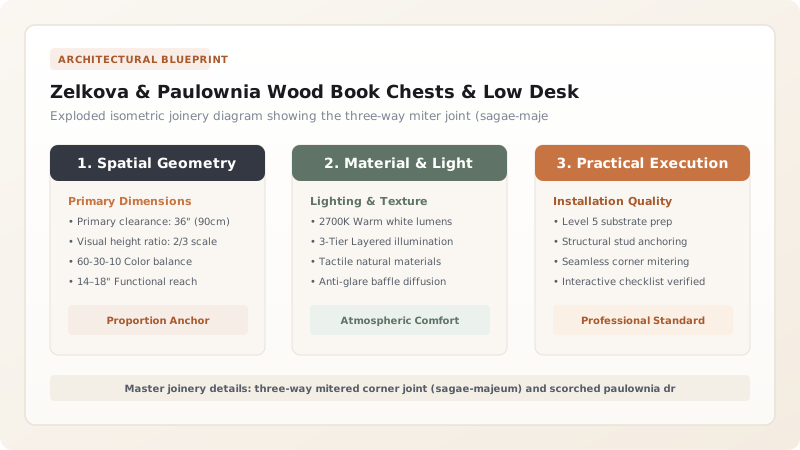
The structural excellence of Sarangbang cabinetry lies in its masterly joinery. Because furniture sat directly atop heated ondol floors, wood was subjected to intense thermal gradients: the bottom of a desk could be 35°C while the top was 18°C. Rigid metal screws or modern glues would cause the wood to split under differential thermal stress. Carpenters utilized complex interlocking mortise-and-tenon joints, notably the legendary sagae-majeum (three-way mitered corner joint), which locks three independent wooden members into a rigid cube that flexes without tearing.
To reinforce key structural intersections, cabinetmakers forged decorative hardware called jangseok. Hand-hammered from wrought iron and blackened by quenching in oil, these fittings were shaped into auspicious symbols: swallowtail hinges (jebikkori) for strength, bat-shaped pulls (symbolizing good fortune and longevity), and round moon lockplates. Left unpolished and dark, this rustic iron hardware harmonized perfectly with the oiled wood, creating timeless masterpieces of functional, meditative art.
Material Selection & Functional Role of Sarangbang Woodworking
Use this reference table to calculate exact physical dimensions, ratios, and specifications before purchasing:
| Wood Species | Physical Properties | Artisanal Application | Functional Role in Scholar Room | Longevity / Maintenance |
|---|---|---|---|---|
| Zelkova (Goemeok / Keyaki) | Dense, heavy, tough; dynamic swirling grain | Desk tops, primary frames, cabinet doors | Structural durability & high aesthetic prestige | 100+ years; buffed annually with walnut oil |
| Paulownia (Odongnamu) | Ultra-light, porous, stable, naturally fire-retardant | Drawer boxes, book chests, inner linings | Regulates humidity & repels silverfish/booklice | Perpetual protection for paper books |
| Persimmon (Meokgamnamu) | Pale wood with dramatic ink-black grain ribbons | Veneer panels, door fronts, small boxes | Visual celebration of ink-painting aesthetics | Highly prized; oiled with camellia oil |
| Korean Red Pine (Jeokmok) | Straight-grained, medium density, aromatic | Slender posts for shelves (sabangtakja) | Airy, lightweight structural frames | 50+ years; develops deep amber patina |
| Hand-Forged Iron (Jangseok) | Malleable wrought iron, blackened with oil | Swallowtail hinges, lockplates, corner braces | Reinforces wood joints without rigid screws | Rust-resistant when oiled periodically |
Practical Constraints
Every successful decoration project must account for physical and environmental constraints:
Intense upward radiant dry heat from the subfloor ondol system
Furniture bases exposed to direct floor heat suffer warping, shrinkage, and joint splitting Mitigation: Design furniture with raised, graceful arched legs (jokja) elevating cases 100 mm above the floor
Extreme rarity of wide, defect-free ancient zelkova trunks with 'dragon grain'
Master-grade figured zelkova boards command astronomical prices in modern restoration Mitigation: Book-match twin book-sawn veneers over stable quarter-sawn pine substrate cores
Execution Blueprint & Craftsmanship Sequence
Execute this professional sequence to achieve flawless results without backtracking:
Timber Sourcing & Log Reading
Select three-year air-seasoned zelkova logs, reading growth ring orientation to isolate swirling 'dragon-grain' (yongmok).
Precision Milling & Planing
Hand-plane structural frame members into slender square sections, checking squareness with Japanese try squares.
Three-Way Miter Joinery (Sagae-Majeum)
Chisel compound three-way interlocking mortise-and-tenons at all shelf corners where posts meet horizontal rails.
Seoan Desk Top Sculpting
Carve the upturned scroll ears (gwijabaegi) on both lateral ends of the solid zelkova desktop using curved gouges.
Paulownia Drawer Charring (Nakdong)
Scorch dry paulownia drawer boards with red-hot iron blocks, brushing away soft spring growth to leave hard, blackened ridges.
Dovetail Drawer Assembly
Join charred paulownia drawer boxes using delicate through-dovetails, sliding into zelkova drawer guides with 1 mm clearance.
Iron Hardware Forging & Mounting
Forge wrought iron corner braces and swallowtail hinges, riveting them over leather washers onto cabinet corners.
Natural Oil Rubbing & Patination
Rub crushed raw walnut meats or cold-pressed perilla oil into the raw wood with woolen cloths, buffing to a warm satin luster.
Common Mistakes & Countermeasures
Avoid these costly errors that compromise aesthetics, ergonomics, and budget:
Coating scholar furniture in high-gloss synthetic polyurethane or thick colored lacquer
Using dense, resinous pine for book drawers and manuscript storage interiors
Using machine-stamped modern brass hardware with sharp, artificial edges
Project Execution Checklist
Track your physical progress. Checkboxes persist automatically on this device:
Frequently Asked Questions
Why is paulownia wood used inside book drawers instead of pine or oak?
Paulownia (odongnamu) possesses extraordinary biological and thermodynamic properties: it is virtually resin-free, naturally fire-resistant, and contains high concentrations of natural tannins that actively repel silverfish, booklice, and moths. Furthermore, it is exceptionally hygroscopic, absorbing ambient moisture to keep paper manuscripts dry.
What is the function of the upturned ends on the Seoan writing desk?
The upturned scroll ends (gwijabaegi) serve a practical and aesthetic purpose: practically, they prevent cylindrical brush handles, inksticks, and paper scrolls from rolling off the low desk onto the floor. Aesthetically, the gentle upward curve echoes the soaring eaves of the Hanok roof.
Why does Korean scholar furniture have such high, open legs?
Because Hanok floors are heated from below by the masonry ondol system, furniture resting directly flat on the floor would absorb intense heat, baking books and drying out timber joints. High, arched legs (jokja) elevate the case 10 to 15 cm above the floor, allowing cooling ambient air to circulate beneath.