Traditional Korean oiled paper flooring (Jangpan) and the hypocaust ondol heating system form the thermodynamic and tactile soul of the Hanok. Built over horizontal stone smoke flues carrying heat from an external hearth (agungi), the floor is surfaced with heavy handmade Hanji mulberry paper laminated in multiple overlapping layers over a smooth clay screed. Saturated repeatedly with raw cold-pressed perilla oil (deulgireum) and burnished with hot river stones, the paper cures into a durable, waterproof, amber-golden leather-like plane that radiates gentle, soothing warmth.
At a Glance: Key Takeaways
- Floor Typology: Multi-layer oiled paper flooring (Jangpan / Ondol-jang)
- Subfloor Heating System: Ondol (subfloor hypocaust flues covered by granite gudeuljang slabs)
- Paper Base: Heavy, fibrous handmade mulberry bast Hanji paper (Jangpan-ji)
- Curing Oil: Raw cold-pressed perilla seed oil (Deulgireum) or boiled tung oil
- Thermal Comfort: Direct radiant floor heating (warm feet, cool head; Du-hyeon-jok-yeol)
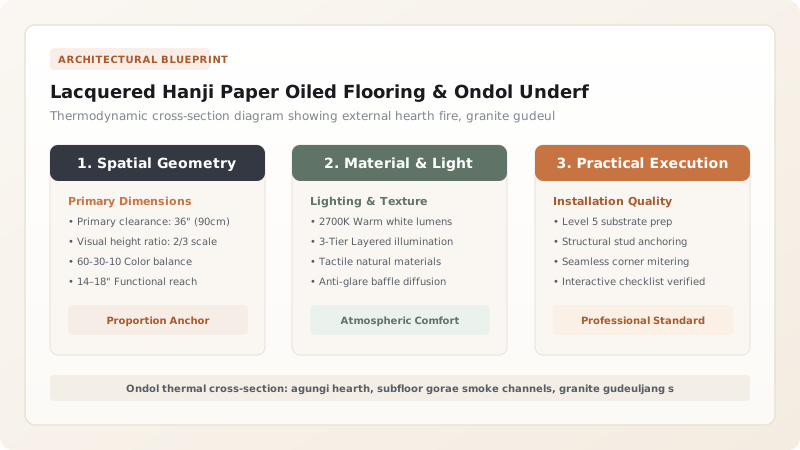
The Thermodynamic Miracle of the Ondol (Gudeul) Hypocaust
In the freezing winters of the Korean peninsula, where arctic winds sweep down from Siberia plunging temperatures below -20°C, survival depended entirely on a unique vernacular heating invention: the ondol (or gudeul, literally 'warm stone'). Unlike Western fireplaces that heat room air inefficiently while sending 80% of combustion heat up the chimney, the ondol captures and stores thermal energy inside the floor itself.
The system operates on pure gravity convection. In a sunken hearth (agungi) located outside the room or inside the kitchen, wood or rice straw is burned. The hot smoke and combustion gases do not rise immediately; instead, they are drawn horizontally beneath the living room through a labyrinth of stone-and-clay channels called gorae. Massive, dense slabs of split granite (gudeuljang) bridging the flues absorb the heat. By the time the exhaust gases reach the freestanding vertical chimney (gultuk) on the opposite side of the house, virtually all thermal energy has been extracted and stored within the masonry floor.
Crafting the Jangpan Floor: Laminated Mulberry Bast Stratigraphy
A granite and clay floor alone is rough, dusty, and uncomfortable. The vernacular genius of Korea was to transform this masonry radiator into a luxurious, warm plane using pure paper: the craft of the jangpan. Over the smooth, level clay screed (badaek), craftsmen laminate successive layers of handmade Hanji paper using natural wheat or rice flour starch paste.
The installation follows a strict multi-tiered stratigraphy. First, a base coat of recycled paper (chobae) is pasted down to absorb residual moisture and cushion minor clay imperfections. Second, two layers of intermediate Hanji (jungbae) are applied. Finally, the top finish layer—thick, heavy, extraordinarily fibrous jangpan-ji crafted from pure winter-harvested mulberry bast bark—is laid down. The sheets are pasted with 50 mm overlapping edges oriented away from the entrance door, creating a continuous, seamless, and tear-resistant vegetal skin across the entire room.
Perilla Oil Impregnation & The Hot River Stone Burnish
Raw paper, however fibrous, would quickly soil, tear under foot friction, and disintegrate if water were spilled upon it. The crowning artisanal transformation is perilla oil curing. When the laminated paper floor has dried completely, the craftsmen take raw, cold-pressed perilla seed oil (deulgireum)—harvested from the agricultural fields of the village—and pour it generously across the paper.
The low-viscosity perilla oil penetrates deeply into the hollow cellulose core of the mulberry fibers. Craftsmen then perform the demanding kinetic ritual of dol-milleugi (stone burnishing). Using large, perfectly smooth water-rounded agate or quartz river stones heated in boiling water, they rub the oiled floor in overlapping circular motions under heavy body pressure. The heat and friction accelerate the oxidative polymerization of the perilla oil’s polyunsaturated fatty acids, cross-linking the oil into a solid, resilient, rubbery polymer. The matte paper transforms into an amber-golden, leather-like plane that is 100% water-impermeable, non-slip, and astonishingly durable.
Du-Hyeon-Jok-Yeol: The Philosophy of Floor-Level Radiant Living
Walking barefoot or sitting cross-legged upon an authentic oiled Hanji ondol floor is a sublime sensory experience. The floor is smooth and cool to the touch in summer, yet in winter it radiates a deep, penetrating, and comforting warmth. In traditional Korean medicine (Hanbang), this radiant floor realizes the supreme health ideal of Du-hyeon-jok-yeol ('cool head, warm feet').
Because heat rises gently from the floor surface without noisy electric blowers or forced-air drafts, no dust or allergens are circulated through the room. The air at breathing level remains crisp, humid, and oxygen-rich, while the lower body is nurtured by continuous conductive and radiant warmth. When the scholar reclines upon his silk-covered sleeping quilt at night, his spine is cradled by the warm, amber-glowing Hanji floor, demonstrating how ancestral architecture harmonized thermal physics, organic materials, and human physiology into a unified masterpiece of domestic well-being.
Ondol Subfloor Stratigraphy & Thermal Performance
Use this reference table to calculate exact physical dimensions, ratios, and specifications before purchasing:
| Stratigraphic Layer | Material Composition | Thickness (mm) | Thermal Role | Installation Rule |
|---|---|---|---|---|
| Flue Voids (Gorae) | Hollow stone channels | 200–300 mm height | Directs hot wood combustion gases from hearth to flue | Slope upward at 1:20 toward chimney for draft |
| Granite Slabs (Gudeuljang) | Split natural granite flagstones | 50–80 mm | Primary thermal accumulator storing heat for 18 hours | Thickest stones placed nearest hearth fire |
| Clay-Straw Screed (Badaek) | Yellow alluvial clay + fine sand + straw | 25–35 mm (2 coats) | Equalizes heat distribution; seals smoke leaks | Float completely dead-level with zero ridges |
| Hanji Paper Lamination | 3 to 5 layers of mulberry paper | 2–3 mm laminated | Elastic, tear-resistant floor substrate | Paste with 50 mm staggered laps like shingles |
| Perilla Oil Patina (Jangpan) | Polymerized raw perilla oil | 0.5 mm surface film | Waterproof, leather-like amber radiant finish | Buff with hot smooth river agates |
Practical Constraints
Every successful decoration project must account for physical and environmental constraints:
Tear and puncture vulnerability from heavy, sharp-legged modern furniture
Metal chair legs or heavy casters can gouge and puncture the paper floor surface Mitigation: Furnish exclusively with floor-seated cushions or place broad wooden coasters under furniture feet
Oxidative oil odor during initial perilla oil curing window (first 7 days)
Unpolymerized perilla oil emits a strong, pungent roasted seed scent as it oxidizes Mitigation: Ventilate the room thoroughly with open munsal doors and maintain moderate floor heating
Execution Blueprint & Craftsmanship Sequence
Execute this professional sequence to achieve flawless results without backtracking:
Gorae Flue Trenching & Stone Wall Bedding
Excavate floor subgrade and build parallel stone retaining walls to form horizontal smoke channels sloping toward the chimney.
Gudeuljang Granite Slab Bridging
Bridge the flues with heavy split granite slabs, packing joints tightly with clay-and-straw pugging to prevent smoke leakage.
Two-Coat Clay Leveling Screed
Trowel a 30 mm bed of yellow clay and fine sand over the granite slabs, smoothing with steel floats to a level, crack-free plane.
Slow-Fire Curing & Drying
Kindle tiny, gradual wood fires in the agungi hearth over seven days to slowly bake the clay screed without thermal shock.
Base & Middle Hanji Layer Pasting
Paste two layers of recycled paper followed by two layers of heavy mulberry Hanji using wheat starch, staggering all joints.
Top Finish Hanji (Jangpan-ji) Placement
Apply the final heavy, premium Hanji sheets, overlapping edges by 50 mm in the direction of door egress.
Raw Perilla Oil Impregnation
Pour raw cold-pressed perilla oil across the bone-dry floor, working it deeply into the paper fibers using cotton rags.
Hot Stone Burnishing & Thermal Curing
Heat smooth river stones in boiling water and buff the oiled floor with firm pressure, curing the oil into an amber satin sheen.
Common Mistakes & Countermeasures
Avoid these costly errors that compromise aesthetics, ergonomics, and budget:
Applying modern polyurethane or commercial vinyl flooring over an active masonry ondol
Applying perilla oil onto damp Hanji paper before wheat starch paste has dried fully
Overheating the ondol hearth immediately after fresh clay screeding
Project Execution Checklist
Track your physical progress. Checkboxes persist automatically on this device:
Frequently Asked Questions
How can paper withstand walking on without tearing?
Traditional floor Hanji (Jangpan-ji) is made from dense, long mulberry bast fibers laminated in multiple overlapping layers. When thoroughly saturated with perilla oil and cured, the vegetable oil polymerizes into a tough, flexible, rubbery solid. The resulting floor has the mechanical toughness, water impermeability, and tensile flexibility of thick saddle leather.
Why is perilla oil used instead of boiled linseed oil for Korean floors?
Perilla oil (deulgireum), cold-pressed from the seeds of Perilla frutescens, has an exceptionally high concentration of alpha-linolenic acid (over 60%). Under the gentle warmth of the ondol floor, it polymerizes into a warm, glowing golden-amber finish with high clarity, without turning dark or brittle like some boiled linseed oils.
What is the medical and philosophical concept of 'Du-hyeon-jok-yeol' in Ondol living?
Du-hyeon-jok-yeol is an ancient Korean medical principle meaning 'cool head, warm feet'. The ondol system delivers heat directly to the soles of the feet through the floor, while air at head level remains cool and fresh. Traditional medicine holds that this vertical thermal balance promotes optimal blood circulation, mental clarity, and deep restorative sleep.