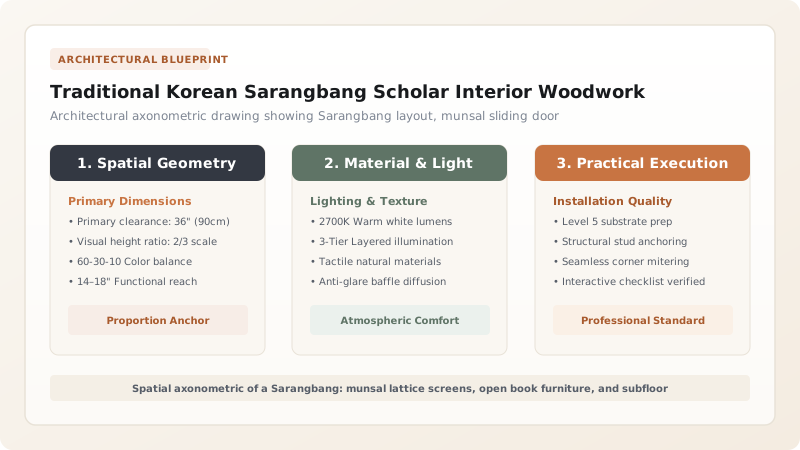
The Sarangbang is the men's study and reception quarters in the traditional Korean Hanok, representing the supreme architectural expression of Joseon Dynasty Neo-Confucian aesthetics. Guided by ideals of austere frugality (geomso) and harmony with nature, the interior features exposed seasoned pine framing, translucent paper sliding doors with intricate geometric wooden lattices (munsal), low scholar writing desks (seoan) crafted from zelkova and paulownia wood, and warm, amber-toned oiled Hanji paper floors heated by the hypocaust ondol system.
At a Glance: Key Takeaways
- Historical Era: Joseon Dynasty (1392–1910) Neo-Confucian scholar (Seonbi) culture, Korea
- Primary Timber: Korean red pine (Pinus densiflora), zelkova (goemeok), and paulownia (odongnamu)
- Paper Membrane: Handmade mulberry bark Hanji paper (Broussonetia papyrifera) on wooden lattices
- Lattice Joinery: Munsal miniature interlocking lap joints assembled with zero metal fasteners
- Floor & Heating System: Lacquered oiled Hanji paper flooring (Jangpan) over masonry Ondol flues
In-Depth Guides in this Directory
Explore specialized subtopic blueprints, technical dimensions, and execution checklists:
Munsal Delicate Paper Door Lattice Patterns & Spacing in Hanok Architecture
Explore the woodworking joinery, geometric symbolism, and Hanji paper glazing of traditional Korean Munsal lattice doors in Hanok design.
Zelkova & Paulownia Wood Book Chests & Low Desks in Korean Sarangbang Furniture
Discover the master joinery, zelkova grain selection, and paulownia insect-repellent properties in traditional Korean Joseon scholar furniture.
Lacquered Hanji Paper Oiled Flooring & Ondol Underfloor Thermal Balance
Master the art of traditional Korean oiled Hanji paper flooring (Jangpan) and ondol hypocaust underfloor thermal balance.
The Neo-Confucian Ethos of the Joseon Seonbi Sanctuary
In the traditional Korean residential compound (Hanok), spatial layout was rigorously segregated according to the social and moral philosophy of the Joseon Dynasty (1392–1910). While the inner quarters (Anbang) belonged to women and domestic family affairs, the Sarangbang was the public face and private intellectual sanctuary of the male scholar-nobleman (Seonbi).
Guided by the strict moral precepts of Neo-Confucianism, the Seonbi cultivated the virtues of geomso (austere frugality) and cheongbin (clean poverty). The Sarangbang was deliberately designed to reflect this intellectual purity. Ostentatious ornamentation, colorful wall paintings, and opulent gilded furnishings were strictly rejected. Instead, the room celebrated natural materials—unpainted red pine, exposed clay plaster, translucent mulberry paper, and honey-toned oiled floors—creating a serene, harmonious environment dedicated to scholarly study, self-cultivation, calligraphy, and quiet tea ceremonies.
The Architecture of Munsal: The Breathable Lattice Screen
The visual and spiritual boundary between the scholar’s inner world and the external landscape is defined by the changho—the paper-glazed sliding and folding doors. The heart of these doors is the munsal, an intricate geometric wooden lattice crafted from fine-grained Korean red pine (Pinus densiflora). Assembled using microscopic half-lap joinery without a single metal fastener, the lattice forms a structural grid of astonishing lightness and dimensional stability.
Pasted to the interior face of the munsal is handmade Hanji paper, manufactured from the inner bast fibers of the paper mulberry tree (Daknamu). Hanji is not mere paper; it is a breathable architectural lung. Unlike modern glass that creates cold drafts and reflective glare, Hanji diffuses harsh direct sunlight into a soft, velvety, shadow-free glow. Its porous organic fibers naturally absorb excess moisture during humid summer mornings and release it during dry afternoons, maintaining an optimal indoor microclimate while enabling subtle acoustic connection to the rustling bamboo garden outside.
The Scholar’s Woodwork: Low Desks & Multi-Tier Shelves
Because the Sarangbang is designed around floor-seated living dictated by the underfloor heating system, all furniture is proportioned for sitting cross-legged on the floor. The center of study is the seoan—a low writing desk featuring a thick solid wood top whose ends curve gently upward in graceful scrolls (gwijabaegi) to prevent ink rolls and brushes from sliding off.
Complementing the desk is the sabangtakja, a multi-tiered open bookshelf composed of four slender, continuous square posts connected by minimal horizontal stretchers. Built using complex three-way mitered joints (sagae-majeum) with zero metal brackets, the sabangtakja provides an airy, almost weightless frame for the display of rare Confucian texts, white porcelain water droppers, antique bronzes, and volcanic scholars' rocks (suseok). Crafted from dense zelkova wood and lightweight paulownia, these furnishings embody the sublime dignity of restraint.
Ondol Thermal Comfort & The Oiled Hanji Floor (Jangpan)
The foundation of Korean domestic comfort is the ondol (hypocaust radiant floor heating system). Heat and smoke from an exterior firebox (agungi) pass horizontally through stone masonry flues beneath the floor, warming massive granite slabs before exhausting through a freestanding vertical chimney. This ancient thermal engine heats the room via pure floor radiation, creating an ideal vertical temperature gradient: warm feet and a cool head, perfectly suited for prolonged intellectual concentration.
The finish surface of this heated floor is the jangpan—a magnificent artisanal floor created by laminating multiple layers of heavy, fibrous Hanji paper across the earthen floor screed. Once dry, the paper is repeatedly saturated with raw cold-pressed perilla oil (deulgireum) and burnished with hot river stones. Over weeks of heat and oxygen exposure, the perilla oil polymerizes into an impermeable, amber-golden, leather-like plane. Cool and silky in summer, and deeply warming in winter, the oiled Hanji floor anchors the scholar to the earth in timeless physical and spiritual harmony.
Architectural Elements & Material Hierarchy in the Sarangbang
Use this reference table to calculate exact physical dimensions, ratios, and specifications before purchasing:
| Architectural Element | Structural Material | Joinery / Craft Technique | Philosophical Meaning | Thermodynamic Role |
|---|---|---|---|---|
| Munsal Lattice Doors | Fine-grained Korean red pine | Miniature lap-mortise interlocking grid | Confucian order, intellectual clarity, humility | Modulates sunlight, humidity, and natural ventilation |
| Low Scholar Desk (Seoan) | Zelkova wood (top) + Paulownia | Mortise-tenon with swallowtail iron hinges | Scholar focus; reverent seated contemplation | Comfortable floor seating above radiant ondol |
| Multi-Tier Shelf (Sabangtakja) | Slender square red pine posts | Three-way mitered corner joints (sagae-majeum) | Airy transparency; modest display of books | Minimal floor footprint preserves open room volume |
| Oiled Hanji Floor (Jangpan) | Laminated mulberry paper + perilla oil | Overlapping shingle paste with wheat starch | Warm earth connection; golden amber luster | Conducts radiant heat smoothly without hot spots |
| Hypocaust Hearth (Ondol) | Granite flagstones + clay flue paths | Smoke-tight drystone and clay masonry | Passive winter survival; communal hearth fire | Massive thermal heat storage radiating for 18 hours |
Practical Constraints
Every successful decoration project must account for physical and environmental constraints:
Tension tears in translucent Hanji door paper during sudden humidity swings
Monsoon humidity expands paper, while dry winter heating shrinks it, causing corner tears Mitigation: Mist Hanji lightly with water during paste application so it shrinks drum-tight naturally upon drying
Smoke and carbon monoxide leakage through hairline fissures in older ondol masonry
Dangerous flue gases could seep through the clay floor into the scholar sleeping quarters Mitigation: Seal ondol flue stones with multiple overlapping layers of lime-clay plaster and heavy oiled paper
Execution Blueprint & Craftsmanship Sequence
Execute this professional sequence to achieve flawless results without backtracking:
Pine Timber Framing & Column Erection
Erect round or square red pine columns over dry granite plinth stones, tying the frame with lintels and roof beams.
Ondol Flue Channel Masonry
Construct parallel smoke flues (gorae) using fieldstones and clay, bridging channels with flat granite slabs (gudeuljang).
Clay Screeding & Smoothing
Apply a 30 mm leveling coat of sticky red clay and fine sand over the stones, smoothing with wooden floats to a level plane.
Laminated Hanji Floor Papering (Jangpan)
Paste successive layers of thick, handmade mulberry Hanji paper over the floor using natural wheat flour paste.
Perilla Oil Curing & Hot Stone Burnishing
Saturate the dry paper floor with raw cold-pressed perilla oil, rubbing with hot river stones to cure into amber leather.
Munsal Door Lattice Assembly
Chisel microscopic half-lap notches into fine red pine slats, interlocking them into geometric grids (tteolsal or ajasal).
Translucent Hanji Window Glazing
Paste translucent, unbleached white Hanji paper to the interior face of the wooden lattice using fresh rice starch.
Scholar Furniture Arrangement
Place low writing desks (seoan), open book racks (sabangtakja), and charcoal brazier across the oiled floor.
Common Mistakes & Countermeasures
Avoid these costly errors that compromise aesthetics, ergonomics, and budget:
Pasting Hanji paper to the outside exterior face of the munsal door lattice
Applying synthetic polyurethane clear coats over the oiled Hanji paper floor (jangpan)
Using modern western-height chairs and high desks in a traditional Sarangbang room
Project Execution Checklist
Track your physical progress. Checkboxes persist automatically on this device:
Frequently Asked Questions
What is the cultural role of the Sarangbang in traditional Korean society?
The Sarangbang was the masculine intellectual sanctuary of the traditional Korean house (Hanok), reserved for the male head of household. Here, scholar-noblemen (Seonbi) read Confucian classics, practiced calligraphy and ink painting, held tea ceremonies, and hosted social discussions with visiting literati, completely separate from the women's inner quarters (Anbang).
Why is Hanji paper pasted to windows and doors instead of glass?
Hanji paper made from mulberry bark (Broussonetia papyrifera) is a living, breathing architectural membrane. Under microscopic examination, its long, interwoven fibers filter harsh direct sunlight into soft, glare-free ambient luminescence, absorb excess indoor humidity during summer, and insulate against winter drafts while allowing continuous fresh air exchange.
How does the traditional Ondol underfloor heating system work?
Ondol (literally 'warm stone') is an ancient subfloor hypocaust heating system. Heat and smoke from an external hearth fire (agungi) travel horizontally through stone channels (gorae) beneath the room. Massive granite slabs (gudeuljang) absorb the heat and slowly radiate warmth upward through the clay and oiled Hanji paper floor, while smoke exhausts through an exterior chimney.
What aesthetic principle guided Joseon scholar furniture design?
Joseon scholar furniture was governed by the Neo-Confucian aesthetic of geomso—frugality, restraint, and understated elegance. Furniture was deliberately unpainted, un-lacquered with heavy colors, and designed with clean rectilinear lines that showcased the natural swirling grain of the wood without ostentatious carving or gold leaf.