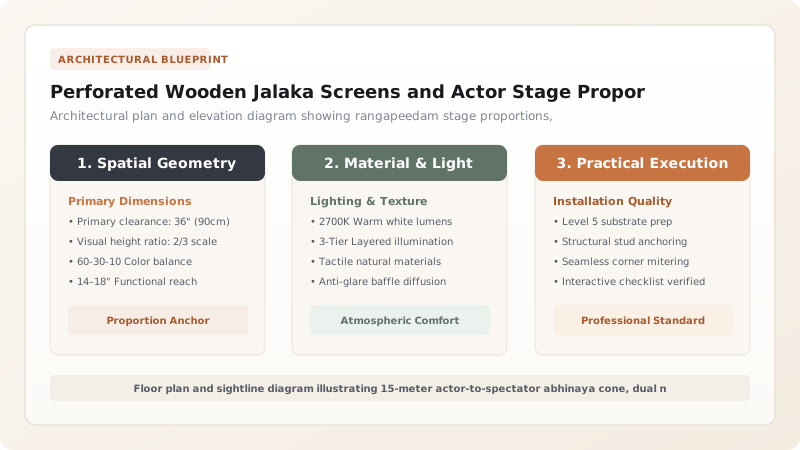
Perforated wooden jalaka screens and precise rangapeedam stage proportions define the environmental buffering and spatial intimacy of the Kerala Koothambalam. Enclosing the entire perimeter of the hall between the granite plinth and timber eaves, pierced wooden jalaka lattices (carved with diamond, floral, and geometric micro-apertures) filter harsh tropical glare, eliminate exterior noise, and permit continuous natural cross-ventilation. At the center of the hall, the elevated square stage (rangapeedam) is proportioned according to the sacred canonical dimensions of the Natyashastra, ensuring that every micro-expression (bhava) and eye movement (netrabhinaya) of the Sanskrit actor is visible to the audience without artificial amplification.
At a Glance: Key Takeaways
- Screen Typology: Pierced Wooden Lattice Screen (Jalaka / Vathil-mada)
- Screen Timber: Quarter-sawn Malabar Teak or Rosewood (Eetti)
- Perforation Ratio: 25% to 35% open void area (glare-free light & ventilation)
- Stage Dimensions: Square platform: typically 16 × 16 angulas (approx. 4.8 m × 4.8 m)
- Sightline Geometry: Max 15-meter viewing radius for micro-gesture visibility (Abhinaya)
The Intimate Universe of Abhinaya: Why Scale Dictates Architecture
In contemporary stadium-scale theatre and cinema, dramatic communication relies on broad body movements, massive set pieces, and amplified sound. In the classical Sanskrit theatre of Kerala—Koodiyattam—dramatic communication operates at a microscopic biological scale. An actor portraying the sorrow of Ravana or the wrath of Arjuna communicates through netrabhinaya: the microscopic quiver of an eyelid, the rhythmic dilatation of a pupil, the subtle elevation of a cheek muscle (bhava), and the precise spatial geometry of hand gestures (mudras).
If a spectator is seated more than 15 meters away, these delicate ocular modulations blur into imperceptibility. Consequently, the master builders of the Koothambalam adhered strictly to the spatial mandates of the Natyashastra, which explicitly warns that a theatre hall must never be built too large. The canonical madhyama (medium-sized) rectangular hall was decreed the supreme architectural ideal, ensuring an intimate, consecrated spatial envelope where every breath and glance of the actor lands with visceral emotional force upon the audience.
The Rangapeedam: The Sacred Coordinates of the Stage
At the center of this theatrical cosmos sits the rangapeedam (performance platform). Built as an exact geometric square (typically measuring 8 by 8 hastas, or approximately 4.8 meters on a side), the stage is elevated 600 mm above the audience floor, supported by dressed granite kerb stones. This elevation elevates the actor's eyes to a level slightly above the seated spectators, establishing a natural, non-fatiguing sightline angle.
Directly behind the stage stands the nepathya (the dressing room and green room), separated by a solid timber partition wall. Piercing this wall are two sacred doorways: the right door (dakshina-dvara) reserved for divine, heroic characters, and the left door (uttara-dvara) for demonic or comic characters (such as the Vidushaka). Framing the four corners of the stage are massive turned columns of fragrant Malabar rosewood, supporting the ornate nine-paneled navagrahacharthu coffered ceiling that concentrates acoustic energy down onto the central arena.
The Jalaka Screen: Daylight Diffusion and Convective Breezes
In the blistering tropical heat of coastal Kerala, where ambient daytime temperatures routinely reach 35°C with 90% relative humidity, enclosing a theatre hall with solid masonry walls would turn the interior into an unlivable, suffocating oven. The master carpenter's solution is the jalaka—pierced wooden lattice screens that replace exterior perimeter walls between the granite plinth and the timber roof eaves.
Carved from dense, weather-resistant quarter-sawn teak planks, the jalaka screens are perforated with thousands of tiny geometric apertures: repeating diamond lozenges (vajra), eight-petaled lotus stars, and stylized jasmine blossoms. The total open area is calibrated to 25% to 35% of the panel surface. This micro-porous perimeter acts as a natural environmental filter: it excludes 85% of blinding solar glare, dampens exterior courtyard noise, and permits cooling sea breezes to circulate continuously through the audience hall, creating a tranquil, shaded oasis.
The Living Flame: The Optical Magic of the Kalivilakku
The final element that completes the sacred atmospheric alchemy of the Koothambalam is the lighting. Long before the invention of electric spotlights, Sanskrit theatre was illuminated by a single, living light source: the monumental kalivilakku—a massive, freestanding cast-bronze oil lamp positioned at the front center of the rangapeedam.
Fueled by pure cold-pressed coconut oil, the lamp holds three heavy cotton wicks facing the actor. Because the exterior jalaka screens filter outside daylight into a velvety ambient twilight, the brilliant, flickering flame of the kalivilakku becomes the primary directional light source. The warm, golden flame illuminates the actor's facial makeup (chutti), catching the reflective foils of gilded headdresses (kireetam) and casting dynamic, breathing shadows across cheekbones and eyes, transforming the actor into a shimmering, mythological deity suspended in timeless architectural space.
Auditorium Fenestration: Perforated Jalaka Wood vs Islamic Mashrabiya vs Western Stained Glass Windows
Use this reference table to calculate exact physical dimensions, ratios, and specifications before purchasing:
| Architectural Parameter | Kerala Wooden Jalaka Screen | Middle Eastern Mashrabiya Lattice | European Cathedral Stained Glass |
|---|---|---|---|
| Daylight Quality & Glare Control | Soft, dappled amber twilight; eliminates 85% of blinding solar glare while highlighting stage | Intricate geometric shadow patterns; excellent glare reduction in intense desert light | Luminous polychrome radiance; colored sunlight illuminates interior but can distract during performances |
| Convective Cross-Ventilation | Continuous natural breeze transit; micro-apertures cool audience in 90% tropical humidity | High air movement; turned wooden bobbins accelerate breezes through the Venturi effect | Zero ventilation; sealed lead-came glass panels require separate operable casements |
| Acoustic Performance | Acoustic Diffusion & Absorption; porous wood surfaces absorb harsh sound and scatter reflections | High sound diffusion; turned dowels scatter street noise while maintaining privacy | Highly reflective; hard flat glass surfaces create destructive specular acoustic flutter |
| Visual Privacy & Sightlines | Complete one-way privacy; audience sees out into courtyard garden without exterior visibility | One-way privacy; allows veiled women to view public street unseen | Bilateral opacity or view; images visible from within, but sightlines to exterior blocked |
| Cultural & Ritual Role | Sacred temple theatre boundary; separates cosmic drama arena from profane exterior world | Domestic Islamic privacy screen; shields private family quarters from street views | Ecclesiastical narrative; depicts biblical iconography and sacred saints in colored light |
Practical Constraints
Every successful decoration project must account for physical and environmental constraints:
Labor-Intensive Carving of Thousands of Jalaka Micro-Apertures
A typical Koothambalam perimeter requires over 100 meters of pierced lattice, taking master carvers months to execute. Mitigation: Utilize standardized geometric stencil templates and specialized hollow-punch steel augers to bore pilot holes rapidly.
Low Ambient Light Levels on the Rangapeedam Stage
Without electric lighting, the diffused light through jalaka screens can leave the stage too dark on overcast monsoon days. Mitigation: Position the monumental three-tiered bronze oil lamp (kalivilakku) at stage center; its coconut-oil flame illuminates the actor's gilded ornaments.
Execution Blueprint & Craftsmanship Sequence
Execute this professional sequence to achieve flawless results without backtracking:
Sacred Stage Sizing and Alignment
Lay out the rangapeedam stage in the front quadrant of the Koothambalam auditorium. Following the Natyashastra, calibrate the stage to an exact square of 8 hastas (approximately 4.2 to 4.8 meters) oriented precisely along the east-west axis.
Stage Base Construction and Granite Kerbing
Construct the elevated stage plinth 600 mm above the auditorium floor using dressed granite kerb stones. Pack the internal core with clean river sand and gravel, topping with tight-fitting tongue-and-groove teak floorboards that provide resonant acoustic spring.
Four-Pillar Stage Canopy Framing
Erect the four sacred stage pillars (kambham) at the corners of the rangapeedam, carved from dense Malabar rosewood. Frame the overhead beam ring that supports the ornate nine-panel navagraha ceiling directly above the actors.
Dressing Room (Nepathya) Wall Assembly
Erect the rear timber partition wall separating the stage from the dressing room. Cut two identical rectangular doorways (dvara) flanking the center of the stage: the right door for actor entrance and the left door for exit.
Jalaka Screen Timber Milling
Select straight-grained, knot-free Malabar teak planks seasoned below 12% moisture content. Plane the planks to uniform 25 mm thickness, cutting mortises and tenons for the interlocking screen perimeter frames.
Perforation Geometric Layout
Transfer complex geometric patterns onto the teak panels using metal scribers: repeating diamond lozenges (vajra), flowering jasmine petals (mulla-poo), and interlocking star grids, maintaining a 30% open void ratio.
Aperture Piercing and Chamfer Carving
Bore pilot holes through each aperture using an auger. With sharp carving chisels, cut away the waste wood, beveling all interior hole edges at a 30-degree chamfer to prevent the wood from casting harsh internal shadows.
Perimeter Screen Installation
Slide the finished jalaka panels into continuous guide grooves plowed along the granite plinth and the underside of the timber wall plate. Fasten panels with wooden wedge keys, allowing them to expand and contract freely with seasonal humidity.
Common Mistakes & Countermeasures
Avoid these costly errors that compromise aesthetics, ergonomics, and budget:
Using clear window glass or wide open casements in the auditorium perimeter walls
Enlarging the stage or auditorium beyond canonical 1:2 rectangular proportions
Painting or chemically staining the pierced teak jalaka screens
Project Execution Checklist
Track your physical progress. Checkboxes persist automatically on this device:
Frequently Asked Questions
What is the primary dramatic art form performed on the Rangapeedam?
The primary art form is Koodiyattam—the world's oldest surviving full-length Sanskrit theatrical tradition, dating back over 1,800 years. Performances are characterized by complex non-verbal storytelling where the actor communicates intricate epic narratives through subtle facial muscle modulations (rasa and bhava), elaborate hand gestures (mudras), and rolling eye movements (netrabhinaya).
Why is the central bronze oil lamp (Kalivilakku) essential to the stage design?
The Kalivilakku is a massive, freestanding bronze oil lamp placed at the front edge of the rangapeedam, fueled by pure coconut oil. Its flickering yellow-orange flame sits at eye level with the actor. Because the pierced jalaka screens eliminate exterior glare, the warm, directional flame of the lamp casts dynamic, moving shadows that dramatically accentuate the actor's painted facial contours and expressive eye movements.
How do the two rear doors in the Nepathya wall function in Koodiyattam staging?
The two doorways represent the cosmic threshold between the profane backstage world and the consecrated theatrical universe. In Koodiyattam convention, characters representing noble, heroic, or divine forces (such as Rama or Arjuna) enter through the right door (stage right), while antagonistic or demonic forces enter through the left door, establishing instant visual symbolism for the audience.
Can the jalaka screens be removed during major temple festivals?
In many historic Koothambalams, several central jalaka panels are designed with removable wooden pins or sliding tracks. During massive annual temple festivals, when crowds overflow the interior hall, these panels can be unpinned and temporarily removed, allowing hundreds of additional devotees seated in the outer courtyard to view the performance.