Monolithic carved granite plinths and turned teak pillar acoustics form the foundational structural and acoustic system of the Kerala Koothambalam. Dense, fine-grained charnockite granite blocks are dressed and carved with canonical mouldings (padma, jagati, and kumuda) to form an elevated moisture-proof plinth (adhishthana). Resting on recessed granite sockets without mortar, massive columns turned from old-growth Malabar teak (Tectona grandis) carry the timber roof girders. The circular and fluted profile of these columns, combined with the cellular fiber density of seasoned teak heartwood, acts as a low-frequency bass resonator that amplifies the deep thrum of the copper mizhavu drum while eliminating standing waves and flutter echoes.
At a Glance: Key Takeaways
- Plinth Material: Dense Highland Charnockite Granite (Krishna-shila)
- Plinth Height: 1.2 m to 1.8 m above surrounding courtyard grade
- Pillar Timber: Old-Growth Malabar Teak (Tectona grandis / Tekka)
- Pillar Diameter: 450 mm to 650 mm turned solid shafts
- Acoustic Target Frequency: 60 Hz to 120 Hz (sympathetic resonance for Mizhavu drum)
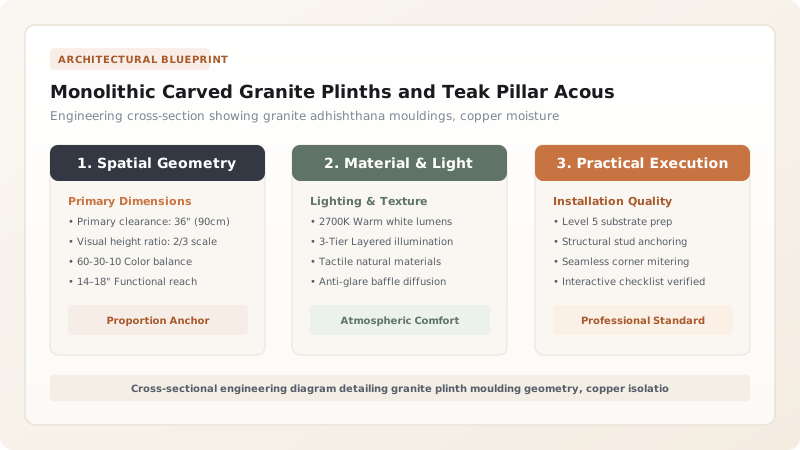
The Granite Adhishthana: Foundation of Sacred Terrestrial Stability
In the architectural syntax of classical Kerala temple carpentry, no wooden member ever touches the raw earth. In a tropical climate characterized by unrelenting humidity, torrential monsoons, and voracious subterranean termites, resting structural timber directly on the ground guarantees catastrophic structural failure within a decade. The solution perfected by master builders (perumthachan) is the adhishthana—a monumental, dry-stone basement plinth carved from solid highland charnockite granite (Krishna-shila).
Elevating the theatre floor 1.2 to 1.8 meters above courtyard grade, the granite plinth is not a simple vertical retaining wall; it is an intricately sculpted architectural sequence governed by canonical texts. Starting from the bottom, the blocks are carved with the upana (footing slab), the padma (upturned lotus petal moulding symbolizing purity rising from the earth), the vertical jagati (the primary plinth wall), and the prominent rounded kumuda (a bold torus moulding that deflects splashing rainwater). This monolithic stone fortress serves as an impenetrable physical barrier against groundwater capillary rise and monsoonal splash erosion.
The Omam Socket: Seismic Friction and Capillary Isolation
At the upper plane of the granite plinth, the mason carves circular or square socket rebates known as omam. The wooden columns of the Koothambalam do not sit flush on flat stone, nor are they bolted down with modern steel pins. Instead, the column base descends 30 mm to 50 mm into the precision-chiseled granite socket, resting on a sacrificial buffer sheet of pure hammered copper.
This joint is a masterclass in vernacular seismic and biological engineering. The copper sheet completely severs capillary moisture migration, while releasing antimicrobial copper ions that inhibit fungal hyphae. Structurally, the absence of rigid mechanical anchors transforms the pillar into a dynamic rocking pivot. Under the extreme lateral accelerations of an earthquake, the massive downward dead weight of the heavy copper-clad roof maintains vertical equilibrium, while the un-anchored column base rocks infinitesimally within its stone socket, dissipating seismic kinetic energy through dry friction rather than suffering catastrophic brittle fracture.
Turned Malabar Teak: Botanical Density and Lathe Geometry
Rising from the granite plinth are the magnificent structural columns, carved from old-growth Malabar teak (Tectona grandis / Tekka). Sourced from the dense rain forests of the Nilambur and Wayanad hills, slow-grown Malabar teak is celebrated globally for its high concentration of natural preservative oils (tectoquinone) and tightly packed annual growth rings (8 to 12 rings per inch), providing extraordinary dimensional stability and compressive strength exceeding 65 MPa.
To shape these massive 600 mm diameter tree trunks, traditional craftsmen utilized giant horizontal bow-lathes anchored between heavy timber posts. Using forged iron chisels driven by the rhythmic pulling of leather ropes, the square baulks were turned into smooth, perfect cylinders or multi-faceted fluted shafts. At the top of each shaft, the timber transitions into an ornate corbel bracket capital known as the pothika, carved with stylized lotus buds (taranga) that cradle the massive primary horizontal roof beams (uttaram) in a secure mortise-and-tenon interlock.
Acoustic Tuning: Resonant Physics for the Mizhavu Drum
The true genius of these turned teak pillars lies in their role as acoustic instruments. In Koodiyattam Sanskrit drama, musical accompaniment is provided by the Mizhavu—a monumental copper pot drum with a tight calfskin head, struck with bare hands to produce deep, resonant bass pulses operating in the 60 Hz to 120 Hz frequency band. In a standard masonry or concrete room, these powerful low-frequency sound waves reflect off flat walls, creating destructive standing waves, flutter echoes, and acoustic boom that obliterate the actor's spoken recitation.
The circular, fluted surfaces of the turned teak columns act as natural convex acoustic diffusers. Instead of bouncing sound back in a single coherent wave, the curved wooden surfaces scatter the sound energy omnidirectionally, maintaining high speech intelligibility across the entire audience hall. Furthermore, the cellular fiber matrix of the dense teak heartwood provides natural damping: it absorbs harsh high-frequency transients while vibrating sympathetically with the warm fundamental resonance of the Mizhavu drum, enveloping the sacred space in a warm, enveloping auditory embrace that has held audiences spellbound for centuries.
Theatre Foundation and Pillar Systems: Koothambalam Granite/Teak vs Roman Travertine/Marble vs Modern Concrete/Steel
Use this reference table to calculate exact physical dimensions, ratios, and specifications before purchasing:
| Architectural Parameter | Koothambalam Granite & Turned Teak | Roman Theatre Travertine & Marble | Modern Theatre Concrete & Structural Steel |
|---|---|---|---|
| Acoustic Resonance & Absorption | Warm, organic reverberation; teak fibers absorb harsh treble (2–4 kHz) while resonating bass (80 Hz) | Brittle, highly reflective; hard crystalline marble reflects 98% of acoustic energy, causing echoes | Dead or harsh; requires artificial sound absorption batts to counteract steel vibration flutter |
| Moisture & Termite Defense | Complete immunity; raised granite plinth severs ground capillary damp; natural teak oil deters insects | High durability in dry Mediterranean climate; prone to moisture staining and salt crystallization | Prone to hidden corrosion inside concrete; steel columns require toxic fireproofing sprays |
| Seismic & Lateral Dissipation | Dynamic rocking joints; columns rest unanchored on granite sockets, dissipating shear through friction | Heavy gravity friction; monolithic stone arches can crack during strong ground shaking | Rigid bolted baseplates; high shear stress concentrations under seismic accelerations |
| Hand Craftsmanship Lineage | Thachu-Sasthra master guilds; each pillar turned by hand to exact mathematical proportions | Vitruvian classical orders; master stone cutting using iron drills and saws | Mass-manufactured industrial rolled H-beams and automated concrete pours |
| Embodied Carbon & Heritage | Carbon-Negative / Low Energy; local granite quarrying, sustainable timber forestry; 500+ years lifespan | Moderate; energy-intensive stone quarrying and transport | Extremely High; iron smelting, cement calcination, heavy fossil-fuel crane logistics |
Practical Constraints
Every successful decoration project must account for physical and environmental constraints:
Immense Weight of Monolithic Granite Plinth Blocks During Transport
Individual 3-meter granite plinth stones weigh upwards of 3 to 5 tonnes, challenging site logistics. Mitigation: Transport stones on heavy timber log rollers hauled by temple work elephants, dressing stone blocks on-site directly adjacent to the foundation trench.
Centrifugal Vibration During Manual Turning of 600 mm Teak Baulks
Turning massive 2-tonne teak logs on traditional wooden lathes can cause violent eccentricity chatter. Mitigation: Rough-hew the square timber into a 16-sided polygon with adzes before mounting on the lathe, balancing weight along the central axis.
Execution Blueprint & Craftsmanship Sequence
Execute this professional sequence to achieve flawless results without backtracking:
Granite Block Quarrying and Dressing
Extract homogeneous charnockite granite blocks from sacred bedrock quarries in the Western Ghats foothills. Split the stone using wooden wedges soaked with water, rough-dressing blocks with heavy iron sledges.
Classical Adhishthana Moulding Carving
Carve the traditional architectural moulding sequence onto the exterior face of the plinth blocks: the flat upana footing, curved padma lotus band, tall vertical jagati wall, and rounded kumuda torus ring, finishing with a drip-edge pattika rail.
Dry Stone Foundation Laying
Excavate a continuous perimeter trench down to stable bedrock or compacted gravel. Set the carved granite blocks in dry interlocking courses without mortar, using copper dowels and lead keys to prevent lateral sliding under seismic movement.
Pillar Socket (Omam) Chiseling
Lay out the exact pillar centerlines on the upper surface of the granite plinth. Chisel circular 30 mm deep socket rebates (omam) into the granite, carving tiny drainage weeps to prevent condensation water from pooling beneath the wood.
Teak Log Selection and Rough-Hewing
Select seasoned heartwood Malabar teak logs free of heart rot or wind shakes. Snap centerlines down the four faces and hew the square baulk into an octagon using broadaxes, preparing the wood for the turning lathe.
Lathe Turning and Fluting
Mount the timber onto a heavy wooden turning lathe driven by wrapped leather rope pulled by two apprentices. As the log spins, the master carpenter advances forged steel gouges, turning the shaft into a flawless cylinder, followed by longitudinal fluting.
Pothika Bracket Capital Carving
Carve the flared timber capital (pothika) at the top of each pillar. Sculpt the traditional taranga (water wave) corbel brackets with descending lotus buds, designed to cradle the heavy primary horizontal timber tie-beams (uttaram).
Pillar Erection and Acoustic Alignment
Hoist the turned teak pillars onto the granite sockets, bedding the wooden end-grain onto a sheet of hammered copper. Align the columns plumb with plumb lines, checking acoustic sightlines toward the elevated central stage.
Common Mistakes & Countermeasures
Avoid these costly errors that compromise aesthetics, ergonomics, and budget:
Setting wooden pillar bases in wet cement grout atop the granite plinth
Using sapwood or second-growth plantation teak for structural acoustic pillars
Polishing the granite plinth with modern high-gloss diamond abrasive pads
Project Execution Checklist
Track your physical progress. Checkboxes persist automatically on this device:
Frequently Asked Questions
Why is charnockite granite chosen for the plinth instead of sandstone or marble?
Charnockite granite (locally known as Krishna-shila) is one of the hardest, most impervious igneous rocks on Earth. Unlike porous sandstone or soft marble, charnockite has near-zero water absorption (<0.2%), resists the acidic weathering of continuous tropical monsoon downpours, and possesses immense compressive strength (exceeding 200 MPa) capable of carrying heavy multi-tiered copper roofs indefinitely.
How do turned wooden pillars function as acoustic resonators?
Solid wooden pillars are not completely inert. Teak heartwood possesses a specific natural density (650–750 kg/m³) and cellular micro-structure that interacts with airborne sound waves. When the circular columns are positioned around the perimeter, their curved surfaces diffuse sound waves uniformly, preventing harsh echoes. Furthermore, the column spacing and diameter resonate sympathetically with the 80–100 Hz fundamental tones of the Mizhavu drum, acting like giant unpowered acoustic tuning forks.
Why are the timber columns not bolted into the granite plinth?
In traditional Kerala carpentry, structural joinery relies on gravity and friction rather than rigid metallic anchors. The massive downward dead-load of the heavy three-tiered timber-and-copper roof holds the columns firmly inside their recessed granite sockets. During an earthquake, this un-anchored joint allows minor rocking and frictional displacement, dissipating violent seismic kinetic energy without snapping the timber shafts.
What is the purpose of placing a copper sheet beneath the timber column base?
Even hard granite can transmit microscopic amounts of moisture via capillary condensation in humid weather. Placing a thin sheet of pure hammered copper between the granite socket and the teak end-grain creates an absolute moisture barrier. Furthermore, copper ions possess natural biocidal properties, permanently poisoning any fungal spores or termites attempting to cross from the stone into the wood.