In Japanese tsukubai architecture, the yakuishi (役石 / functional stones) and stone lantern (tōrō) establish the spatial choreography, ergonomic stability, and twilight illumination of the purification ritual. The yakuishi comprise three critical stones orbiting the central basin: the mae-ishi (front crouching stone where the guest kneels), the teshoku-ishi (candlestick stone to the right for holding a night lantern), and the yuoke-ishi (hot water stone to the left for holding a winter wash pail). Positioned behind or adjacent to this triad is a low-slung stone lantern—typically an Oribe-dōrō or Misaki-dōrō—carefully oriented to cast gentle, non-glaring amber light across the water basin and stepping stones during evening tea ceremonies (yobanashi).
At a Glance: Key Takeaways
- Stone Typology: Yakuishi: Functional auxiliary stones orbiting the central water basin
- Primary Crouching Stone: Mae-ishi: broad, level river flagstone (60x40 cm, perfectly stable underfoot)
- Lateral Auxiliary Stones: Teshoku-ishi (right / candle stone) and Yuoke-ishi (left / hot water pail stone)
- Lantern Typology: Oribe-dōrō (buried stem lantern), Misaki-dōrō (cape lantern), or Yukimi-dōrō
- Ceremonial Function: Choreographs body kneeling posture, night lighting, and winter temperature adjustments
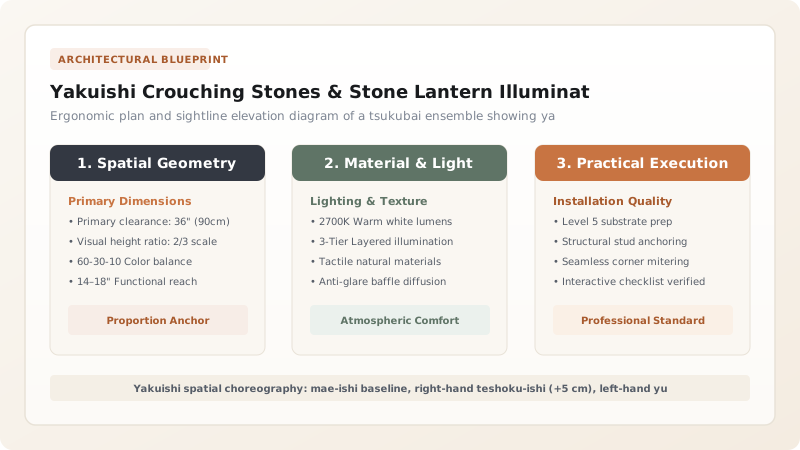
Choreography of Stone: The Yakuishi System
In the austere aesthetic universe of the Japanese tea garden (chaniwa), nothing is accidental. Every stone along the path possesses a specific name, a precise elevation, and a codified ergonomic role. Around the central water basin, this discipline manifests in the yakuishi (役石)—literally the 'stones of office' or 'functional stones'.
Rather than placing random river rocks around the basin for rustic effect, master tea designers establish a strict tri-axial spatial choreography. The stones dictate how the human body moves through three-dimensional space: how the guest approaches, where the straw sandals come to rest, which knee touches the earth first, and where ceremonial utensils are placed. This spatial discipline transforms what could be a mundane utilitarian wash station into a graceful, meditative dance of purification.
The Mae-Ishi: The Crouching Foundation
The premier stone of the ensemble is the mae-ishi (前石 / front stone). Positioned directly in front of the basin—separated by a distance of thirty to thirty-five centimeters—the mae-ishi is a substantial river flagstone with a generous, perfectly flat upper surface measuring approximately sixty by forty centimeters.
The setting of the mae-ishi is an exercise in absolute stability. Because a guest will kneel or crouch upon this stone while balancing a bamboo water ladle, the stone must be 100% rock-solid. A loose or rocking mae-ishi instantly shatters the guest's inner concentration (zanshin). The elevation of the mae-ishi forms the zero-datum plane of the entire ensemble: the water basin rises twenty-five to thirty-five centimeters above it, ensuring that a crouching person can effortlessly reach forward to scoop water from the mizu-ana without overbalancing or straining the back.
Lateral Auxiliaries: Teshoku-Ishi & Yuoke-Ishi
Flanking the central axis are the two secondary functional stones. To the right sits the teshoku-ishi (手燭石 / candlestick stone), and to the left sits the yuoke-ishi (湯桶石 / hot water bucket stone). Both stones are selected with flat top planes, but crucially, both are set approximately five to eight centimeters higher than the central mae-ishi.
This slight elevation serves two essential ergonomic functions. First, it establishes a subtle three-dimensional amphitheatrical enclosure that cradles the crouching guest. Second, it keeps ceremonial utensils clean and dry, elevated above any surface moisture that might splash onto the mae-ishi during washing. During evening tea ceremonies (yobanashi), the guest places their portable cast-iron candle lantern onto the teshoku-ishi on the right; during harsh mid-winter ceremonies, a cedar pail of warm water rests upon the yuoke-ishi on the left, allowing the host to provide hospitality that softens the bite of freezing mountain winds.
The Tōrō: Stone Lantern Optics & Twilight Sanctuary
Completing the tsukubai sanctuary is the tōrō (石灯籠 / stone lantern). Positioned behind or slightly offset from the basin—often partially veiled behind the feathery branches of a Japanese maple or Japanese yew—the lantern provides functional guidance for evening and dawn tea gatherings.
Tea masters favored low-profile, rustic lantern forms, most notably the Oribe-dōrō (織部灯籠). Named after the avant-garde tea master Furuta Oribe (1544–1615), this lantern has no wide circular base; its slender rectangular stem is buried directly into the moist earth, allowing it to nestle low amidst ferns and moss. The firebox (hibukuro) houses a single beeswax candle or rapeseed oil wick. Its carved stone apertures are oriented downward, casting a warm, pool of amber light across the glistening black Nachi pebbles and the mirror-like water of the basin, transforming the twilight garden into an enchanting threshold between the mundane world and the eternal peace of tea.
Ergonomic & Spatial Specifications for Tsukubai Yakuishi Stones
Use this reference table to calculate exact physical dimensions, ratios, and specifications before purchasing:
| Functional Stone | Japanese Name | Spatial Location | Elevation Relative to Mae-ishi | Ergonomic / Ceremonial Role |
|---|---|---|---|---|
| Front Crouching Stone | Mae-ishi (前石) | Centered 30–35 cm in front of basin | Baseline reference plane (0 cm elevation) | Guest stands, stoops, or kneels to scoop water with hishaku ladle |
| Candlestick Stone | Teshoku-ishi (手燭石) | Flanking right side of basin | +5 to +8 cm higher than mae-ishi | Supports portable iron hand-candle lantern (teshoku) during night gatherings |
| Hot Water Stone | Yuoke-ishi (湯桶石) | Flanking left side of basin | +5 to +8 cm higher than mae-ishi | Holds cedar pail (yuoke) of warm water during freezing winter tea ceremonies |
| Back Screen Stone | Suiki-ishi (水掬石) | Centered behind the basin | +10 to +15 cm higher than basin rim | Visual anchor and backdrop stone framing the water basin against garden |
| Tea Garden Lantern | Tōrō (石灯籠) | Offset diagonally behind basin | Total height 80–120 cm above grade | Casts soft, downward-directed twilight illumination over the water surface |
Practical Constraints
Every successful decoration project must account for physical and environmental constraints:
Differential ground settling beneath auxiliary stones under foot traffic and rain
The mae-ishi can tilt over time, causing water to pool on its surface and creating slip hazards. Mitigation: Install a consolidated 15 cm crushed granite base beneath all yakuishi before final positioning.
Wind extinguishing open flame candles inside stone lantern fireboxes during outdoor tea gatherings
Leaves guests in pitch darkness along the wet stone garden path. Mitigation: Cover the firebox apertures (hibukuro) with translucent oiled Japanese washi paper screens.
Execution Blueprint & Craftsmanship Sequence
Execute this professional sequence to achieve flawless results without backtracking:
Spatial Triangulation & Stride Layout
Establish the approach line from the inner roji stepping stones (tobi-ishi), determining the exact ergonomic center where a kneeling guest will comfortably reach the basin.
Sub-Base Compaction & Drainage Gravel
Excavate 20 cm beneath each stone footprint, tamping crushed granite gravel to create unyielding structural footing pads that prevent seasonal settling.
Mae-Ishi Front Stone Bedding & Stability Locking
Bed the large flat river flagstone (mae-ishi) firmly into the gravel, tapping with a wooden tamper and jumping on all corners to verify 100% rock-solid stability.
Teshoku-Ishi (Right Auxiliary Stone) Placement
Position a smaller flat-topped stone to the right of the basin, elevating its top plane 5 to 8 cm higher than the mae-ishi to provide a clean platform for lighting.
Yuoke-Ishi (Left Auxiliary Stone) Placement
Set the hot-water pail stone to the left of the basin at an identical elevation (+5–8 cm), ensuring the triangular geometry around the basin is dynamically balanced.
Oribe-Dōrō Stone Lantern Selection & Siting
Select a weathered granite lantern with a buried stem (ikekomi-dōrō), setting the lantern base 60–80 cm diagonally behind the basin amidst low foliage.
Lantern Aperture Alignment & Screening
Rotate the lantern's firebox (hibukuro) so its primary crescent-moon or square opening directs soft light downward onto the basin and mae-ishi.
Night Illumination Testing with Candlelight
Light a beeswax candle within the firebox at dusk, adjusting adjacent shrubbery to ensure the flame casts gentle dappled shadows without direct glare into guests' eyes.
Common Mistakes & Countermeasures
Avoid these costly errors that compromise aesthetics, ergonomics, and budget:
Setting the mae-ishi front stone with any rotational wobble or rocking under human body weight
Installing modern high-lumen electric spotlights directly above the tsukubai ensemble
Reversing the lateral positions of the teshoku-ishi and yuoke-ishi auxiliary stones
Project Execution Checklist
Track your physical progress. Checkboxes persist automatically on this device:
Frequently Asked Questions
Why is the candlestick stone (teshoku-ishi) positioned to the right and the hot water stone (yuoke-ishi) to the left?
This layout reflects refined tea ceremony ergonomics. During evening ceremonies, guests carry a portable iron hand-lantern (teshoku) in the right hand; upon arriving at the tsukubai, they naturally place it onto the stone to their right. The hot water pail (yuoke)—used in winter to dilute freezing water—is placed on the left, allowing the right hand to remain free to manipulate the bamboo water ladle.
What is an Oribe-dōrō and why is it frequently paired with a tsukubai?
The Oribe-dōrō (designed by tea master Furuta Oribe in the late 16th century) is a stem-type stone lantern (ikekomi-dōrō) that lacks a wide base platform; its vertical pillar is buried directly into the earth. This makes it low, unobtrusive, and intimate, blending seamlessly into garden foliage. It often features a mysterious carved figure on its pillar, historically associated with secret Christian (Kakure Kirishitan) tea masters.
What happens if a guest steps onto the auxiliary stones instead of the mae-ishi?
In tea etiquette, stepping on the teshoku-ishi or yuoke-ishi is a serious social breach. Stepping stones are strictly codified: tobi-ishi stepping stones are for walking; the mae-ishi is exclusively for standing and crouching; the side stones are sacred furniture surfaces reserved solely for lanterns and hot water buckets.