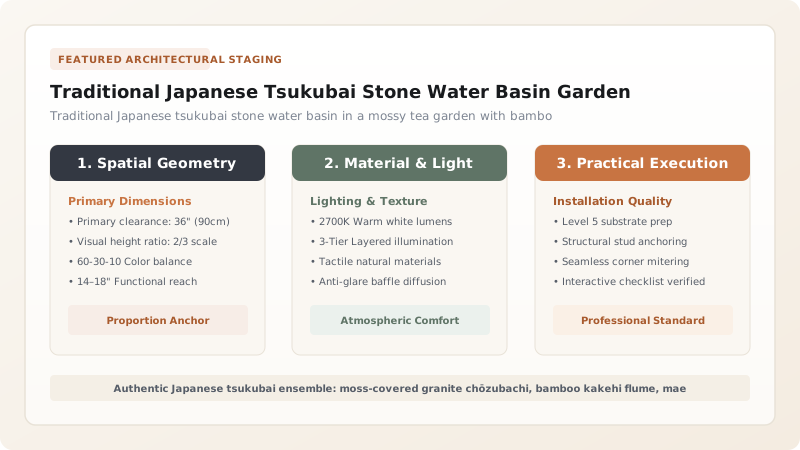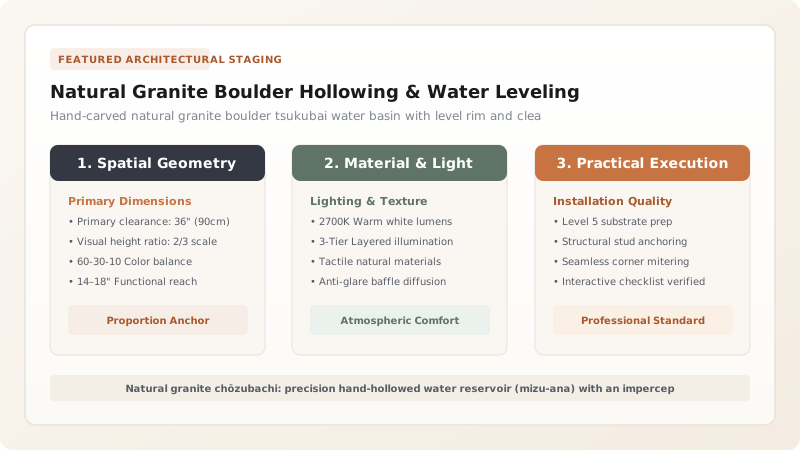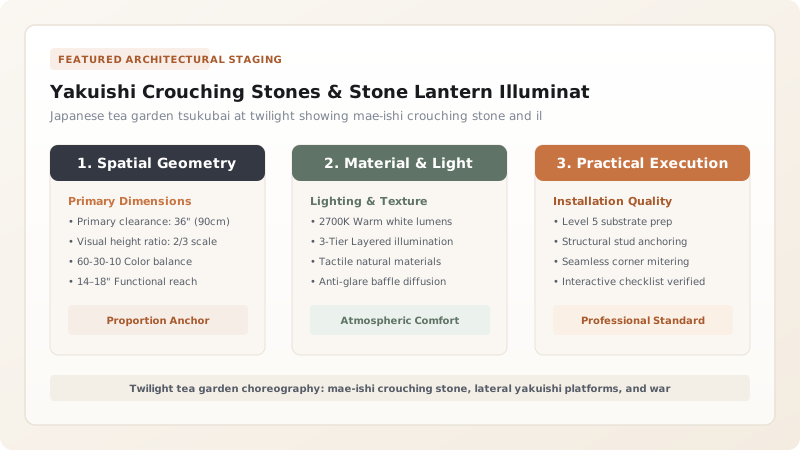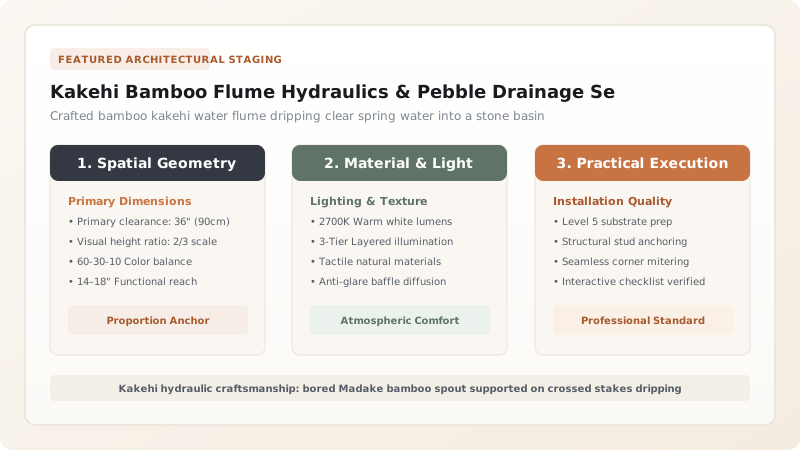
In Japanese tsukubai design, the kakehi (bamboo water flume) and the umi (gravel sea) form a closed, harmonious hydraulic circuit combining gravitational fluid dynamics with contemplative acoustics. The kakehi is hand-fashioned from thick-walled Japanese timber bamboo (Madake or Moso), bored through its internal diaphragms and suspended on crossed wooden pegs (kakehi-kui) over the stone basin. Hydraulically calibrated to deliver a slow, rhythmic gravitational trickle (1–2 drops per second), the water creates soft acoustic resonance before overflowing into the umi—a deeply excavated drainage basin filled with smooth black Nachi river pebbles overlying a concealed gravel soakaway that instantly absorbs runoff without surface puddling.
At a Glance: Key Takeaways
- Flume Bamboo: Cured Japanese timber bamboo: Madake (Phyllostachys bambusoides) or Moso (P. edulis)
- Support Joinery: Kakehi-kui: crossed bamboo or cedar stakes tied with black tarred twine (shuro-nawa)
- Flow Rate Calibration: Gravitational slow trickle (0.5–1.0 L/min) or rhythmic single-drop acoustic cadence
- Drainage Sea (Umi): Excavated pit (depth 45–60 cm) filled with hand-selected black Nachi pebbles
- Subsurface Plumbing: Concealed French drain or perforated terracotta soakaway pipe beneath gravel bed
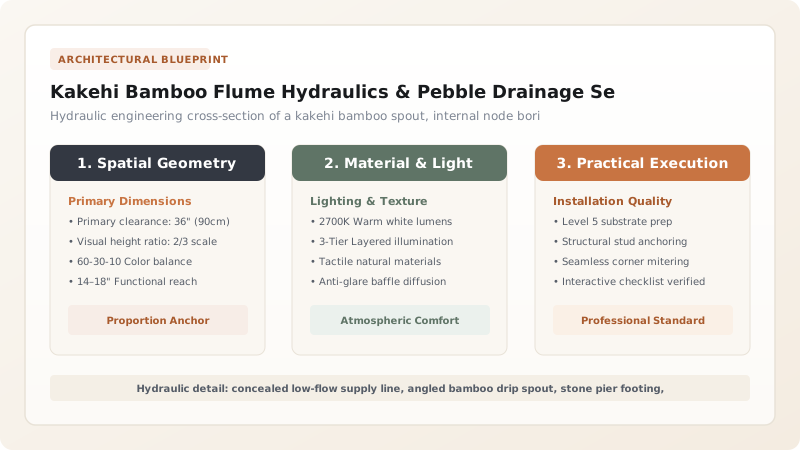
The Hydraulic Poetry of the Kakehi
In the quiet enclosure of the inner tea garden (uchi-roji), sound is as vital an architectural element as stone or foliage. The audio landscape must shut out the distant clamor of urban life, replacing it with natural white noise that calms the human nervous system. This auditory miracle is performed by the kakehi (筧)—the suspended bamboo water flume.
Rather than utilizing exposed copper plumbing or industrial fountain nozzles, Japanese garden tradition dictates that water must arrive organically. The kakehi emerges discreetly from a low evergreen thicket or behind a weathered stone lantern. Crafted from a single culm of straight-grained Japanese timber bamboo, the flume hovers horizontally over the water basin, held aloft by a pair of slender bamboo or cedar stakes tied into an X-form. The water does not rush; it trickles under pure gravity, breaking away from the angled bamboo snout in heavy, deliberate droplets that strike the basin surface with a resonant, bell-like timbre.
Bamboo Fabrication: Curing, Boring & The Angled Snout
Fabricating a durable kakehi requires specialized knowledge of bamboo anatomy. Green, freshly cut bamboo is full of moisture, starch, and sap; if exposed to outdoor garden moisture, it will crack longitudinally and develop unsightly black mildew within months. Master craftsmen select thick-walled Madake (Phyllostachys bambusoides) or Moso bamboo harvested in late autumn after mountain frosts have driven starches back into the root system.
The culm is heat-cured using the aburanuki process—either boiled in water or passed over a charcoal fire to sweat out natural plant oils, which are wiped across the rind to form a natural protective lacquer. Using long auger bits, the interior nodal diaphragms are bored out to create an unobstructed water channel, leaving only the final rear node partially intact to act as a pressure-dampening baffle. The discharge tip is cut with a sharp pull-saw at a crisp 45-degree angle: this beveled undercut prevents surface tension from pulling water droplets backward along the bamboo belly, ensuring a clean, vertical gravitational drip.
The Umi: Sunken Sea & Subsurface Soakaway Engineering
Beneath the floating water basin and surrounding stepping stones lies the umi (海)—the 'sea'. In the symbolic language of tea aesthetics, the garden is a microcosm of nature: the water descending from the bamboo flume represents a mountain waterfall, while the sunken drainage basin below represents the ocean into which all earthly waters ultimately flow.
Behind this poetic metaphor lies rigorous subterranean drainage engineering. In hyper-humid Japanese gardens subject to heavy typhoon rains, standing water around a tsukubai would rapidly turn soil into mud, fouling guests' footwear and breeding mosquitoes. The umi is excavated to a depth of fifty to sixty centimeters. Beneath the surface lies a modern or traditional French drain: perforated pipes bedded in coarse granite aggregate and wrapped in geotextile fabric. Any water splashing over the basin rim filters instantly through the gravel, draining away to a remote dry well and keeping the garden surface perpetually clean and dry.
Lithic Dressing: Nachi-Guro Pebbles & The Black Sea
The visible surface of the umi is dressed with a dense layer of hand-selected river stones. The gold standard of Japanese garden craft is Nachi-guro (那智黒石)—smooth, water-worn black pebbles gathered from the coast of the sacred Kumano mountains in Wakayama Prefecture.
These pebbles—ranging in size from twenty to forty millimeters—are laid by hand in a uniform layer roughly fifty millimeters deep across the gravel bed. When dry, Nachi pebbles exhibit a soft, velvety charcoal-grey matte finish. However, as water drips from the kakehi and splashes from the guest's hand-washing, the wet stones instantly transform into a deep, glossy, obsidian-black mirror. This dynamic optical transformation—from dry grey stone to glistening wet inky black—provides an exquisite sensory reward, visually confirming that the cleansing waters of the tea sanctuary are alive and active.
Hydraulic Components & Drainage Layering in the Tsukubai Umi System
Use this reference table to calculate exact physical dimensions, ratios, and specifications before purchasing:
| System Stratum | Material Spec | Thickness / Dimensions | Functional Contribution | Maintenance Requirement |
|---|---|---|---|---|
| Bamboo Flume (Kakehi) | Heat-cured Madake Bamboo | Diameter 40–50 mm, Length 80–120 cm | Conveys pristine water; projects sound over basin | Replace every 2–4 years as bamboo weathers |
| Support Stakes (Kakehi-kui) | Split Cedar or Bamboo Stakes | Paired stakes tied in X-frame with shuro-nawa | Secures flume at exact elevation and forward angle | Re-tie tarred palm cord when weathered |
| Surface Pebble Bed | Polished Black Nachi Pebbles | Diameter 25–40 mm (50 mm bed depth) | Softens splash sound; conceals drainage basin | Wash stones annually to remove fallen leaf debris |
| Intermediate Filter Bed | Washed River Pea Gravel | 6–12 mm rounded river gravel (150 mm depth) | Rapid vertical drainage; prevents fine silt wash-out | Inspect every 5 years for sediment clogging |
| Subsurface Soakaway | Perforated French Drain + Aggregate | 100 mm pipe in 300 mm crushed granite bed | Discharges water to garden soakaway or dry well | Flushed clean every decade with water hose |
Practical Constraints
Every successful decoration project must account for physical and environmental constraints:
Rapid organic decay of natural bamboo flumes exposed to continuous moisture and sun
Bamboo splits and develops black mildew stains after two to three seasons of continuous water flow. Mitigation: Treat bamboo with hot boiling water to leach natural starches (aburanuki) and coat interior with beeswax.
Silt, moss debris, and autumn leaves accumulating within the drainage sea pebbles
Organic detritus clogs voids between pebbles, causing water to pool and stagnate on the garden surface. Mitigation: Install a removable wire mesh catch-basket beneath the basin drain and clean surface pebbles each autumn.
Execution Blueprint & Craftsmanship Sequence
Execute this professional sequence to achieve flawless results without backtracking:
Umi Drainage Pit Excavation
Excavate a rectangular or curvilinear pit measuring 1.2 meters across and 50 cm deep directly beneath the proposed water basin and surrounding auxiliary stones.
Subsurface Drain Line & Dry Well Installation
Lay a 100 mm perforated PVC or clay drain pipe at a 1:50 slope in the pit bottom, routing it to a garden gravel dry-well or subterranean stormwater recharge pit.
Base Aggregate & Filter Fabric Bedding
Bed the drain pipe in 20 cm of washed crushed stone aggregate, covering the layer with non-woven geotextile fabric to prevent fine garden sediment from fouling the soakaway.
Basin Foundation Pier Setting
Construct a solid foundation pier of large flat quarry stones in the center of the pit to provide unyielding vertical support for the heavy granite basin.
Cured Bamboo Flume (Kakehi) Crafting
Select a flawless segment of cured Madake bamboo, boring internal nodes with a spade bit and cutting an acute 45-degree angle at the water discharge snout.
Support Stake (Kakehi-kui) Joinery & Cordage
Drive two slender bamboo stakes into the ground at an angle, lashing them at their intersection using black tarred hemp cord (shuro-nawa) to cradle the flume.
Hydraulic Calibration & Flow Metering
Connect a concealed copper or PEX water supply line into the rear of the bamboo flume, adjusting a needle valve until water drops at a steady, rhythmic drip of 60–80 drops per minute.
Nachi Pebble Layering & Surface Detailing
Fill the upper 10 cm of the sunken pit with hand-selected, tumbled black Nachi river pebbles, feathering the stones around the basin base and stepping stones.
Common Mistakes & Countermeasures
Avoid these costly errors that compromise aesthetics, ergonomics, and budget:
Using green, unseasoned bamboo cut in springtime for the kakehi water flume
Connecting the bamboo flume directly to high-pressure municipal water without a pressure regulator
Filling the drainage sea with sharp, crushed limestone or modern angular gravel
Project Execution Checklist
Track your physical progress. Checkboxes persist automatically on this device:
Frequently Asked Questions
What is the meaning of the word 'kakehi' and how does it function?
The word 'kakehi' (筧) translates as a water pipe or conduit. In Japanese garden architecture, it refers to the bamboo flume that conveys spring water from a hidden source (often concealed inside a bamboo grove or rock cluster) to discharge into the stone water basin. It functions as both a functional aqueduct and an acoustic instrument.
Why is the drainage pit around a tsukubai called the 'umi' (sea)?
In the poetic symbolism of Japanese landscape architecture, the garden is a miniature cosmos (mitate). The mossy stepping stones represent mountain peaks, the bamboo flume represents a mountain brook, the chōzubachi represents a clear mountain tarn, and the sunken pebble drainage pit represents the boundless ocean (umi) that gathers all water back to its source.
Why are black Nachi pebbles (Nachi-guro) considered the premier stone for the umi?
Nachi-guro pebbles—quarried historically from the sacred Kumano region of Wakayama—are dense, pitch-black siliceous stones smoothed by ocean surf. When wet, they transform into a luminous, mirror-like inky black that creates an extraordinary optical contrast against clear water droplets and pale green garden moss.