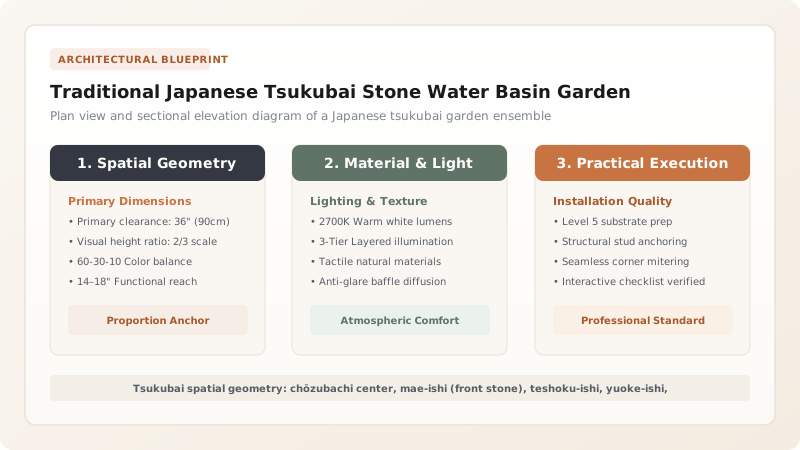
The Japanese tsukubai (蹲踞 / crouching water basin) is a sacred ritual stone ensemble positioned along the roji (dewy path) in traditional chaniwa (tea garden) architecture. Conceived by 16th-century tea master Sen no Rikyū, the tsukubai requires tea ceremony guests to physically stoop down (tsukubau) in an act of egalitarian humility to rinse their hands and mouth (temizu) before entering the tearoom. The architectural ensemble centers around a low natural granite water basin (chōzubachi), fed by a calibrated bamboo spout (kakehi), surrounded by designated functional stones (yakuishi)—including the crouching stone (mae-ishi), candlestick stone (teshoku-ishi), and hot water stone (yuoke-ishi)—all set within a sunken pebble drainage basin (the sea / umi) illuminated by a stone lantern (tōrō).
At a Glance: Key Takeaways
- Architectural Context: Chaniwa (tea garden) and Roji (dewy path) preceding the chashitsu tearoom
- Philosophical Origin: Sen no Rikyū (1522–1591); embodies wabi-sabi, ritual purification, and social equality
- Core Basin (Chōzubachi): Natural weathered granite boulder (shizen-seki) or repurposed Buddhist stone base
- Auxiliary Stones (Yakuishi): Mae-ishi (front stone), teshoku-ishi (candlestick stone), yuoke-ishi (bucket stone)
- Hydraulic Drainage: Kakehi (split bamboo flume) discharging into an umi (gravel sea / French drain)
In-Depth Guides in this Directory
Explore specialized subtopic blueprints, technical dimensions, and execution checklists:
Natural Granite Boulder Hollowing & Water Leveling for Tsukubai Basins
Stonecraft guide to selecting natural granite boulders, cold-chisel core hollowing, water-reservoir carving, and lip-leveling for Japanese tsukubai basins.
Kakehi Bamboo Flume Hydraulics & Pebble Drainage Sea in Tea Gardens
Technical guide to crafting Japanese kakehi bamboo water flumes, gravitational hydraulic calibration, and sunken pebble drainage sea (umi) soakaways.
Yakuishi Crouching Stones & Stone Lantern Illumination in Tsukubai Ensembles
Architectural placement of yakuishi auxiliary stones (mae-ishi, teshoku-ishi, yuoke-ishi) and stone lantern (tōrō) illumination in tea gardens.
The Philosophy of Roji & The Purifying Threshold
In the Japanese tea ceremony (chanoyu), the garden is not merely an ornamental landscape; it is a transformative spiritual journey. The path leading from the secular outside world to the rustic tearoom (chashitsu) is known as the roji (露地), literally translating as the 'dewy ground' or 'path of spiritual awakening'. As guests walk across the uneven stepping stones (tobi-ishi) amidst ferns and moss, the garden systematically strips away the stresses, pretensions, and hierarchical distinctions of everyday feudal society.
The physical and psychological threshold of this journey is the tsukubai (蹲踞). Conceived in the late 16th century by the legendary tea master Sen no Rikyū (1522–1591), the tsukubai takes its name from the verb tsukubau, meaning 'to crouch' or 'to stoop down'. In an era when warlords and samurai ruled Japan with absolute military authority, Rikyū positioned the water basin so low to the earth that even a daimyo was forced to remove his long katana sword, stoop his body, and bend his knees in an attitude of profound personal humility before entering the sacred fellowship of the tea room.
Anatomy of the Tsukubai Ensemble: The Four Sacred Stones
A true tsukubai is not an isolated birdbath, but an exquisitely balanced asymmetrical stone composition governed by centuries of tea garden codification. At its heart sits the chōzubachi (手水鉢), the central stone basin containing clear, living spring water. The basin is traditionally nestled low, its top rim rising only thirty to thirty-five centimeters above the surrounding ground, framed by four sacred functional stones known collectively as yakuishi (役石).
Directly in front of the basin lies the mae-ishi (前石 / front stone), a broad, flat river boulder set completely stable and level where the guest kneels or crouches to perform the purifying temizu ritual. To the right is the teshoku-ishi (手燭石 / candlestick stone), slightly elevated to provide a stable perch for a portable iron candle lantern during evening tea gatherings. To the left sits the yuoke-ishi (湯桶石 / hot water bucket stone), reserved during freezing winter gatherings for a wooden pail of warm water. Behind the basin, completing the composition, is the suiki-ishi (水掬石 / basin-level stone) or screen stone, balancing the composition against the backdrop of moss and dwarf bamboo.
Hydraulic Harmony: The Kakehi & The Sunken Sea (Umi)
Water is delivered to the basin through the kakehi (筧)—a minimalist flume crafted from cured green or aged brown bamboo. Supported by crossed wooden stakes (kakehi-kui), the flume projects silently out from adjacent shrubbery, terminating precisely over the center of the water reservoir. Rather than delivering a pressurized industrial stream, the kakehi is hydraulically calibrated to release a slow, gravitational trickle: single drops that strike the still water surface with a soft, resonant ping (suikinkutsu resonance), transforming the acoustic landscape of the garden into a sanctuary of contemplative peace.
Beneath the basin and surrounding stones lies the umi (海), literally 'the sea'. This is an excavated sunken pit, lined with fine pea gravel and topped with dark, water-worn river cobbles (tama-ishi). When water overflows the basin or is poured from the bamboo ladle during hand-washing, it does not create muddy puddles. Instead, it splashes gently onto the smooth river stones and vanishes instantly through a concealed French drain, keeping the path dry and pristine while symbolizing the eternal return of all mountain springs back into the cosmic sea.
The Wabi-Sabi Aesthetic: Living Patina & Stone Selection
In contemporary landscape architecture, the tsukubai is celebrated as one of the ultimate expressions of wabi-sabi—the Japanese philosophy that finds transcendent beauty in imperfection, simplicity, and the natural patina of time. Master garden designers reject pristine, machine-cut marble or glossy polished stone for the chōzubachi. Instead, they seek out shizen-seki: unworked, river-weathered granite boulders bearing deep pitted hollows, iron oxidation stains, and colonies of living velvet moss and lichen.
Historic tea masters frequently practiced mitate—the art of seeing new artistic purpose in discarded objects. Ancient pagodas, weathered Buddhist temple foundation stones, and hollowed stone mortars (usu) were salvaged and repurposed into celebrated tsukubai basins, carrying the spiritual patina of bygone centuries into the tea garden. Shaded beneath Japanese maples and illuminated at dusk by the soft amber glow of a low stone lantern (tōrō), the tsukubai remains a timeless architectural device for grounding the human spirit in quietude and reverence.
Components & Spatial Geometry of the Traditional Tsukubai Ensemble
Use this reference table to calculate exact physical dimensions, ratios, and specifications before purchasing:
| Ensemble Component | Japanese Term | Material Specification | Elevation / Placement | Ritual / Hydraulic Function |
|---|---|---|---|---|
| Central Water Basin | Chōzubachi (手水鉢) | Hollowed natural granite boulder (shizen-seki) | Height 25–35 cm above front stone | Holds pristine spring water for hand-washing and mouth-rinsing |
| Front Crouching Stone | Mae-ishi (前石) | Broad, flat river flagstone (60x40 cm) | Flush with roji stepping stones; 30 cm from basin | Primary platform where guest kneels or crouches during temizu |
| Candlestick Stone | Teshoku-ishi (手燭石) | Flat stone positioned to the right of the basin | Elevated 5–8 cm higher than mae-ishi | Holds a portable candle lantern (teshoku) during evening tea ceremonies |
| Hot Water Bucket Stone | Yuoke-ishi (湯桶石) | Flat stone positioned to the left of the basin | Elevated 5–8 cm higher than mae-ishi | Holds a wooden pail of warm water for hand-washing during freezing winter |
| Basin Drainage Sea | Umi (海) | Sunken gravel pit filled with black river pebbles | 15–20 cm below surrounding soil line | Absorbs splash runoff through hidden French drain; conceals plumbing |
| Bamboo Water Spout | Kakehi (筧) | Bored madake or moso green/cured bamboo | Extends 15–25 cm over the basin cavity center | Supplies a continuous slow, contemplative gravitational water drip |
Practical Constraints
Every successful decoration project must account for physical and environmental constraints:
Freezing winter temperatures causing water expansion and fracture of the granite reservoir
Water trapped in the mizu-ana expands when frozen, creating hairline cracks that permanently drain the basin. Mitigation: Drain the basin during deep winter freezes or float a small wooden block in the water to absorb expansion pressures.
Algal blooms and stagnant mosquito breeding in uncirculated garden water basins
Standing warm water develops foul odors, green slime, and insect larvae within days. Mitigation: Install a continuous slow gravitational overflow through the kakehi and ensure the drain connects to an active soakaway.
Execution Blueprint & Craftsmanship Sequence
Execute this professional sequence to achieve flawless results without backtracking:
Garden Microclimate & Roji Pathway Siting
Locate the tsukubai in a sheltered, shaded pocket along the inner tea garden path (uchi-roji), positioned so that stepping stones (tobi-ishi) lead guests naturally toward the basin.
Drainage Trench Excavation & Umi Soakaway Pit
Excavate a 1.2x1.2 meter drainage pit 60 cm deep beneath the ensemble, installing a perforated PVC or clay drain tile bedded in crushed gravel to discharge runoff.
Chōzubachi Granite Boulder Selection & Cavity Leveling
Set the hollowed granite basin onto a compacted stone foundation, checking with a spirit level to ensure the rim allows water to spill silently toward the rear.
Mae-Ishi Front Crouching Stone Setting
Bed a large, perfectly flat river stone (mae-ishi) 30 cm in front of the basin, testing stability under foot to guarantee zero rocking when a guest kneels upon it.
Flanking Stone Placement (Teshoku-ishi & Yuoke-ishi)
Set the candlestick stone to the right and the hot water bucket stone to the left, elevating their top planes slightly above the front stone to establish tri-axial spatial balance.
Kakehi Bamboo Flume Hydraulics Installation
Bore out the internal nodes of a 40 mm diameter cured bamboo pole, mounting the spout on paired crossed bamboo stakes and connecting a concealed low-flow water line.
Pebble Dressing of the Sunken Sea (Umi)
Fill the excavated drainage pit around the basin and stepping stones with smooth, hand-selected black Nachi river pebbles (kuro-ishi), concealing all subsurface piping.
Stone Lantern (Tōrō) Setting & Ladle Placement
Erect a low-profile granite lantern (such as an Oribe-dōrō) behind the basin to cast warm light across the water, resting a small long-handled bamboo water ladle (hishaku) across the basin rim.
Common Mistakes & Countermeasures
Avoid these costly errors that compromise aesthetics, ergonomics, and budget:
Setting the stone basin at standing height (60–80 cm) like a conventional garden fountain
Creating a noisy, high-pressure water jet through the bamboo kakehi spout
Scrubbing green moss, lichen, or weathering patina off the granite basin with chemical cleaners
Project Execution Checklist
Track your physical progress. Checkboxes persist automatically on this device:
Frequently Asked Questions
What is the philosophical meaning of crouching at the tsukubai before a tea ceremony?
In feudal Japan, social status was rigid; samurai carried deadly swords and commoners knelt before lords. Tea master Sen no Rikyū revolutionized architecture by placing the tsukubai low to the ground and making the tearoom entrance (nijiriguchi) a tiny 90-cm-high sliding hatch. Every guest—whether a mighty shogun or a humble merchant—had to disarm, crouch at the tsukubai to wash hands, and crawl on hands and knees into the tearoom, establishing absolute egalitarian equality and purity in the sanctuary of tea.
What is the difference between a chōzubachi and a tsukubai?
A chōzubachi is simply the stone water basin itself. A tsukubai is the complete architectural ensemble consisting of the chōzubachi set at a low crouching height, the front crouching stone (mae-ishi), flanking auxiliary stones (teshoku-ishi and yuoke-ishi), the bamboo water flume (kakehi), and the pebble drainage sea (umi).
What does 'temizu' mean in the context of the tea garden?
Temizu (手水) is the Shinto-derived ritual of purifying the body and spirit before entering a sacred sanctuary. The guest takes the bamboo ladle in the right hand, pours water over the left hand, switches hands to wash the right, rinses the mouth with water cupped in the left palm, and tilts the ladle vertically so the remaining water washes the handle clean for the next guest.