
Juraku-nuri (聚楽塗り) is the crown jewel of Japanese interior plastering, renowned across Kyoto's grand tea rooms and imperial villas. Formulated from authentic Juraku-tsuchi—a rare, weathered volcanic silt quarried in central Kyoto—the soil is blended with microscopic washi paper fibers (nusa) and bound with pure mucilage boiled from red seaweed (Funori or Tsunomata). Applied in a razor-thin 1.5mm skim using flexible steel trowels, Juraku plaster dries to a warm, glare-free velvety matte surface.
At a Glance: Key Takeaways
- Fiber Reinforcement: Combed Japanese washi hemp paper pulp (Nusa / Asa)
- Finish Thickness: 1.2mm to 1.8mm single-pass precision skim
- Seaweed Binder: Red algae Funori (Gloiopeltis tenax) or Tsunomata (Chondrus ocellatus)
- Soil Source: Authentic Juraku-tsuchi from Nishijin, Kamigyo-ku, Kyoto
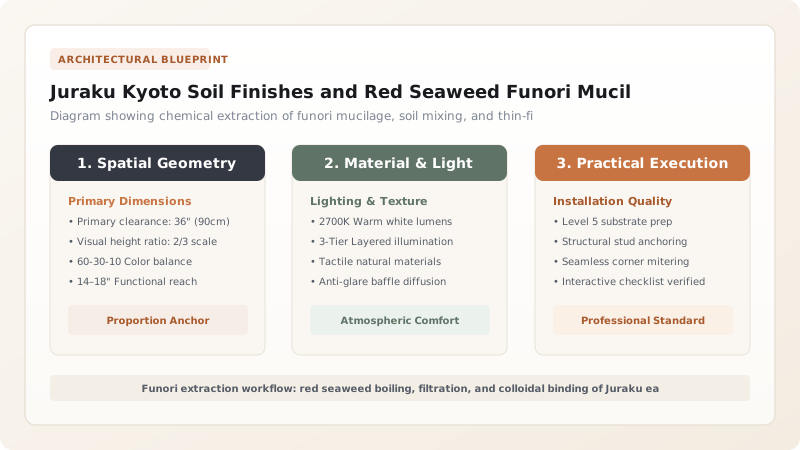
Geological Pedigree of Kyoto Juraku-Tsuchi
True Juraku-tsuchi is geographically unique. It is harvested exclusively from a specific geological layer (approx. 2 to 5 meters underground) in the Nishijin district of Kyoto, where Toyotomi Hideyoshi erected the famed Jurakudai Palace in 1587.
Formed by millions of years of volcanic ash deposition and alluvial weathering of granitic bedrock, Juraku soil has an exquisite particle distribution: roughly 70% weathered feldspar and quartz silt, 20% fine sand, and only 10% active clay. The natural trace iron oxides impart its signature warm honey-amber tonality (Juraku-iro) that cannot be replicated with synthetic colorants.
Funori Seaweed: The Chemistry of Natural Polysaccharide Mucilage
Because authentic Juraku soil has a very low natural clay fraction, it cannot bind itself into a durable wall skin without an added binder. Synthetic acrylic or vinyl glues are strictly prohibited because they create an unnatural shiny plastic film that stops breathability.
Instead, masters use Funori—a marine mucilage extracted by boiling dried red seaweed (Gloiopeltis tenax or Chondrus ocellatus / Tsunomata). The seaweed releases funoran, a sulfated galactan polysaccharide. When mixed into wet earth, funoran forms a colloidal biological network that coats every soil particle. It acts as a natural water-retention agent and film-former, giving the earth high slip under the steel trowel and drying to a rub-resistant, dust-free matte finish.
Nusa: Combed Washi Hemp Fibers for Invisible Reinforcement
To prevent micro-crazing across a 1.5mm thin finish skin, artisans introduce Nusa—microscopic fibers harvested from unbleached Japanese hemp (asa) or scraps of mulberry washi paper.
The fibers are boiled in lye water, beaten on stone anvils, and combed until the individual filaments measure less than 3mm in length. When dispersed in the Funori-earth slurry, these gossamer threads are invisible from a standing distance, yet they form a multi-directional internal web that absorbs drying stresses, preventing hairline shrinkage cracks across the expanse of the wall.
The Sakan Masterstroke: Chirimen Texture and Margin Cleanliness
Applying Juraku plaster is a high-speed, high-concentration performance. The master uses a Nami-kote—an ultra-thin, flexible spring-steel finishing trowel (0.3mm thick). The plaster must be laid, flattened, and textured in a single continuous flowing pass across the entire wall without stopping.
In tea room work, the sakan creates the prized Chirimen-hada (crepe texture) by drawing the trowel with light, sweeping circular arcs, bringing fine sand particles slightly to the surface. Along exposed unlacquered cedar posts (hashira), the plaster margin is dressed with a micro-thin margin trowel (chiri-kote), leaving a razor-sharp, hair-thin shadow gap that showcases the immaculate joint between living timber and ancient earth.
Juraku Finish Formulation & Tooling Specifications
Use this reference table to calculate exact physical dimensions, ratios, and specifications before purchasing:
| Component / Stage | Material Specification | Volume Ratio | Preparation Method | Visual / Physical Quality |
|---|---|---|---|---|
| Base Soil | Authentic Kyoto Juraku-tsuchi | 10 Parts by volume | Sifted through 40-mesh brass sieve | Warm honey-ochre matte tone |
| Liquid Binder | Red Seaweed Funori Extract | Diluted to light syrup density | Boiled 30 min in soft water & strained | Reversible, non-yellowing mucilage |
| Fiber Netting | Combed Washi Hemp (Nusa) | 0.5 Part by volume | Beaten & teased to 3mm filaments | Invisible micro-crack prevention |
| Finishing Blade | Surgical spring steel Nami-kote | 0.3mm ultra-flexible blade | Hand-lapped beveled edges | Uniform velvety Chirimen texture |
Practical Constraints
Every successful decoration project must account for physical and environmental constraints:
Zero Tolerance for Scratches or Errors on Exposed Timber
Unfinished cedar posts in tea rooms cannot be planed or sanded after plastering; requires protective washi tape and surgical trowel control.
Extreme Sensitivity of Wet Juraku to Direct Sun and Drafts
Drafts cause differential drying, resulting in dark cloud-like water stains across the wall; requires sealed shoji screens during application.
Execution Blueprint & Craftsmanship Sequence
Execute this professional sequence to achieve flawless results without backtracking:
Juraku Soil Sifting and Inspection
Sift raw Juraku earth through a 40-mesh sieve to eliminate oversize pebbles while retaining natural fine sand and granitic silt grains.
Funori Seaweed Boiling and Straining
Boil 100g dried Funori seaweed in 3 liters soft well water for 30 minutes; strain through fine silk cloth to yield a clear, viscous mucilage binder.
Nusa Hemp Fiber Dispersion
Tease combed washi hemp fibers into warm water, whisking vigorously until individual filaments float freely without fiber clusters.
Batch Compounding and Resting
Blend sifted Juraku soil with warm Funori mucilage and dispersed Nusa fibers, kneading by hand until reaching a smooth, buttery paste; let rest 30 minutes.
Single-Pass Precision Troweling
Apply a uniform 1.5mm skim over the pre-dampened naka-nuri wall using a 0.3mm flexible Nami-kote, working continuously from top to bottom.
Margin Dressing and Natural Curing
Tool clean 1mm margins around exposed timber posts using a chiri-kote margin trowel; allow the wall to cure in calm, draft-free shade for 4 days.
Common Mistakes & Countermeasures
Avoid these costly errors that compromise aesthetics, ergonomics, and budget:
Re-Troweling Juraku Plaster After It Has Begun to Set
Using Chemical Tap Water High in Chlorine or Minerals
Project Execution Checklist
Track your physical progress. Checkboxes persist automatically on this device:
Frequently Asked Questions
Does a Juraku earthen wall shed dust on your clothes if you brush against it?
When properly formulated with the correct proportion of boiled Funori seaweed binder and compressed by a skilled sakan master, an authentic Juraku wall does not shed dust or chalk onto clothing.
Can Juraku earthen plaster be cleaned if it gets stained?
Because Juraku is an untreated natural mineral surface, liquid stains (such as tea or oil) absorb deeply and cannot be washed away with water. Superficial dust is cleaned with a dry ostrich-feather duster, and localized damage is repaired by re-applying a fresh Juraku skim.


