
Japanese Tsuchikabe (土壁) is the quintessential earthen wall system of traditional sukiya-zukuri residences, machiya townhouses, and chashitsu tea rooms. Constructed by weaving a flexible split-bamboo lattice (takekomai) tied with black palm fiber twine (shuronawa), the wall is built up in three distinct stages: fermented straw-clay base plaster (arakabe), intermediate leveling plaster (naka-nuri), and a delicate finish coat of prized Kyoto earthen soil (Juraku-tsuchi) bound with boiled red seaweed mucilage (funori). Tsuchikabe acts as a dynamic hygrometric lung, moderating humidity and providing natural thermal comfort and acoustic serenity.
At a Glance: Key Takeaways
- Base Soil Matrix: Anaerobically fermented subsoil clay + fermented rice straw (Arakabe)
- Lath Armature: Split Madake/Mousouchiku bamboo tied with Shuro palm twine (Takekomai)
- Organic Binder: Boiled red seaweed mucilage extract (Funori / Tsunomata)
- Top Finish Soil: Authentic Juraku-tsuchi from Nishijin, Kyoto (weathered granitic silt)
In-Depth Guides in this Directory
Explore specialized subtopic blueprints, technical dimensions, and execution checklists:
Takekomai Split-Bamboo Lattice Lathing and Shuro Palm Twine Knotting Techniques
Technical manual on traditional Japanese Takekomai bamboo lathing, Madake splitting, continuous Shuronawa knotting, and timber frame anchorage.
Arakabe Fermented Straw-Clay Formulations and Naka-Nuri Intermediate Plaster Coats
Technical manual on Arakabe anaerobic straw-clay fermentation, two-sided bamboo packing, and Naka-Nuri intermediate sand-clay leveling plaster.
Juraku Kyoto Soil Finishes and Red Seaweed Funori Mucilage Binders
Master artisan guide to Kyoto Juraku earthen soil finishes, red seaweed Funori mucilage preparation, washi hemp fibers, and tea room troweling.
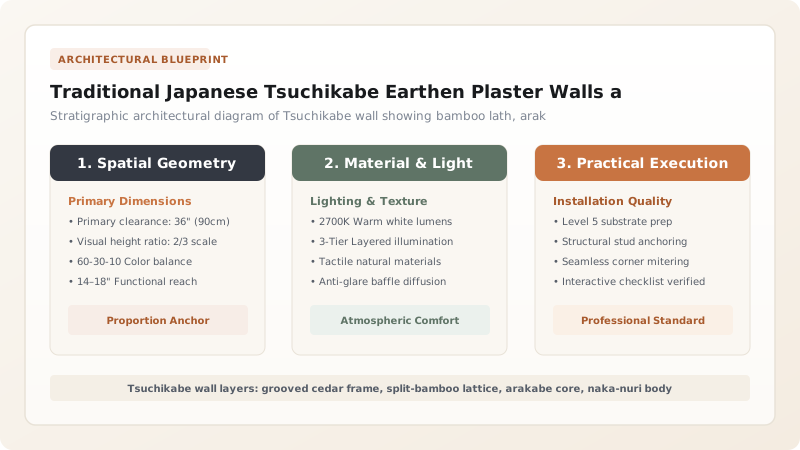
Wabi-Sabi Aesthetics and the Architectural Philosophy of Tsuchikabe
In traditional Japanese architecture—particularly tea house design (chashitsu) pioneered by Sen no Rikyū—the wall is not a sterile dividing partition; it is an organic, tactile canvas embodying the philosophy of wabi-sabi (transience and natural imperfection). Rather than hiding earthen soils beneath glossy paints or papers, master plasterers (sakan) celebrated the earthy textures of untreated regional subsoils.
A finished Tsuchikabe wall glows with soft, glare-free matte illumination, subtly reflecting seasonal changes in light. The exposed clay, fine sand particles, and microscopic flecks of aged rice straw create a soothing, acoustically damped interior environment that fosters contemplation and mindfulness.
The Takekomai Armature: Split Bamboo and Shuro Palm Twine
Tsuchikabe contains zero steel nails or synthetic mesh. The internal reinforcement skeleton is Takekomai—a resilient lattice woven from split Japanese timber bamboo (Madake, Phyllostachys bambusoides). Vertical split-bamboo laths are sprung into pre-drilled holes in horizontal cedar wall plates.
Horizontal split-bamboo slats are layered over the uprights and lashed tightly at every intersection using Shuronawa—a rot-resistant natural twine spun from the dark fibers of the hemp palm (Trachycarpus fortunei). This flexible wooden grid can absorb earthquake shear waves, flexing with timber frame movement without shedding the clay core.
Arakabe Chemistry: Anaerobic Straw Fermentation and Clay Plasticity
The core structural body of the wall is Arakabe. Local subsoil clay containing natural illite and montmorillonite is mixed with clean water and large volumes of chopped rice straw (wara, 30mm to 50mm lengths). The mixture is piled into outdoor pits, sealed with canvas, and allowed to ferment anaerobically for 3 to 12 months.
During fermentation, anaerobic bacteria digest the pectin in the straw, producing organic acids and slimy polysaccharide biopolymers. These biological polymers disperse clay clusters into microscopic platelets, vastly increasing green plasticity and workability. Simultaneously, the decaying straw fibers form an interlocking microscopic net that prevents drying shrinkage fractures.
Juraku-Tsuchi and Funori Seaweed: The Peak Finish Coat
The ultimate refinement in Japanese plastering is the finish coat (shita-nuri / kabe-shiage). The gold standard is Juraku-tsuchi, an alluvial volcanic earth quarried around the historic Jurakudai Palace site in Kyoto. Naturally rich in iron and weathered feldspar, it exhibits an exquisite, warm honey-ochre hue.
Because raw Juraku earth contains little clay, it is bound using Funori—a gelatinous mucilage extracted by boiling red seaweeds (Gloiopeltis tenax). Funori acts as an organic film-former and moisture retarder, allowing the sakan master to compress the earth with ultra-thin steel trowels (kote) into a velvet-matte, dust-free surface that breathes continuously.
Tsuchikabe Layer Formulation & Thickness Specifications
Use this reference table to calculate exact physical dimensions, ratios, and specifications before purchasing:
| Wall Layer | Traditional Name | Primary Soil / Binder Matrix | Fiber Reinforcement | Thickness & Drying Time |
|---|---|---|---|---|
| Bamboo Armature | Takekomai (竹小舞) | Split Madake bamboo grid (30mm spacing) | Shuro palm fiber twine knots | 15mm lattice thickness (Dry) |
| Rough Earth Base | Arakabe (荒壁) | Anaerobically fermented subsoil clay | Fermented rice straw (wara, 40mm) | 18mm – 22mm (Dry 30–60 days) |
| Intermediate Leveling | Naka-Nuri (中塗り) | Aged alluvial clay + fine silica river sand | Fine chopped straw (mi-tsu-su) | 6mm – 8mm (Dry 14–21 days) |
| Kyoto Fine Finish | Juraku-Nuri (聚楽塗り) | Authentic Kyoto Juraku soil + Funori extract | Fine combed washi hemp fiber | 1.5mm – 2.0mm (Dry 3–5 days) |
Practical Constraints
Every successful decoration project must account for physical and environmental constraints:
Extremely Long Construction Curing Cycles (3 to 6 Months)
Tsuchikabe cannot be rushed; complete multi-coat drying through seasonal humidity requires long project planning schedules.
Exhaustion of Historic Kyoto Juraku Earth Pits
Authentic Juraku clay deposits in Kyoto are largely built over; certified heritage restorers must source stockpiled historic earth.
Execution Blueprint & Craftsmanship Sequence
Execute this professional sequence to achieve flawless results without backtracking:
Timber Post Mortising and Split-Bamboo Lathing
Drill 12mm holes into timber sill and beam plates; spring split-bamboo uprights into place, weaving horizontal slats and tying with Shuro palm twine.
Arakabe Fermentation and Primary Application
Ferment clay and rice straw for 90 days; press thick arakabe into the bamboo lattice from one side, squeezing through until curling over the rear.
Reverse Ura-Nuri Application and Slow Drying
Smooth the protruding clay on the reverse wall face (ura-nuri); allow the thick earth core to dry naturally in shade for 40 to 60 days.
Intermediate Naka-Nuri Leveling
Trowel an 8mm intermediate coat of sand-tempered clay and fine straw over the dampened arakabe, leveling to a plumb plane with a wood float.
Funori Seaweed Decoction Preparation
Boil dried red Funori seaweed in soft water for 30 minutes, straining through fine muslin to yield a crystal-clear, viscous mucilage binder.
Juraku Earthen Finish Troweling
Combine Juraku earth with Funori mucilage and fine hemp fibers; apply a uniform 1.5mm finish coat using flexible Japanese steel trowels.
Common Mistakes & Countermeasures
Avoid these costly errors that compromise aesthetics, ergonomics, and budget:
Using Chemical Fungicides or Disinfectants in Arakabe Mud
Applying Intermediate Coats Before Arakabe Has Dried Completely
Tying Bamboo Lath with Synthetic Nylon Twine
Project Execution Checklist
Track your physical progress. Checkboxes persist automatically on this device:
Frequently Asked Questions
Why does fermented Arakabe mud smell strong during application?
The anaerobic fermentation of straw creates organic fatty acids and microbial enzymes that emit a strong pungent barnyard aroma while wet. However, once the wall dries completely, the odor vanishes entirely, leaving a clean, fresh earthy scent.
How does Tsuchikabe perform during an earthquake?
Tsuchikabe is a dynamic seismic energy-dissipator. Under earthquake ground motion, the flexible bamboo lattice and micro-cracking of the clay core absorb shear energy, preventing the timber frame from experiencing catastrophic structural failure.
Can damaged Tsuchikabe earthen walls be patched easily?
Yes. One of the greatest virtues of earth construction is total circularity. Damaged plaster can be re-wetted with water, scraped off, re-kneaded with fresh clay and straw, and re-applied seamlessly without creating any building waste.


