
Arakabe (rough wall) and Naka-Nuri (intermediate coat) form the structural and thermal body of a Japanese earthen wall. Arakabe is formulated by fermenting local subsoil clay with chopped rice straw (wara) for 3 to 12 months in sealed pits, allowing anaerobic bacteria to break down plant pectin into colloidal binders. Applied to both sides of the Takekomai bamboo lattice and cured for up to 60 days, it is leveled with Naka-Nuri—a sand-tempered clay coat with fine straw that creates a true plumb plane.
At a Glance: Key Takeaways
- Arakabe Clay Source: Subsoil clay (Kabe-tsuchi) dug from beneath organic topsoil
- Fermentation Period: 90 to 365 days anaerobic curing in outdoor mud pits
- Naka-Nuri Formulation: 1 Part Aged Clay : 2.5 Parts Sharp River Sand + Fine straw (Mi-tsu-su)
- Straw Reinforcement: Unwashed rice straw (Wara, chopped to 30mm–50mm lengths)
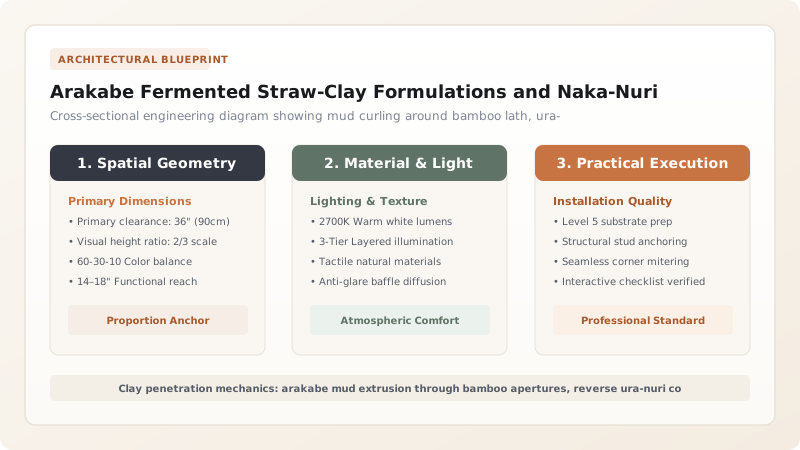
Microbiology of Arakabe: Anaerobic Pectin Fermentation
Raw clay mixed freshly with straw lacks cohesive plasticity and shrinks violently. The genius of traditional Japanese plastering lies in fermentation (jukusei). Unwashed subsoil clay, water, and chopped rice straw are trodden thoroughly into outdoor pits, sealed beneath straw mats, and left to ferment for 3 to 12 months.
Anaerobic microorganisms (including cellulolytic bacteria and lactobacilli) digest the plant starches and pectin in the straw, releasing organic acids, polysaccharide mucilage, and humic polymers. This biological broth disperses clay particles down to sub-micron colloidal platelets, producing a silky, highly plastic mud with exceptional cohesive tenacity and dramatically reduced shrinkage.
Application Technique: Omote-Nuri and Reverse Ura-Nuri Consolidation
Applying arakabe is executed in two synchronized passes. The plasterer applies the first coat—Omote-nuri—to the front face using a heavy, flat iron trowel (arakabe-gote). The artisan presses firmly, forcing the fibrous mud through the 30mm bamboo openings until it bulges out on the reverse side like rounded mushrooms.
Shortly after, the reverse side—Ura-nuri—is troweled. The protruding mud knobs are smoothed and integrated with an additional coat of fresh arakabe, completely encasing the bamboo lattice within a 40mm thick monolithic earth sandwich. The wall is left to dry naturally for 30 to 60 days, with deep shrinkage fissures considered beneficial as mechanical keys for the next coat.
Naka-Nuri Engineering: Sand-Tempered Leveling and Hairline Crack Control
Because arakabe dries with significant shrinkage and surface irregularities, the finish coat cannot be applied directly over it. The plasterer applies the Naka-nuri (intermediate coat).
The Naka-nuri formula introduces a high proportion of sharp silica river sand (1 part aged clay to 2.5 parts sand) and superfine chopped straw (mi-tsu-su, 5mm to 15mm lengths). The sand forms an aggregate skeleton that completely halts shrinkage, while the sakan master uses long aluminum or wooden straightedges (naka-nuri-jaku) to true the wall to absolute plumb alignment with timber columns.
Hyrothermal Physics: The Wall as an Indoor Climate Lung
A typical 8-mat room with full Tsuchikabe walls contains approximately two tons of clay and straw. This substantial mass functions as an active indoor climate regulator. During humid Japanese summers, the clay core adsorbs gallons of atmospheric water vapor, preventing mold growth and interior mugginess.
During dry winter months, the stored moisture is released slowly into living quarters, maintaining indoor relative humidity between 45% and 60% without mechanical humidifiers. Furthermore, the thick earth envelope provides phenomenal acoustic dampening, creating the serene, whisper-quiet atmosphere characteristic of traditional tea houses.
Arakabe & Naka-Nuri Mortar Mix Specifications
Use this reference table to calculate exact physical dimensions, ratios, and specifications before purchasing:
| Plaster Layer | Subsoil Clay Fraction | Sand Ratio | Straw Grade & Length | Working Trowel |
|---|---|---|---|---|
| Arakabe Base (Omote) | 100% Fermented subsoil clay | Zero sand (pure clay body) | Coarse rice straw (Wara, 40mm) | Heavy iron Arakabe-gote (240mm) |
| Arakabe Reverse (Ura) | 100% Fermented clay | Zero sand | Coarse rice straw (30mm) | Rectangular iron trowel |
| Naka-Nuri Intermediate | 1.0 Part Matured clay | 2.0 to 2.5 Parts Sharp Sand | Fine rice straw (Mi-tsu-su, 10mm) | Thin steel Naka-nuri-gote (210mm) |
| Naka-Nuri Chirimen Finish | 1.0 Part Matured clay | 3.0 Parts Graded River Sand | Ultra-fine hemp fiber (Nusa) | Beveled finishing kote |
Practical Constraints
Every successful decoration project must account for physical and environmental constraints:
Strong Fermentation Odor During Initial Weeks
Arakabe emits a distinct barnyard ammonia aroma while wet, requiring open ventilation and client expectation management during application.
Long Weather Dependency During Rainy Monsoon (Tsuyu)
Arakabe drying halts during the June-July monsoon season; construction schedules must plan mud work for dry autumn or spring months.
Execution Blueprint & Craftsmanship Sequence
Execute this professional sequence to achieve flawless results without backtracking:
Subsoil Clay Quarrying and Straw Chopping
Excavate iron-rich subsoil clay beneath humus layers; chop clean winter rice straw into 40mm lengths using a traditional straw chopper (wara-kiri).
Pit Mixing and Anaerobic Fermentation
Tread clay, water, and straw into mixing pits; seal with plastic sheeting and allow anaerobic fermentation for a minimum of 90 days.
Omote-Nuri Face Application
Press fermented arakabe firmly into the bamboo lath from the front face, forcing mud through the lattice until protruding on the back.
Ura-Nuri Reverse Consolidation
Trowel fresh arakabe over the protruding mud on the reverse face, locking the bamboo core permanently inside a 40mm monolithic earth matrix.
Extended Natural Shade Drying (30–60 Days)
Allow the heavy arakabe core to dry slowly in shade; verify complete moisture evaporation and stabilization of shrinkage cracks.
Naka-Nuri Intermediate Leveling Application
Dampen the dry arakabe; apply an 8mm coat of sand-tempered clay and fine straw, floating to a dead-plumb plane with a steel straightedge.
Common Mistakes & Countermeasures
Avoid these costly errors that compromise aesthetics, ergonomics, and budget:
Applying Naka-Nuri Over Incompletely Cured, Damp Arakabe
Omitting Sand from the Naka-Nuri Intermediate Mix
Project Execution Checklist
Track your physical progress. Checkboxes persist automatically on this device:
Frequently Asked Questions
Why is rice straw used instead of hemp or wood fiber in Arakabe?
Rice straw contains high concentrations of natural silicates, hollow cellular vascular tubes for moisture breathing, and plant pectin that feeds the anaerobic bacteria during fermentation, producing natural biopolymer binders.
Can cracks in the Arakabe base coat be ignored?
Yes! Shrinkage cracks in the arakabe base coat are expected and desirable. They act as natural expansion breaks and provide deep mechanical grip (re-entrant keys) that permanently lock the subsequent naka-nuri leveling coat to the wall.


