
In Sukiya architecture, unpeeled sugi (cryptomeria cedar) posts and asymmetrical alcove pillars (tokobashira) anchor the spatial composition. Rather than squared, machine-planed lumber, artisans select naturally curved logs retaining patches of raw bark, insect grooves, or nodal swelling, utilizing sophisticated scribed joinery (hikikaeshi) to honor the innate spirit of living trees.
At a Glance: Key Takeaways
- Key Species: Kitayama Sugi (Kyoto cedar), Akamatsu (Japanese red pine), Madake bamboo
- Bark Treatment: Kawa-tsuki (unpeeled bark left intact or partially hand-brushed)
- Primary Focal Pillar: Tokobashira (alcove post defining the tokonoma display niche)
- Joinery Technique: Scribed irregular mortise-and-tenon (hikae-shiguchi)
The Forestry Tradition of Kitayama Sugi
The premier source of Sukiya timber is the mountainous Kitayama region north of Kyoto, where foresters have cultivated Kitayama sugi (Cryptomeria japonica) for over 600 years. Through intensive pruning and specialized coppicing (daisugi), foresters produce straight, dense-grained poles with minimal taper.
For Sukiya teahouses, trees are often selected for delicate natural irregularities. In kawa-tsuki (bark-bearing) pillars, the bark is carefully preserved during winter harvesting when sap flow is dormant, ensuring the cambium layer clings tenaciously to the sapwood without flaking during seasoning.
The Tokobashira as Spatial Anchor
The tokobashira is the most scrutinized architectural element in a traditional Japanese interior. Positioned between the decorative alcove (tokonoma) and the adjacent auxiliary storage alcove (chigaidana), it establishes the tonal hierarchy of the entire chamber.
While formal Shoin architecture used square, planed hinoki cypress, Sukiya masters deliberately seek out asymmetry: an unpeeled red pine log with a gentle organic sweep, a slender cedar trunk with natural undulating flute grooves (shiboridake), or a weathered bamboo pole. This intentional asymmetry reminds visitors of nature's imperfect vitality.
Scribing Irregular Timbers: The Hikikaeshi Technique
Framing a building with unpeeled, non-cylindrical, irregularly curved logs is far more challenging than working with square lumber. Standard carpenters rely on straight snapped chalk lines; Sukiya carpenters (sukiya-daiku) must establish imaginary reference centerlines suspended in space through string lines and plumb bobs.
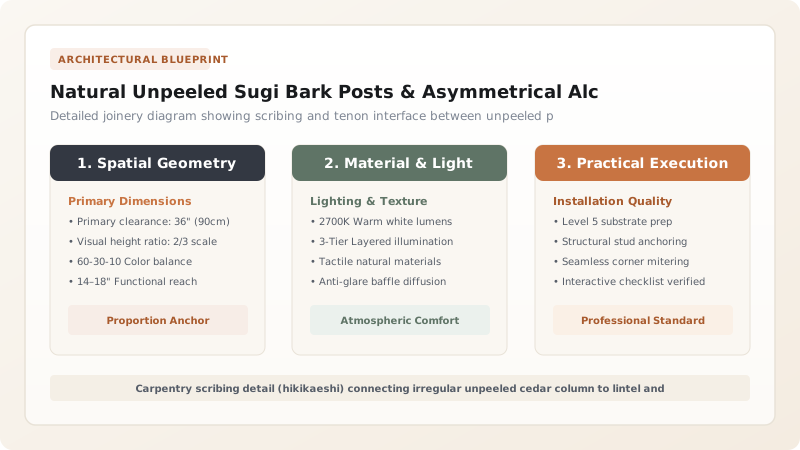
To join a natural bark post to a horizontal lintel (kamoi) or tie-beam (nageshi), carpenters employ hikikaeshi—a three-dimensional compass scribing method. The irregular organic profile of the log is mirrored onto the mating beam, which is hollowed out with fine gouge chisels until the horizontal wood hugs the bark post with zero visible gap.
Seasonal Stability and Bark Preservation
Preserving natural tree bark on interior columns introduces unique preservation challenges. Fluctuating indoor humidity can cause differential shrinkage between bark and xylem, leading to bark detachment or infestation by powder-post beetles.
Authentic Sukiya logs undergo slow, shaded air-drying for two to three years before framing. In modern museum-grade installations, timbers receive controlled vacuum heat treatment to sterilize biological pathogens without burning the fragile bark scales, followed by light application of camellia seed oil to maintain moisture balance.
Sukiya Post Selection: Wood Species and Surface Finish Characteristics
Use this reference table to calculate exact physical dimensions, ratios, and specifications before purchasing:
| Wood Variety | Surface Treatment | Visual Character | Optimal Placement |
|---|---|---|---|
| Kitayama Sugi (Cedar) | Kawa-tsuki (unpeeled velvet bark) | Soft fibrous brown texture, delicate wabi warmth | Primary tokobashira or middle partition pillar |
| Akamatsu (Japanese Red Pine) | Unpeeled rough bark with resin scales | Rugged, reddish-amber, muscular curvature | Exterior veranda support or rustic tea entrance |
| Shibori-Sugi (Fluted Cedar) | Peeled bark revealing natural flutes | Undulating ripples created by wooden battens | Formal tokobashira in high-tier tea chambers |
| Madake (Timber Bamboo) | Smoked or naturally aged (Susutake) | Golden honey to dark sepia lacquer sheen | Slender alcove dividing mullion or window lintel |
Practical Constraints
Every successful decoration project must account for physical and environmental constraints:
Extreme wood shrinkage differential across bark, sapwood, and heartwood.
Unseasoned posts will develop massive tension splits along the show face as the core dries. Mitigation: Cut a relief kerf (sewari) down the hidden rear spine of the post to direct shrinkage stresses away from the display face.
Modern heating and air-conditioning desiccation.
Forced-air HVAC systems strip moisture from bark, causing brittleness and cracking. Mitigation: Incorporate passive humidity control and maintain 50% to 60% relative indoor humidity in teahouse pavilions.
Execution Blueprint & Craftsmanship Sequence
Execute this professional sequence to achieve flawless results without backtracking:
Timber Cruising and Winter Harvesting
Select standing cedar in mountain groves during mid-winter dormancy. Fell with hand saws and haul with padded slings to protect fragile bark.
Slow Canopy Shade Curing
Store harvested logs in well-ventilated, shaded sheds for 24 to 36 months, periodically rotating to ensure uniform moisture equilibrium.
Plinth Stone Scribing (Hikitate)
Place the natural post bottom over the undressed granite foundation boulder. Use compass scribers to transfer rock contours, chiseling the post base for a rock-solid seat.
Virtual Centerline Establishment
Mark ink reference axes on the hidden flat top and bottom facets of the post, using plumb bobs to align the log's visual center despite trunk bends.
Mortise and Pocket Carving
Hand-cut mortises and housing pockets into the column using razor-sharp Japanese mortise chisels (oire-nomi), preserving surrounding bark edges.
Beam Contour Scribing (Hikikaeshi)
Scribe horizontal cedar lintels and plaster grounds directly to the irregular bark face, carving compound hollows with curved spoon gouges.
Dry Fitting and Wedge Locking
Assemble the joint dry, inspect tolerances under raking light, and secure with concealed hardwood oak or keyaki draw-bore pins.
Bark Finishing and Oil Buffing
Gently clean loose moss or dust from bark fissures using a natural badger-hair brush, then lightly buff exposed sapwood facets with camellia oil.
Common Mistakes & Countermeasures
Avoid these costly errors that compromise aesthetics, ergonomics, and budget:
Harvesting bark-on logs during spring or summer when sap is running.
Using power routers or mechanical template jigs to join unpeeled posts.
Project Execution Checklist
Track your physical progress. Checkboxes persist automatically on this device:
Frequently Asked Questions
What is the purpose of the vertical saw cut (sewari) on the back of tea posts?
The sewari is an intentional stress-relief cut made down the hidden back side of a round timber post. As the green log dries and shrinks, tension is released along this hidden kerf, preventing ugly cracks from opening on the visible display face.
Will the bark on a Sukiya post attract bugs into my house?
Authentic architectural-grade Sukiya timbers undergo rigorous kiln heat-treating or organic freeze-desiccation that kills all dormant insect larvae without damaging the delicate natural bark scales.
Can I touch the bark on a Sukiya post?
In tea ceremony etiquette, physical touch is reserved for examining tea bowls and utensils. The tokobashira post is a revered architectural display anchor that is observed visually; skin oils from repeated handling can darken and wear away the delicate bark.
What kind of wood is used for the horizontal alcove threshold (tokogamatichi)?
The base beam of the alcove (tokogamachi) is typically made from dense, dark hardwoods like Japanese black lacquer-coated pine, bog oak, or polished mulberry wood to provide a dramatic grounding contrast to the light cedar pillar.


