Natural Urushi is tapped from 10 to 15-year-old Toxicodendron vernicifluum trees in summer. The raw sap (arami-urushi) undergoes mechanical filtration through fine Yoshino washi paper, followed by Nayashi (stirring to break molecular aggregates) and Kurome (gentle solar or gentle heat dehydration down to 3% water content). Curing is driven by laccase enzymatic polymerization, strictly requiring 75-85% relative humidity at 20-25°C inside a cedar-lined furo chamber.
At a Glance: Key Takeaways
- Botanical Source: Toxicodendron vernicifluum (Urushi-no-ki)
- Annual Sap Yield: 150 - 200 ml per mature tree (single season harvest)
- Chemical Active: Urushiol (60-70%), water (20-25%), plant gum (6-8%), laccase (1%)
- Filtration Medium: Kouso-derived Yoshino washi paper under manual twisting pressure
- Dehydration Process: Kurome (gentle heating < 45°C to evaporate excess water)
- Curing Atmosphere: Furo box: 20-25°C, 75-85% RH (dark, dust-free environment)
Sustainable Tree Tapping & Seasonal Sap Classifications
Urushi sap harvesting is an ancient, highly disciplined agroforestry craft practiced primarily in the Iwate and Fukushima prefectures of Japan, as well as mountainous regions of China. Tappers (urushi-kaki) select trees that have reached 10 to 15 years of maturity. Using specialized curved scrapers (kaki-gama), the tapper cuts horizontal scoring grooves through the outer bark into the phloem vessels where resin canals reside. White, viscous milky sap exudes slowly and is scooped with an iron spatula into bamboo or wooden collection tubs.
Sap harvested across the season exhibits radically different chemical and physical properties:
- Hatsu-urushi (Early Sap, June - July): High water content, lower urushiol concentration; used primarily for priming porous substrates and making foundational sabi paste.
- Sakari-urushi (Prime Summer Sap, July - August): Highest urushiol concentration (up to 75%), superior gloss, and optimal laccase enzyme activity; reserved for surface finish coats and high-grade makie joinery.
- Sue-urushi (Late Autumn Sap, September - October): Dense, viscous, high in plant gums; traditionally deployed for structural mugi-urushi adhesives.
Refining Chemistry: Yoshino Washi Filtration, Nayashi, and Kurome
Raw, unrefined sap (ki-urushi or arami-urushi) straight from the tree contains bark fragments, insect debris, and soil dust. It is warmed gently to reduce viscosity and filtered by wrapping it inside ultra-strong handmade Yoshino washi paper (made from mulberry fibers) and twisting the paper bundle tightly using wooden levers. The raw sap is forced through the microscopic pores of the washi paper, straining out all solid particulate matter without shearing the organic polymer chains.
To convert filtered sap into transparent or black finishing lacquer, it undergoes two sequential mechanical and thermal treatments: Nayashi and Kurome. Nayashi involves slow, continuous stirring in shallow wooden vats for several hours at ambient temperature. This mechanical shearing breaks up clustered water-in-oil droplets and homogenizes the emulsion. Immediately following, Kurome applies gentle radiant heat (strictly maintained below 45°C to avoid denaturing the heat-sensitive laccase enzyme) while stirring continuously. This evaporates excess water content from roughly 25% down to approximately 3%, darkening the sap into a glossy, translucent amber-brown liquid ready for master brush application.
Biology of Enzymatic Curing & Cedar Furo Chamber Construction
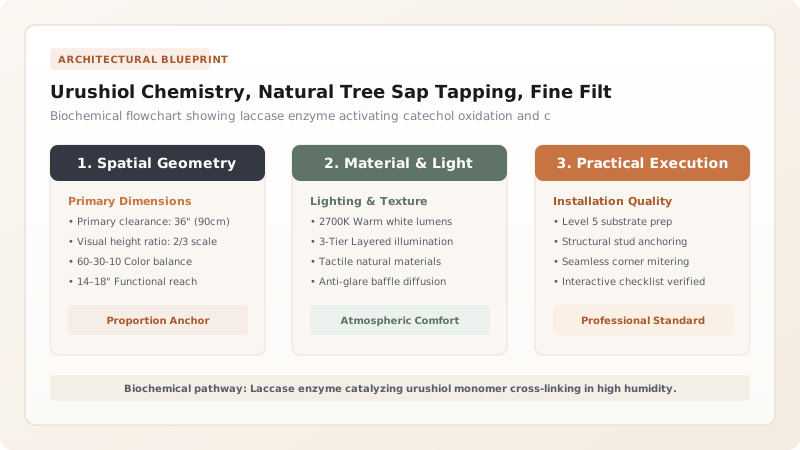
The chemical curing of urushi is an enzymatic oxidation process. The enzyme laccase contains four copper atoms in its catalytic core. When exposed to water vapor ($H_2O$), laccase transfers electrons from the phenolic hydroxyl groups on the urushiol catechol rings to atmospheric oxygen, forming unstable ortho-semiquinone radicals. These radicals immediately initiate spontaneous addition polymerization and aromatic coupling with the unsaturated aliphatic side chains, creating an intensely dense, three-dimensional polymeric network.
To maintain the precise microclimate necessary for laccase activation, craftsmen build a furo (or muro)—a traditional airtight cabinet framed entirely from unfinished Japanese cedar (sugi) or cypress (hinoki). Cedar wood possesses unique hygroscopic properties, absorbing excess moisture during humid periods and releasing vapor when ambient humidity drops. Craftsmen hang wet linen or cotton cloths along the interior walls, maintaining a continuous 75% to 85% relative humidity and temperatures of 20°C to 25°C. Inside this dust-free, humid environment, urushi cures smoothly from the interior out, without developing wrinkled surface skins or trapping tacky uncured core layers.
Seasonal Urushi Sap Yields and Physical Properties
Use this reference table to calculate exact physical dimensions, ratios, and specifications before purchasing:
| Sap Harvesting Stage | Urushiol Content | Water Content | Enzymatic Activity | Primary Architectural Application |
|---|---|---|---|---|
| Hatsu-urushi (Early Summer) | 60 - 65% | 25 - 30% | Moderate | Deep wood and ceramic priming; sabi-urushi mixing |
| Sakari-urushi (Mid-Summer) | 70 - 75% | 15 - 20% | Peak / Very High | Kuro-roiro finish layers, e-urushi gold sizing |
| Sue-urushi (Late Autumn) | 65 - 70% | 18 - 22% | Low to Moderate | Mugi-urushi structural adhesive formulations |
| Nayashi/Kurome Processed | 85 - 90% | < 3% | Preserved (< 45°C limit) | High-gloss architectural tile finishes and polished makie |
Practical Constraints
Every successful decoration project must account for physical and environmental constraints:
Extreme Tree Scarcity and Harvest Exhaustion
A tapped urushi tree is felled at the end of a single harvest season, necessitating 15-year reforestation cycles. Solution: Support certified sustainable Japanese urushi tree plantations (such as Joboji Urushi conservation programs).
Sensitization and Severe Contact Dermatitis
Urushiol vapors in poorly ventilated workshops can cause systemic allergic reactions in susceptible personnel. Solution: Equip workshops with dedicated negative-pressure exhaust hoods and maintain barrier creams.
Execution Blueprint & Craftsmanship Sequence
Execute this professional sequence to achieve flawless results without backtracking:
Tree Selection and Bark Scoring
Select healthy 12-15 year old Toxicodendron vernicifluum trees. Cut horizontal incisions through outer bark at 30-minute intervals to stimulate phloem resin canal exudation.
Raw Sap Collection and Storage
Scoop raw milky sap with an iron spatula into cedar containers. Store in cool, dark environments sealed from open air to prevent premature surface skin oxidation.
Yoshino Washi Filtration
Warm raw sap to 35°C. Enclose in a folded sleeve of high-strength Yoshino washi paper and apply manual torsion with wooden clamps to filter out bark impurities.
Nayashi Homogenization
Stir filtered sap continuously in a wide wooden vat for 2 hours at ambient room temperature to disrupt water-oil emulsion clusters.
Kurome Dehydration Control
Apply gentle radiant heating (never exceeding 43°C) while stirring under open air. Dehydrate until moisture drops to ~3% and lacquer turns translucent amber-black.
Furo Chamber Calibration
Dampen internal cedar furo walls with distilled water. Monitor hygrometer to confirm stable 75-80% RH and 22°C temperature before introducing coated ceramic pieces.
Common Mistakes & Countermeasures
Avoid these costly errors that compromise aesthetics, ergonomics, and budget:
Overheating Urushi Above 45°C During Kurome
Using Distilled Water in Furo That Creates Water Droplets on Lacquer
Using Synthetic Paper or Cheesecloth for Filtration
Project Execution Checklist
Track your physical progress. Checkboxes persist automatically on this device:
Frequently Asked Questions
Can Urushi cure in a standard heated drying oven?
No. A conventional oven dries materials through heat and air circulation, driving off moisture. Urushi strictly requires moisture (water vapor) to fuel enzymatic oxidation. Heating urushi in a dry oven will cook the sap, denature the laccase enzyme, and leave it permanently uncured.
Why does a mature Urushi tree produce only 150-200 ml of sap in its lifetime?
Urushi resin canals are narrow protective barriers within the inner bark, produced by the tree solely to seal physical wounds against fungal infections. Tappers harvest sap in tiny drops across months; by autumn, the tree's energy reserves are exhausted, and the tree is cut down to allow new shoots to sprout from the root collar.
How can you tell if an Urushi finish has fully cured?
A fully cured urushi surface is glass-hard, completely non-tacky, and emits a faint, pleasant sweet-woody fragrance. When lightly pressed with a fingernail or a soft wooden stick, it leaves zero indentation mark.