Transforming broken ceramic tiles into permanent architectural wall features requires a multi-stage finishing procedure. Level joined tiles with Kuro-Roiro black lacquer to build optical depth. Once cured and water-honed, apply red Bengara-e-urushi sizing. When tacky, dust 24K gold powder (Keshi-fun or Maru-fun) using a silk-tipped bamboo quill. Seal with clear Suri-urushi and burnish with a natural agate pencil to achieve a flawless, reflective gold seam.
At a Glance: Key Takeaways
- Substrate Mounting: Cementitious backer board with modified silane-polymer adhesive
- Optical Undercoat: Kuro-Roiro-Urushi (iron/carbon black high-refractive lacquer)
- Gold Sizing Agent: Bengara-E-Urushi (iron-oxide red refined lacquer)
- Gold Powder Grade: 24-Karat Keshi-fun (fine smoke dust) or Maru-fun No. 1-3
- Dusting Tool: Funzutsu (bamboo tube tipped with No. 120-150 silk mesh)
- Burnishing Tool: Menou-bo (polished natural agate stone burnisher)
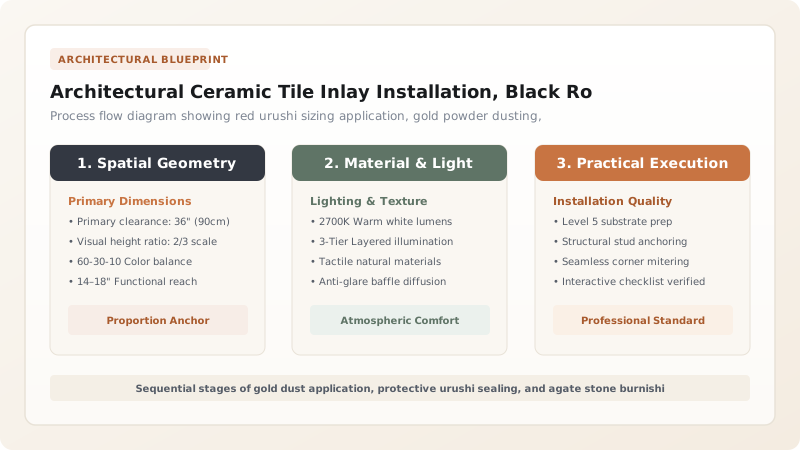
Architectural Mounting & Substrate Sub-Assembly for Ceramic Murals
When integrating kintsugi ceramics into architectural interiors—such as luxury hospitality reception backdrops, luxury bathroom wall revetments, or feature niche accents—the ceramic shards cannot simply be repaired in isolation. Thermal expansion differences between heavy wall masonry and brittle ceramic tiles must be isolated.
Artisans pre-assemble kintsugi tile panels onto high-rigidity structural substrates, such as 12.5 mm glass-mat reinforced cementitious backer boards (e.g., HardieBacker or Knauf Aquapanel). Individual fractured tiles are joined on the bench using mugi-urushi. Once the joints achieve structural cure, the consolidated tiles are adhered to the backer board using an elastic, non-shrink modified silane-polymer (SMP) or epoxy-polyurethane hybrid adhesive. This elastomeric bed absorbs structural building movements, seismic micro-vibrations, and thermal fluctuations, protecting the delicate urushi-bonded seams from shear stress.
Kuro-Roiro Black Undercoating & Red Bengara-E-Urushi Sizing
Before precious metal can be dusted, the seam requires two specialized lacquer coatings. The first is Kuro-Roiro-Urushi—a refined lacquer made by reacting clear urushi with fine iron hydroxide particles or carbon black. Using a specialized fine-line detail brush made from rat-whisker hair (nezumi-ke-fude), the artisan paints a continuous line of kuro-roiro along the honed sabi-urushi seam. Kuro-roiro provides an opaque, light-absorbing base: if gold is applied over a light-colored substrate, the metal appears pale and thin; an intense black undercoat gives the 24K gold visual warmth, depth, and optical richness.
After the black line cures in the furo for 24 hours and is wet-honed with 1500-grit water-paper, the artisan paints a microscopically thin sizing line of Bengara-E-Urushi (clear lacquer ground with iron-oxide red pigment). Red bengara serves two purposes: its distinct coloration allows the craftsman to see the line clearly against the black base, and its high oil-resin ratio provides an extended tack window for metal powder adhesion. The piece is allowed to stand in a clean room until the sizing reaches the 'whistling tack' stage—tacky enough to hold metal dust, but firm enough that the brush hairs do not sink into the film.
24K Gold Dusting (Makie-Fun), Suri-Urushi Locking, and Agate Burnishing
Metal dusting requires extraordinary control of powder dispersion. Genuine 24-karat gold powder comes in two primary metallurgical forms: Keshi-fun (ultrafine microscopic gold particles produced by chemical precipitation or microscopic filing, giving a soft matte luster) and Maru-fun (spherical polished gold granules graded from No. 1 to No. 10, engineered for high-mirror burnishing). The artisan loads the gold powder into a funzutsu—a hollow natural bamboo tube capped at one end with stretched silk mesh (typically No. 120 or 150 mesh). By gently tapping the bamboo quill with an index finger, a uniform cloud of gold particles descends onto the tacky red lacquer line.
Once dusted, the piece is placed in the furo for 3 to 5 days until the sizing cures completely, permanently entrapping the lower half of each gold granule. Next, the loose excess gold is brushed off with a soft swan-feather duster. To protect the exposed upper half of the gold particles from friction and wear, the artisan performs katame (or suri-urushi): raw, clear ki-urushi is wiped thinly over the gold vein using fine washi paper and immediately buffed off with clean tissue. The microscopic lacquer film settles into the tiny interstitial voids between gold grains, locking them into an impenetrable matrix.
The final step is Migaki (burnishing). The artisan lubricates the seam with a droplet of camellia oil (tsubaki-abura) and glides a polished natural agate pencil (menou-bo) or hematite burnisher along the gold line under controlled, firm hand pressure. The burnisher compresses the soft 24-karat gold spheres, closing micro-gaps and transforming the textured powder into a mirror-like, gleaming ribbon of pure liquid light.
Gold Powder Grades and Burnishing Specifications for Kintsugi
Use this reference table to calculate exact physical dimensions, ratios, and specifications before purchasing:
| Powder Classification | Particle Size & Geometry | Application Technique | Visual Character | Architectural Durability |
|---|---|---|---|---|
| Keshi-fun (Gold Leaf Dust) | < 5 microns (irregular flakes) | Silk-tipped bamboo quill or soft cotton ball | Soft, matte, silky antique luster | Moderate; ideal for vertical low-contact panels |
| Maru-fun No. 1 to 3 | 10 - 20 microns (spherical beads) | Bamboo funzutsu with No. 120 silk screen | Luminous semi-gloss after light agate rub | High; excellent abrasion resistance |
| Maru-fun No. 5 to 7 | 30 - 50 microns (heavy spheres) | Fine quill dusting; multiple suri-urushi coats | Brilliant mirror shine after intense burnishing | Very High; withstands repeated cleaning |
| Gin-fun (Pure Silver Dust) | 15 - 30 microns (spherical silver) | Silk quill dusting; double urushi seal | Cool silver gleam; natural antique patina over decades | High; sealed with urushi to prevent oxidation |
Practical Constraints
Every successful decoration project must account for physical and environmental constraints:
Extreme Cost of High-Purity 24K Gold Powder
Large architectural wall murals consume significant gram quantities of precious gold, inflating material budgets. Solution: Utilize graded Maru-fun No. 3 for focal seams, and complement with authentic silver (Gin-fun) or polished Urushi on secondary accents.
Dust Contamination During Gold Application
Airborne dust settling on tacky e-urushi ruins the mirror finish of the burnished gold vein. Solution: Execute gold dusting inside an enclosed laminar-flow clean booth or dedicated positive-pressure dust-free box.
Execution Blueprint & Craftsmanship Sequence
Execute this professional sequence to achieve flawless results without backtracking:
Substrate Layout and Dry-Fitting
Arrange repaired ceramic tile fragments onto glass-mat cement backer board. Mark expansion joints and test alignment of fracture veins across adjoining tile boundaries.
Backer Board Bonding with Elastic Adhesive
Trowel modified silane-polymer adhesive onto the backer board using a 4 mm notched trowel. Embed the ceramic tiles, leveling with a rubber mallet, and allow adhesive to cure for 24 hours.
Kuro-Roiro Black Base Application
Dip a rat-whisker detail brush into kuro-roiro urushi. Paint a crisp 1.5 mm line centered over the honed joint seam. Cure in the furo (80% RH, 22°C) for 24 hours.
Water-Honing and Bengara-E-Urushi Sizing
Wet-hone the black line with 1500-grit water-paper. Paint a microscopic layer of red bengara-e-urushi over the black line. Wait approximately 20-30 minutes until tacky.
24K Gold Powder Dusting
Load genuine 24K gold powder into a bamboo funzutsu. Tap the tube lightly over the seam, depositing a dense, uniform layer of gold over the red sizing. Cure in the furo for 4 days.
Suri-Urushi Sealing and Agate Stone Burnishing
Brush away loose gold with a feather duster. Wipe on clear ki-urushi and buff off immediately with tissue. Once cured, apply a drop of camellia oil and burnish with an agate stone pencil to a mirror polish.
Common Mistakes & Countermeasures
Avoid these costly errors that compromise aesthetics, ergonomics, and budget:
Dusting Gold Powder onto Overly Wet Lacquer Sizing
Skipping the Clear Suri-Urushi Locking Coat
Rigid Direct Mortar Installation on Masonry Walls
Project Execution Checklist
Track your physical progress. Checkboxes persist automatically on this device:
Frequently Asked Questions
Can Kintsugi ceramic wall installations be cleaned with standard household detergents?
Fully cured authentic Urushi and burnished 24K gold are impervious to water and mild pH-neutral soaps. However, abrasive scrubbing powders, bleach, ammonia-based cleaners, and scourer pads should never be used, as they will scratch the delicate 24-karat gold surface. Clean with warm water and a soft microfiber cloth.
What is the difference between Keshi-fun and Maru-fun gold powder?
Keshi-fun is an ultra-fine, microscopic flake powder produced by chemical precipitation or leaf grinding. It is easy to apply and gives a soft, velvety matte gold finish, but cannot be burnished to a high gloss. Maru-fun consists of microscopic spherical gold beads that can withstand firm pressure from an agate stone, allowing the craftsman to burnish the vein to a brilliant mirror-like metallic polish.
Can broken porcelain tiles be reassembled on-site after being installed on a wall?
No. Authentic Kintsugi requires controlled humidity cabinet (furo) curing at 75-85% RH and 20-25°C across several multi-day stages. Attempting to execute authentic urushi kintsugi on a vertical wall in an uncontrolled room will result in uncured, tacky seams and dust-contaminated finishes. All kintsugi work must be completed on the workbench before installation.