
The signature velvety satin sheen of classical Venetian terrazzo is achieved through traditional hand-stone abrasion and natural organic finishing. Rather than using high-RPM motorized diamond grinders and synthetic urethane sealers, artisans work with the orsa—a weighted abrasive volcanic stone block mounted on a long broom handle. After progressive grinding with pumice and water, the cured floor is deeply saturated with cold-pressed boiled linseed oil and buffed with natural unbleached Venetian beeswax.
At a Glance: Key Takeaways
- Hand-Grinding Tool: L'Orsa (curved abrasive sandstone or volcanic stone mounted on a long pole)
- Abrasive Media: Natural pumice stone, quartz sands, and Istrian abrasive stone slurry
- Deep Penetrant: Olio di lino cotto (warm boiled linseed oil thinned with citrus spirits)
- Burnishing Wax: Pure natural beeswax (cera vergine d'api) hand-buffed with wool cloths
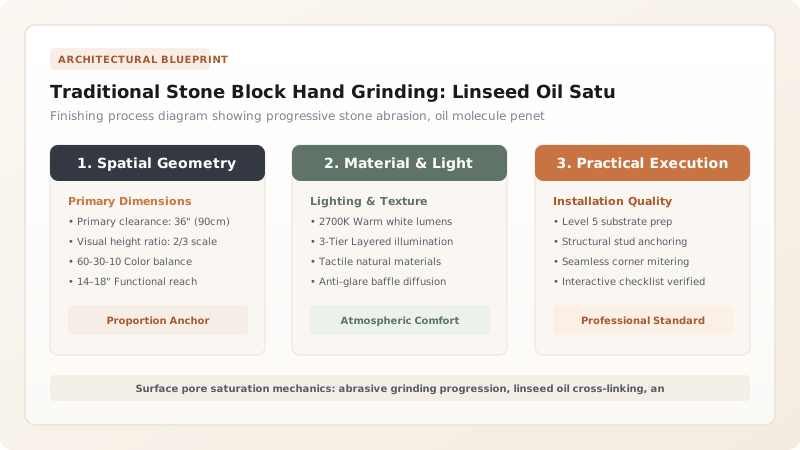
L'Orsa: The Ergonomics of Hand-Stone Grinding
Long before electric rotary floor polishers, the Venetian terrazziere ground floors using an ancient tool known as l'orsa ('the bear'). The orsa consists of a heavy, curved abrasive stone block—traditionally Istrian sandstone or volcanic pumice—weighing between 8 and 12 kilograms, affixed to the end of a long, angled ash-wood handle.
Standing upright, the artisan grips the handle with both hands, using body weight to rhythmically swing the stone block in broad, overlapping semi-circular arcs across the floor. Lubricated with continuous flushes of fresh water, the stone block shears off the protruding tops of marble chips and removes excess lime paste without gouging the soft matrix.
The Three Abrasive Phases: Sgrossatura to Lustratura
Achieving a flawless surface requires three distinct sequential grinding phases. The first phase is sgrossatura (rough grinding), utilizing coarse quartz sand slurry and rough sandstone to level all aggregate facets into a single flat plane.
The second phase is arrotatura (medium honing), where finer volcanic pumice blocks remove scratch lines and expose the crystalline structure of the marble. The final wet phase is lustratura (polishing), performed using ultra-fine pumice powder and lead or felt pads, bringing the marble facets and lime matrix to a smooth, matte-honed tactile finish.
Linseed Oil Saturation: Nourishing the Mineral Matrix
A raw, ground lime terrazzo floor is porous and thirsty; left unprotected, it would readily absorb wine, coffee, and oil stains. To seal the stone without creating a plastic film, Venetian masters saturated the floor with olio di lino cotto (boiled linseed oil).
Applied warm and thinned slightly with natural gum turpentine or citrus peel spirits, the small linseed oil molecules penetrate 3 to 5 mm deep into the microscopic capillary pores of the slaked lime binder. Over several days, the oil oxidizes and polymerizes through atmospheric cross-linking, forming a tough, flexible, hydrophobic resin deep within the stone matrix that enriches the color of the marble aggregate.
Beeswax Burnishing: The Venetian Satin Glow
The ultimate protective and aesthetic layer is pure unbleached Venetian beeswax (cera vergine d'api). Melted with a hint of carnauba wax and lavender essential oil, the paste is spread thinly across the cured linseed oil substrate.
Using heavy weighted polishing pads faced with raw wool blankets (panno di lana), craftsmen vigorously buff the floor. The frictional heat melts the micro-crystalline wax into the surface pores, creating a breathable, water-repellent satin sheen that glows under candlelight and develops an increasingly rich, self-healing patina with decades of domestic wear.
Terrazzo Surface Finishes: Traditional Linseed & Wax vs Modern Polyurethane Topcoats
Use this reference table to calculate exact physical dimensions, ratios, and specifications before purchasing:
| Finishing Metric | Traditional Linseed Oil & Beeswax System | Modern Two-Part Polyurethane Coating |
|---|---|---|
| Surface Appearance | Warm, deep satin glow; highlights marble mineral depth | High-gloss, reflective plastic film covering stone surface |
| Scratch Repairability | 100% self-healing; simple re-waxing buffs out shoe scuffs | Scratches require complete chemical stripping and recoating |
| Vapor Dynamics | Micro-porous; allows slab moisture vapor to breathe | Impenetrable plastic seal; trapped moisture causes white blisters |
| Tactile Feel | Warm, silky, organic stone feel under bare feet | Cold, synthetic plastic feel; prone to static electricity |
| Aging Behavior | Develops a magnificent antique patina across generations | Yellows under UV light and flakes off traffic paths in 5–8 years |
Practical Constraints
Every successful decoration project must account for physical and environmental constraints:
Spontaneous combustion risk of linseed oil-soaked cotton rags
Rags used to wipe boiled linseed oil generate exothermic heat as the oil oxidizes, creating a severe spontaneous combustion fire hazard if piled indoors. Mitigation: Immediately submerge all oil-saturated rags in metal buckets filled with water, or lay them flat outdoors on concrete away from structures to dry safely.
Maintenance requirements of traditional beeswax finishes in high-traffic commercial settings
High-volume foot traffic in commercial hotel lobbies will wear through natural beeswax within weeks, requiring frequent re-buffing. Mitigation: Install sacrificial walk-off mats at entryways and utilize automated orbital burnishing machines equipped with natural hog's hair pads for rapid weekly maintenance.
Execution Blueprint & Craftsmanship Sequence
Execute this professional sequence to achieve flawless results without backtracking:
Preliminary Floor Washing and Water Flood
After the 35-day cure, remove burlap covers. Flood the floor with clean water to lubricate abrasive action and prevent airborne mineral dust.
Phase 1: Sgrossatura Rough Grinding with the Orsa
Mount a coarse sandstone block onto the orsa handle. Spread sharp river sand across the floor and grind in circular overlapping strokes until all marble facets are level.
Slurry Cleansing and Pinhole Grouting (Stuccatura)
Wash away coarse grinding sludge. Trowel a thin slurry of tinted lime paste and marble dust across the floor to fill microscopic pinholes and air bubbles exposed by grinding.
Phase 2: Arrotatura Medium Honing with Volcanic Pumice
Grind the floor with fine-grained pumice stone blocks and water, removing all sand scratch marks and creating a silky, uniform honed texture across the entire bay.
Complete Drying and Moisture Testing
Mop up all slurry and allow the floor to dry thoroughly for 10 days under gentle ventilation until moisture content drops below 3%.
Boiled Linseed Oil Deep Saturation
Heat raw boiled linseed oil to 45°C. Apply generously with wool mops in two penetrating coats, allowing the porous lime matrix to absorb the oil until saturated.
Wiping Excess Oil and Oxidative Curing
After 4 hours, vigorously wipe all unabsorbed surface oil off the marble faces using dry cotton rags, allowing the internal oil to cross-link for 4 days.
Beeswax Paste Application and Wool Buffing
Apply a thin film of Venetian beeswax paste. Buff vigorously with heavy wool-lined floor burnishing pads until the floor achieves its signature warm satin luminescence.
Common Mistakes & Countermeasures
Avoid these costly errors that compromise aesthetics, ergonomics, and budget:
Applying linseed oil before the floor has completely dried from wet grinding
Leaving a thick layer of unbuffed beeswax on the floor
Project Execution Checklist
Track your physical progress. Checkboxes persist automatically on this device:
Frequently Asked Questions
How often does a traditional Venetian terrazzo floor need to be re-waxed?
In residential homes, a traditional beeswax finish requires rewaxing only once every two to three years. Daily maintenance consists simply of sweeping with a soft broom and damp mopping with warm water and a capful of natural Marseille or Castile olive-oil soap, which naturally replenishes the wax sheen.
Can modern motorized floor polishers be used with traditional stones?
Yes. While historical apprentices used the manual orsa handle, modern terrazzo restorers frequently mount traditional sandstone blocks, volcanic pumice discs, or natural felt pads onto low-RPM (175 RPM) rotary floor machines, achieving identical artisanal finishes with significantly reduced physical strain.
Why does linseed oil make the colors of the marble pop so dramatically?
Unfinished marble facets scatter light randomly due to microscopic surface fractures from grinding. Linseed oil has a refractive index (approx. 1.48) that closely matches that of calcium carbonate marble (approx. 1.50). When the oil fills the surface micro-pores, light penetrates into the crystalline lattice instead of scattering, revealing the deep, rich natural mineral hues.
How do you clean an antique Venetian terrazzo floor that has become stained or dull?
Never use acidic cleaners, vinegar, or bleach on antique terrazzo. To restore dull floors, clean with mineral spirits or dilute citrus solvent to strip old dirty wax. Re-saturate dry areas with a drop of warm boiled linseed oil, and apply a fresh coat of beeswax buffed with wool pads to restore the original 18th-century glow.


