
The seminato technique is the pinnacle of Venetian terrazzo craftsmanship. Unlike pre-mixed terrazzo where marble gravel is mixed into mortar before laying, seminato involves hand-scattering carefully graded dry marble chips (semina) across a freshly troweled lime-pozzolan paste bed. By scattering larger size 4–5 marble chunks first and filling inter-aggregate voids with fine size 1–2 granules, the craftsman achieves an astonishing 80% to 85% surface stone density with seamless visual flow.
At a Glance: Key Takeaways
- Artisan Gesture: Semina a mano (rhythmic, wide-arc manual hand-scattering from wooden trays)
- Aggregate Sizing: Graded from Grade 1 (3–5 mm) up to Grade 5 (18–25 mm) Italian marble chips
- Surface Target Density: 80% to 85% exposed marble facet coverage after compaction and grinding
- Signature Marbles: Rosso Verona, Giallo Mori, Nero Ebano, and Bianco di Carrara
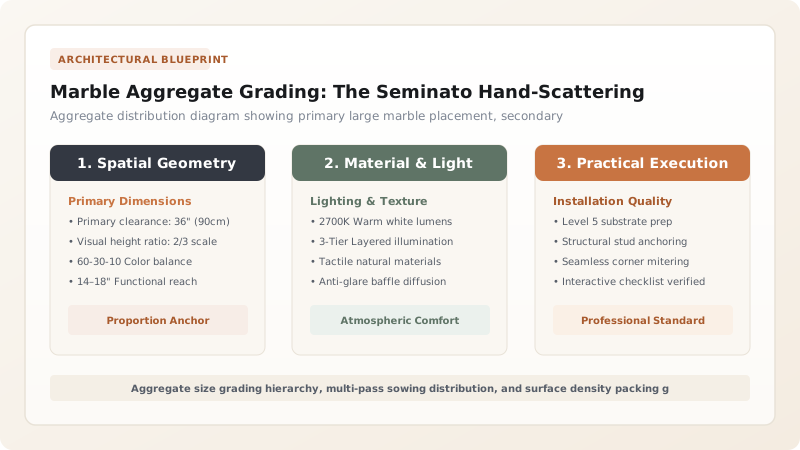
The Semina Gesture: Rhythmic Kinematics of the Terrazziere
In Venetian dialect, the term seminato means literally 'sown' or 'seeded,' drawing an explicit parallel to an agricultural farmer sowing wheat across a plowed field. The master craftsman stands on temporary wooden staging planks over the freshly troweled lime paste, holding a shallow wooden tray (paletta) filled with sorted marble chips.
Using a fluid, sweeping arc of the wrist and forearm, the artisan casts the marble fragments across the wet bed. The gesture must be practiced for years: too forceful, and the chips dive deep into the soft lime; too timid, and clusters form unsightly aggregate mounds. The goal is an effortless, uniform dispersion where each marble chip lands flat on its widest facet.
Aggregate Sizing Hierarchy: The Granulometric Matrix
A high-end seminato floor does not utilize uniform-sized gravel. The optical brilliance and structural durability rely upon a tightly controlled granulometric gradation curve divided into distinct size classes.
The artisan begins with Grana Grossa (Grade 4 and 5, measuring 15 to 25 mm across), placing dramatic, high-character chunks of veined marble such as Rosso Verona or Portoro. Once these dominant stones are cast, the master sows Grana Media (Grade 3, measuring 8 to 12 mm) to surround the focal pieces. Finally, the artisan sifts a fine shower of Graniglia Sottile (Grade 1 and 2, measuring 2 to 5 mm) over the entire bed, filling every interstitial void between the larger stones.
Color Theory and Regional Venetian Marble Palettes
The choice of marble in Venetian palazzi was an exercise in civic pride and chromatic harmony. The quintessential Venetian palette is built around three noble regional stones: Rosso Verona (a warm, nodular ammonite-rich limestone from nearby Valpolicella), Giallo Reale or Giallo Mori (a luminous golden-amber marble from the Veneto foothills), and Bianco di Carrara (pristine crystalline white from Tuscany).
These were accented with Nero Ebano or Nero Portoro to provide deep graphic grounding, and greyish-white Pietra d'Istria quarried across the Adriatic Sea. The lime paste matrix itself was subtly tinted with raw umber, yellow ochre, or pulverized cocciopesto terracotta dust to harmonize with the dominant stone aggregate.
Mechanical Seating with Hand Beaters (Battitoio)
Immediately following the final hand-sowing pass, the scattered marble chips sit proud of the lime paste. Before the heavy roller can be introduced, the stones must be initially seated without lateral displacement.
Craftsmen use the battitoio—a flat wooden hand paddle or rectangular oak float fitted with a long upright handle. Tapping gently in a vertical stamping motion, the artisan drives the loose chips downward until their upper faces sit in a single level plane, ensuring the sharp edges of adjacent stones interlock like stones in a dry-stack stone wall.
Marble Aggregate Sizing Grades for Authentic Venetian Seminato
Use this reference table to calculate exact physical dimensions, ratios, and specifications before purchasing:
| Aggregate Grade | Fragment Dimension Range | Role in the Mosaic Field | Application Percentage |
|---|---|---|---|
| Grade 5 (Extra Large) | 18 mm to 25 mm | Focal centerpiece stones; showcasing rich natural veining | 15% to 20% by surface area |
| Grade 4 (Large) | 12 mm to 18 mm | Secondary anchor chips framing central focal zones | 25% to 30% by surface area |
| Grade 3 (Medium) | 7 mm to 12 mm | Bridging aggregate providing visual rhythm and balance | 20% to 25% by surface area |
| Grade 1 & 2 (Fine Grout Filler) | 2 mm to 6 mm | Infill granules locking voids between larger fragments | 25% to 30% by surface area |
Practical Constraints
Every successful decoration project must account for physical and environmental constraints:
Physical exhaustion and posture fatigue during large-area hand scattering
Maintaining uniform aggregate spacing over hundreds of square meters requires intense concentration and repetitive kneeling posture that can lead to patchy scattering. Mitigation: Divide large palace halls into 15 to 20 square meter working bays separated by temporary screed strips, rotating master scatterers every two hours.
Tonal variation across different quarry veins of Italian marble
Ordering marble chips in multiple lots can result in noticeable shade mismatches (e.g. pale pink vs dark red Verona) across adjoining floor zones. Mitigation: Procure 100% of required marble aggregate from a single quarry extraction block, dry-blending the entire batch before beginning the installation.
Execution Blueprint & Craftsmanship Sequence
Execute this professional sequence to achieve flawless results without backtracking:
Sorting and Washing Raw Marble Aggregates
Wash crushed marble chips through vibrating sieves to remove stone dust and dirt. Sort fragments into labeled wooden bins according to dimensional grades (1 through 5).
Substrate Wetting and Lime Paste Troweling
Dampen the cured sottofondo underlayer. Trowel a fresh 18 mm bedding layer of lime-cocciopesto paste tinted with mineral pigment, screeding to an even, plastic consistency.
Placing Staging Planks over the Wet Bed
Position lightweight wooden spanning planks supported on perimeter battens to allow craftsmen to work suspended across the floor without stepping into wet mortar.
First Sowing Pass: Large Grade 4–5 Focal Chips
Hand-scatter Grade 4 and 5 Rosso Verona and Portoro chips across the wet bed, maintaining roughly 50 to 70 mm spacing between major focal fragments.
Second Sowing Pass: Medium Grade 3 Bridging Chips
Sow Grade 3 Giallo Reale and Carrara chips in a wide sweeping arc, ensuring fragments surround and balance the larger focal stones evenly.
Third Sowing Pass: Fine Grade 1–2 Infill Granules
Cast a dense shower of fine Grade 1 and 2 marble granules across the surface, filling every exposed lime gap until stone-to-stone contact is established across the field.
Vertical Seating with the Wooden Battitoio
Tap the scattered stones vertically with the flat oak battitoio paddle, forcing the marble chips downward into the lime bed until all upper facets align horizontally.
Initial Slurry Squeegee and Roller Prep
Squeegee excess lime paste that flushes to the surface across the stones, filling microscopic surface pores before bringing on the heavy granite roller.
Common Mistakes & Countermeasures
Avoid these costly errors that compromise aesthetics, ergonomics, and budget:
Using unwashed marble aggregate containing heavy stone dust (flour)
Throwing marble chips from high standing positions onto the wet bed
Project Execution Checklist
Track your physical progress. Checkboxes persist automatically on this device:
Frequently Asked Questions
Why is hand-scattering (seminato) superior to pre-mixing marble in mortar?
When marble aggregate is pre-mixed into mortar, the stone-to-binder ratio is limited to roughly 50% to 60%, leaving wide bands of mortar between chips. By hand-sowing the dry aggregate onto the surface, craftsmen achieve 80% to 85% stone density, maximizing the visible marble area and significantly increasing the compressive hardness of the floor.
How are decorative geometric borders and medallions created in seminato?
Artisans bend thin wooden or brass separator strips (bindelli) into the wet bedding paste to establish the borders. They then hand-sow specific single-color marble chips (such as pure black Nero Portoro or white Carrara) inside the bordered compartments, creating framing ribbons, corner rosettes, and family crests.
Can broken reclaimed antique marble be used for seminato?
Historically, that was precisely how seminato was born! Venetian builders collected marble offcuts and architectural debris from the construction of St. Mark's Basilica and grand palazzi, crushing the scraps with hammers into graded gravel that was repurposed into luxurious floors.
What is the optimal depth of marble aggregate penetration into the matrix?
The marble chips should penetrate approximately two-thirds of their thickness into the wet lime paste during hand-sowing and tamping. The subsequent heavy stone roller pass drives them the remaining distance until their top facets are flush, anchoring them securely within the lime-cocciopesto bed.


